- https://cleartax.in/s/rent-control-act
- https://legal251.com/resources/key-elements-to-include-in-your-rent-agreement/
- https://addressadvisors.com/blog/documents-required-for-rental-agreement-guide-for-tenants-and-landlords
Table of Contents
What Is a Room Rental Agreement? Room Rental Agreement vs Full Property Lease in 2026When Do You Need a Room Rental Agreement? Key Components of a Room Rental Agreement Documents Required for Room Rental Agreement How to Create a Room Rental Agreement? Is Registration Mandatory for Room Rental Agreements?Common Issues in Room Rental Agreements and Solutions How NoBroker Can Help with Room Rental Agreements Frequently Asked Questions?
Quality Service Guarantee Or Painting Free
Unbeatable Price
5-Star Rated Partner!
2200+ Shades!
Top Quality Paint
Free Cancellation!
Get a rental agreement with doorstep delivery

Find the BEST deals and get unbelievable DISCOUNTS directly from builders!

5-Star rated painters, premium paints and services at the BEST PRICES!
Loved what you read? Share it with others!
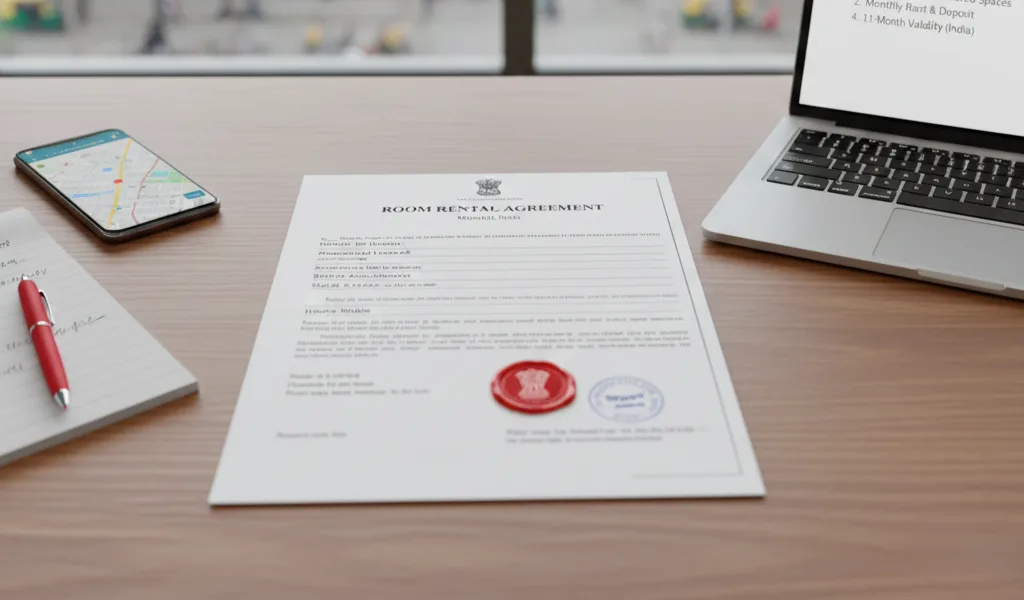
What Is a Room Rental Agreement: Meaning, Purpose and Importance in 2026
Published : January 12, 2026, 12:54 PM
Updated : January 21, 2026, 11:52 AM
Author :
 KRUTHI
Summary
A room rental agreement defines the rights and duties of landlords and tenants in shared living spaces. It clearly states private and shared areas, rent, security deposit, house rules, and utility sharing. Unlike a full property lease, it focuses on co-living arrangements and helps prevent disputes between occupants. With proper documentation, stamping, and optional notarization or registration, it provides legal protection, clarity, and a peaceful living environment.
Table of Contents
What Is a Room Rental Agreement? Room Rental Agreement vs Full Property Lease in 2026When Do You Need a Room Rental Agreement? Key Components of a Room Rental Agreement Documents Required for Room Rental Agreement How to Create a Room Rental Agreement? Is Registration Mandatory for Room Rental Agreements?Common Issues in Room Rental Agreements and Solutions How NoBroker Can Help with Room Rental Agreements Frequently Asked Questions?
A room rental agreement governs the rental of a single room in a shared property. It addresses co-living nuances such as shared space use, chores, noise, and responsibilities to prevent conflicts. Understanding what a room rental agreement is is essential for both landlords renting out spare rooms and tenants seeking affordable accommodation, as it provides a legal safety net that a generic lease often fails to offer. By clearly defining boundaries and expectations, this agreement ensures a harmonious living environment in shared households.
What Is a Room Rental Agreement?
A room rental agreement is a specialized legal contract explicitly used when a tenant rents only one room within a property rather than the entire premises. This document defines the rights and obligations of the landlord and tenant, clearly separating private bedrooms from shared areas. Depending on the duration of the stay, this agreement may not be notarized or registered with local authorities to ensure its legal validity and enforceability in future disputes.
Room Rental Agreement vs Full Property Lease in 2026
It is important to distinguish between renting a room and leasing an entire house, as the legal rights and responsibilities differ significantly.
Quality Service Guarantee Or Painting Free
Unbeatable Price
5-Star Rated Partner!
2200+ Shades!
Top Quality Paint
Free Cancellation!
Get a rental agreement with doorstep delivery
Find the BEST deals and get unbelievable DISCOUNTS directly from builders!
5-Star rated painters, premium paints and services at the BEST PRICES!
| Aspect | Room Rental Agreement | Full Property Lease |
|---|---|---|
| Space Covered | One private bedroom + shared access to common areas. | The entire property (all rooms, kitchen, hall, etc.). |
| Common Areas | Shared with the landlord or other tenants. | Exclusive usage rights for the tenant and their family. |
| Privacy | Limited to the specific rented room. | Total privacy within the entire premises. |
| Rent Amount | Lower, covering only a portion of the property. | Higher, covering the full market value of the home. |
| Tenant Count | Multiple individual agreements for different rooms. | One single agreement covering the tenant and their family. |
A room rental agreement specifically addresses the complexities of multiple unrelated people living together. In contrast, a full property lease grants a single household exclusive control over the entire space.
When Do You Need a Room Rental Agreement?
You need this specific agreement whenever there is a shared living arrangement involving distinct individual tenancies rather than a joint lease. [1]
- Renting a room in a shared flat: When friends or strangers rent individual bedrooms in a larger apartment.
- PG or co-living arrangements: Essential for paying guest accommodations with shared amenities.
- Paying guest accommodation: Formalizes the stay for professionals or students in private homes.
- Renting out part of a house: When a homeowner rents out a spare bedroom to generate extra income.
- Student or working professional stays: Provides a flexible, often shorter-term housing solution for transients.
Key Components of a Room Rental Agreement
To be effective, a room rental agreement template must include specific clauses that go beyond a standard lease to address shared living dynamics. [2]
- Landlord and tenant details: Full legal names, permanent addresses, and contact information of both parties.
- Room description and access to common areas: Clearly identifies the specific room rented and defines access rights to the kitchen, hall, and balcony.
- Rent amount and payment mode: Specifies the individual rent share, due date, and accepted payment methods (UPI, bank transfer).
- Security deposit: States the amount held as a refundable deposit for damages and the conditions for its return.
- Duration of stay: Defines the start and end date of the tenancy, including renewal terms.
- Utility and maintenance charges: Details how electricity, water, internet, and cleaning bills are split among occupants.
- House rules (guests, noise, pets): Sets boundaries on overnight guests, quiet hours, and pet ownership to ensure harmony.
- Notice period and exit terms: Specifies the advance notice required before vacating the room.
Documents Required for Room Rental Agreement
Drafting a room-rental agreement requires valid documentation to verify the parties' identities and ensure legal compliance. [3]
- ID proof of landlord and tenant: Aadhaar Card, PAN Card, or Passport to verify identity.
- Address proof: Permanent address proof for the tenant (e.g., Voter ID, Driving License).
- Property ownership proof (optional): Electricity bill or tax receipt to confirm the landlord's authority to rent.
- Passport-size photos: Recent photographs of the tenant and landlord for the agreement document.
How to Create a Room Rental Agreement?
Creating a legally valid room rental agreement involves a structured process to ensure all terms are clear, fair, and enforceable under the law.
Step 1: Draft the Agreement
Start by drafting the terms. Unlike a standard lease, focus heavily on the specifics of the room and shared spaces. Clearly define which bedroom is being rented, what furniture is included (bed, wardrobe, desk), and the rules for kitchen and bathroom use. Mention the exact split for utilities like Wi-Fi and electricity.
Step 2: Choose Stamp Paper or E-Stamp
Purchase non-judicial stamp paper of the appropriate value. The value depends on the state laws where the property is located. In many states like Maharashtra and Karnataka, e-stamping is available and preferred for its convenience and verifiable authenticity.
Step 3: Sign the Agreement
Both the landlord and the tenant must sign the agreement on all pages. It is legally advisable to have two witnesses (who are not beneficiaries of the agreement) sign as well, and to provide their names and addresses to validate the execution of the contract.
Step 4: Notarize or Register (If Required)
For agreements lasting more than 11 months, registration with the Sub-Registrar's office is mandatory for admissibility in court. For shorter durations (11 months), notarization by a Notary Public is a common and often sufficient means of establishing the document's authenticity.
Is Registration Mandatory for Room Rental Agreements?
Whether you need to register the document depends mainly on the agreement's term and local state laws. [1]
- Not mandatory for agreements under 11 months: Most room rentals are drafted as 11-month Leave and License agreements to avoid the strict registration requirement.
- Mandatory if the tenancy exceeds 12 months: The Registration Act requires that any lease for a year or morebe registered to be legally valid.
- Rules vary by state: Some, like Maharashtra, have strict laws requiring registration for all leave-and-licence agreements regardless of tenure, while others are more lenient.
Common Issues in Room Rental Agreements and Solutions
Shared living often leads to disputes that a standard lease doesn't cover. A well-drafted rental room agreement can prevent these specific conflicts.
- Unclear shared space boundaries: Specify exactly which shelves in the fridge or cupboards in the kitchen belong to whom.
- Utility bill disputes: Define the exact formula (e.g., per head vs. per room) for splitting variable bills like electricity.
- Guest policy conflicts: Set clear limits on the number of nights a guest can stay per month to prevent overcrowding.
- Cleaning responsibility confusion: Create a rotation schedule or agree to hire a professional cleaner and split the cost.
- Privacy concerns: Include "knock-before-entering" clauses for private rooms to respect individual boundaries.
- Early termination issues: Define the notice period clearly (e.g., 30 days) and the penalty for leaving without notice.
How NoBroker Can Help with Room Rental Agreements
Navigating the nuances of what to include in a room rental agreement can be complex, but professional assistance makes it simple. NoBroker provides a specialized room rental agreement service tailored for shared housing and co-living arrangements. We help you draft clear house rules, ensure legal compliance with local rental laws, and offer convenient doorstep notarization services. Our platform assists with proper documentation, stamp paper procurement, and, where applicable, online registration, making the entire process of setting up a room rental smooth, secure, and legally protected for both landlords and tenants.
Frequently Asked Questions?
Q1. What is a room rental agreement?
Ans: A room rental agreement is a legal contract between a landlord and a tenant for renting a single room within a property, outlining rights to private and shared spaces.
Q2. How is a room rental agreement different from a lease?
Ans: A lease typically covers an entire property with exclusive possession, while a room rental agreement covers only one room and includes rules for shared common areas.
Q3. What should be included in a room rental agreement?
Ans: It should include rent details, utility splits, specific house rules (guests, noise, cleaning), room description, and the security deposit refund policy.
Q4. Do I need to register a room rental agreement?
Ans: Registration is generally mandatory for agreements of 12 months or more, but optional for 11-month contracts in many states (except Maharashtra).
Q5. What is the standard room rent agreement format?
Ans: The standard format is an 11-month Leave and License agreement printed on stamp paper, notarized, and signed by both parties and witnesses.
Recommended Reading

Society Maintenance Charges : Meaning, Cost, Types and Calculation
January 31, 2025
200574+ views

Leave and License Agreements: Meaning, Calculator, Format and Registration in 2026
January 31, 2025
68077+ views

A Comprehensive Guide to Karnataka Rent Control Laws and Tenant Rights
January 31, 2025
62039+ views
Paying Guest Agreement Format: Rules, Terms, Sample and Legal Rights in India
January 31, 2025
38132+ views

Uttar Pradesh Rent Control Act Explained
January 31, 2025
35666+ views
Loved what you read? Share it with others!
ARTICLE SOURCES
Most Viewed Articles

Franking Charges Explained: Meaning and Benefits
January 31, 2025
1116845+ views
Society Maintenance Charges : Meaning, Cost, Types and Calculation
January 31, 2025
200574+ views

BBMP E-Khata Registration process for property owners in Bangalore, Karnataka in 2025
March 19, 2025
145603+ views

Daughter's Right in Fathers' Property - the Law is Finally Equal for both Genders?
June 1, 2025
145230+ views

Rectification Deed Format and Process in India 2025
June 1, 2025
135730+ views
Author
Recent blogs in
What Is Cidco Lease Deed: Types, Tenure, Rights and Responsibilities in India 2026
February 20, 2026 by Ananth
Perpetual Lease Deed: Meaning, Rights, Benefits and Registration Process in India 2026
February 20, 2026 by Vivek Mishra
Ground Lease Vs Land Lease: Meaning, Key Features and Legal Distinctions in 2026
February 20, 2026 by Vivek Mishra
Lease Extension Agreement: Required Documents, Cost and Registration in India 2026
February 20, 2026 by Ananth
Mobile Home Lease Agreement: Types, Rights, Rules & Legal Requirements in 2026
February 20, 2026 by Ananth










 Full RM + FRM support


Join the conversation!