- https://acr-journal.com/article/contemporary-legal-provisions-under-rera-strengthening-consumer-protection-in-india-s-real-estate-sector-1570/
- https://ibbi.gov.in/uploads/resources/b614f39d0f66b3a37737adbfc3c6dbfe.pdf
Table of Contents
What Happens When an Under-Construction Project Stalls?Legal Protection for Homebuyers in Stalled Real Estate ProjectsProtection Under the Insolvency and Bankruptcy CodeRERA Remedies When Your Builder Delays PossessionWhat Happens if Your Builder Files Insolvency Under IBC?Step-by-Step: What Homebuyers Should Do if a Project StallsRERA vs IBC - Which Law Has Priority?ConclusionFrequently Asked Questions
Loved what you read? Share it with others!


Home
Blog
Real Estate Legal Guide & Laws
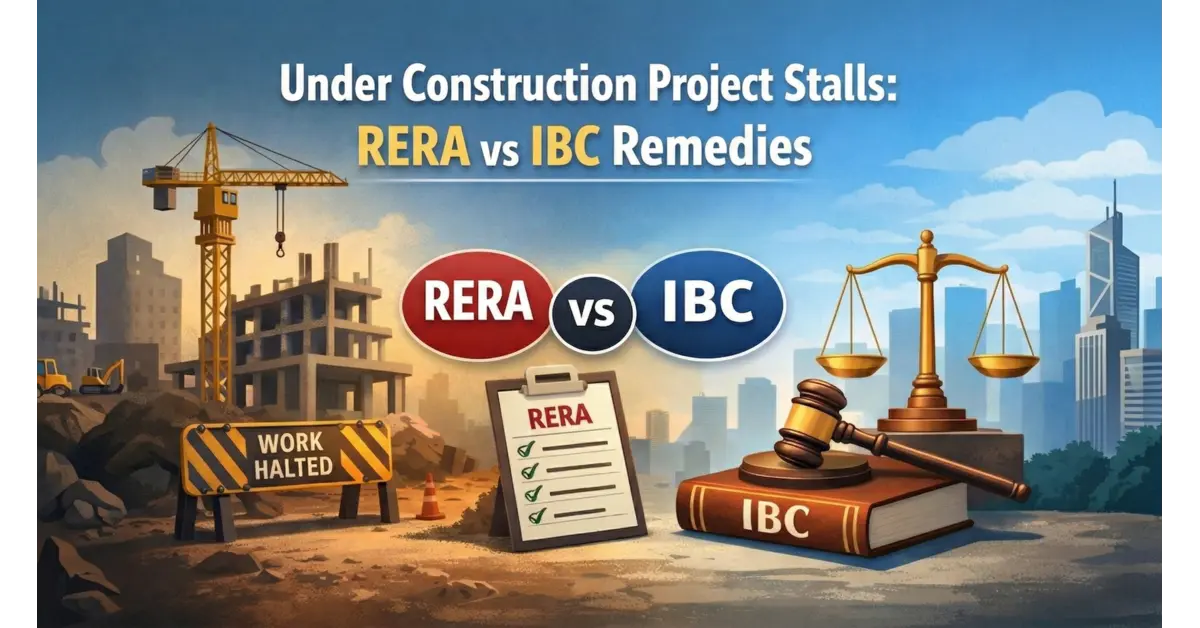
Under Construction Project Stalls: RERA vs IBC Remedies ([full_year] Guide)
Under Construction Project Stalls: RERA vs IBC Remedies (2026 Guide)
Updated : April 6, 2026, 5:34 PM
Author :

Table of Contents
What Happens When an Under-Construction Project Stalls?Legal Protection for Homebuyers in Stalled Real Estate ProjectsProtection Under the Insolvency and Bankruptcy CodeRERA Remedies When Your Builder Delays PossessionWhat Happens if Your Builder Files Insolvency Under IBC?Step-by-Step: What Homebuyers Should Do if a Project StallsRERA vs IBC - Which Law Has Priority?ConclusionFrequently Asked Questions
Thousands of homebuyers across India face a nightmare when an under construction project stalls after years of consistent payments. Statistics indicate that over 4 lakh housing units are currently stuck due to delayed timelines or developers' insolvency, leaving families in financial ruin. Fortunately, the legal landscape in 2026 offers two major frameworks for relief: the Real Estate Regulatory Authority (RERA) and the Insolvency and Bankruptcy Code (IBC). Understanding these laws is essential for any buyer looking to secure their investment.
If your under construction project stalls, you can file a complaint under RERA for possession, interest, or a full refund. If the builder becomes insolvent, you may need to submit a claim under the IBC insolvency process through the National Company Law Tribunal (NCLT).
This guide explains:
- RERA remedies for delays.
- ibc insolvency rights for buyers.
- Refund and compensation options.
- Which law takes priority in legal conflicts?
What Happens When an Under-Construction Project Stalls?
A stalled real estate project refers to a housing development where construction stops or is significantly delayed. When these issues arise, the once-promising construction site turns into a graveyard of concrete, leaving buyers with nothing but paper agreements and mounting debt. (1)
Common causes include:
- Builder insolvency: The developer runs out of funds to pay contractors and vendors.
- Funding shortages: Banks stop lending to the project due to poor progress or high risk.
- Legal disputes: Conflicts over land ownership or environmental clearances halt the work.
- Poor sales: Insufficient buyer interest results in insufficient working capital for the builder.
Legal Protection for Homebuyers in Stalled Real Estate Projects
The Indian government has introduced robust laws to protect investors when an under construction project stalls. These laws ensure that buyers are no longer at the mercy of developers and have clear avenues to seek justice and financial recovery. (2)
Protection Under RERA
The Real Estate (Regulation and Development) Act is the primary shield for homebuyers. It mandates RERA registration for all large projects and provides a dedicated authority to hear grievances.
- Refund with interest: If the project is delayed, you have the statutory right to withdraw and receive your entire principal amount back with interest.
- Delay compensation: If you choose to wait, the builder is legally obligated to pay you monthly interest for every month the possession is delayed.
- Project takeover (Section 8): RERA has the power to remove a failed developer and hand the project over to the Association of Allottees for completion.
- Mandatory RERA registration: Ensuring your project is registered is important because RERA-approved projects offer much greater transparency and legal protection for the average buyer.
Protection Under the Insolvency and Bankruptcy Code
The IBC provides a framework for resolving a developer's financial failure. It treats the situation as a corporate debt issue rather than just a consumer dispute.
- Financial creditor status: Homebuyers are officially recognized as financial creditors, putting them on par with banks during the debt recovery process.
- Committee of Creditors: You get a seat and a vote in the committee that decides whether to revive the project or liquidate the builder's assets.
- Resolution plans: New, financially stable developers can submit plans to take over stalled real estate projects and complete the remaining construction.
- Legal Precedents: Recent Supreme Court rulings have confirmed that homebuyers under IBC have significant power to influence the outcome of insolvency proceedings.
RERA Remedies When Your Builder Delays Possession
When an under construction project stalls, the first step for most buyers is to approach the state RERA authority. This forum is designed specifically for real estate issues and is generally faster than traditional civil courts.
Can You Get a Refund Under RERA?
Homebuyers have an absolute and unconditional right to seek a refund plus interest if the builder fails to deliver possession within the timelines agreed upon in the builder-buyer agreement. This is particularly useful for those who can no longer afford to wait for a project that shows no signs of restarting. The interest rate is typically set at the State Bank of India's lending rate plus 2 per cent, ensuring the buyer is fairly compensated for their lost time.
How to File a Complaint with RERA
Filing a complaint is a structured process that can be done online through the state's official portal.
- Online Registration: Visit the state RERA website (e.g., MahaRERA or UP-RERA) and create a user profile to file your grievance.
- Documentation: Upload your allotment letter, payment receipts, and the builder-buyer agreement to support your claim for refund or interest.
- Payment of Fees: Pay the nominal filing fee required by the authority to process your case and schedule a formal hearing.
- Attendance: You or your authorized representative must attend the hearings to present your case against the developer's representatives.
- Execution: Once the order is passed, you can file for an execution petition if the builder fails to pay the ordered refund.
What Happens to RERA-Approved Projects if Construction Stops?
For RERA-approved projects, the authority plays a proactive role in monitoring the progress and ensuring the developer remains compliant with the law.
- Project monitoring: The builder must upload quarterly progress reports; if they fail to do so, RERA can initiate an investigation into the project.
- Takeover by authority: Under Section 8, the authority can revoke the developer's license and appoint an external agency or the buyers' group to finish the job.
- Developer penalties: Builders can face fines up to 10% of the total project cost for violating timelines or mismanaging the project's escrow account funds.
What Happens if Your Builder Files Insolvency Under IBC?
If the builder's financial health collapses entirely, the case moves to the NCLT under the IBC. This is a more complex process where the entire company is scrutinized to resolve its total debt.
Are Homebuyers Financial Creditors?
Yes, the Supreme Court of India has firmly established that homebuyers are "Financial Creditors" under the IBC. This classification is a massive victory for those caught in stalled real estate projects because it gives them legal standing to participate in the corporate insolvency resolution process (CIRP). Instead of being treated as minor stakeholders, buyers now have a collective voice in deciding the future of the developer's company and its remaining assets.
What Is Reverse CIRP in Real Estate Insolvency?
"Reverse CIRP" is a specialized judicial mechanism where the insolvency process is restricted to a single project rather than the developer's entire company. This prevents a situation where a builder's failure in one city stops a healthy, near-completion project in another city. It allows for a project-specific resolution in which construction can continue with external funding or the original promoter’s own resources, keeping buyers' interests at the forefront.
What Happens to Your Booked Flat During Insolvency?
When insolvency is declared, your booked flat becomes part of a larger resolution plan to complete the project.
- Claim filing: You must submit your claim to the Interim Resolution Professional (IRP) using Form CA to prove you are a legitimate creditor.
- Resolution plan: The IRP invites bids from other developers willing to take over and complete the stalled real estate projects.
- New developer takeover: If a plan is approved, a new developer takes charge, and your original booking is honored, though the possession date may change.
Step-by-Step: What Homebuyers Should Do if a Project Stalls
Navigating a situation where your under construction project stalls requires a calm and methodical approach. Following these steps ensures your legal rights are protected from the very beginning.
Step 1 - Check RERA Registration
Verify the current status of the developer’s license on the state RERA portal. Ensure that the RERA registration has not expired and that the builder has been filing their mandatory quarterly updates. If the registration has expired, the builder is legally barred from selling or advertising any units in the project.
Step 2 - Review Builder-Buyer Agreement
Review your contract to identify the promised possession date and the force majeure clauses. In 2026, courts have ruled that "one-sided" agreements are unfair trade practices; therefore, even if your contract says you aren't entitled to interest, the law under rera generally overrides these unfair terms.
Step 3 - File a Complaint with RERA
If the delay is significant and the builder is not providing a clear restart date, file a formal complaint. Seeking a legal order early can help you secure a refund or interest before the builder’s financial situation worsens further, making it easier to recover your funds through the authority.
Step 4 - Monitor Insolvency Proceedings
Keep a close watch on the NCLT website and newspapers for any insolvency petitions filed against your developer. If an insolvency professional is appointed, you must act immediately to join the collective process, as individual RERA cases are often put on hold during a company-wide moratorium.
Step 5 - Submit Claim to IRP
If the project enters the insolvency stage, download Form CA and submit it to the appointed IRP along with all your evidence. This ensures you are counted as a financial creditor and allows you to vote on the resolution plans that will determine how and when your flat will be completed.
Essential Documentation List:
- Registered Builder-Buyer Agreement.
- Allotment Letter and demand notices.
- All original payment receipts and bank statements.
- Loan sanction letters and EMI proofs.
- Any email correspondence or letters regarding construction updates.
RERA vs IBC - Which Law Has Priority?
When an under construction project stalls, there is often a conflict between these two powerful laws. While they both aim to help, their priorities and methods of relief differ significantly.
Comparison Table
| Factor | RERA | IBC |
|---|---|---|
| Purpose | Protect individual homebuyer rights | Resolve corporate insolvency and debt |
| Authority | State RERA Authority | National Company Law Tribunal (NCLT) |
| Relief | Refund, interest, or project takeover | Resolution plan or liquidation of assets |
| Priority | Primary forum for consumer grievances | Takes precedence once insolvency begins |
In cases where a developer is admitted into insolvency, the IBC moratorium typically pauses all ongoing RERA proceedings. This is because the law aims to treat all creditors fairly in a single forum. However, for most everyday delays in which the builder remains solvent, RERA remains the primary and most effective route for individual relief.
Conclusion
Facing a situation where an under construction project stalls is undoubtedly one of the most challenging experiences for any property buyer. However, the legal developments of 2026 have significantly leveled the playing field. Between the regulatory oversight of RERA and the financial creditor status provided by the IBC, you have powerful tools to fight for your rights.
Key Takeaways:
- RERA provides direct remedies for refunds and the monthly delay interest.
- IBC protects buyers during the developer's financial bankruptcy.
- Courts favour project completion to ensure buyers eventually get their homes.
- Legal advice is important for navigating these complex frameworks effectively.
If you are looking for reliable platforms that can connect you with RERA-verified and legitimate builders, give NoBroker a shot. Find your dream home without worry at zero brokerage! Connect today.
Frequently Asked Questions
The under-construction project I booked 2 years ago has stalled. What are my legal options under RERA?
You can file a complaint with the state RERA authority to seek either a full refund with interest or monthly compensation for the delay. If the project is significantly abandoned, you can also join other buyers to request the authority to take over the project under Section 8.
Can I get a refund if my builder delays possession?
Yes, under Section 18 of the RERA Act, you have an unconditional right to a refund of your entire investment plus interest if the developer fails to deliver the property by the agreed-upon date. You do not need the builder's permission to exercise this right.
My builder has applied for insolvency under the IBC. What happens to my booked flat?
Your flat enters the insolvency resolution process. You must file a claim with the IRP. A new developer may be brought in to finish the project, ensuring you eventually receive your home, though timelines will likely be significantly extended.
Which law has priority: RERA or IBC?
The IBC generally has priority over RERA in cases of direct conflict. Once an insolvency petition is admitted by the NCLT, a moratorium is declared, which halts all other legal proceedings, including RERA complaints, to allow for a centralized debt resolution.
Can homebuyers start insolvency proceedings against a builder?
Yes, but you cannot do it alone. The law requires a minimum of 100 homebuyers, or 10% of allottees in the same project, to join together to file an insolvency petition against a developer with the NCLT.
How do I check whether my project is RERA-registered?
You can visit your state's official RERA website and use the "Project Search" or "Registered Projects" feature. You can search using the project's name, the developer's name, or the specific RERA registration number provided in your brochure or agreement.
What documents are required to file a RERA complaint?
You need your registered Builder-Buyer Agreement, the Allotment Letter, all payment receipts, bank loan documents, and any letters or emails from the builder regarding the delay. A copy of the project's RERA-approved projects certificate from the website is also helpful.
How long does RERA take to resolve complaints?
While the law suggests a 60-day window for resolution, in practice, it can take between 6 to 12 months depending on the complexity of the case and the state's caseload. However, it is still much faster than traditional civil court litigation.
Can I approach both RERA and IBC simultaneously?
You can start with RERA, but if the developer is later admitted into insolvency by the NCLT, your RERA case will be stayed. It is often wise to start with RERA and monitor the builder's financial health before considering the NCLT route.
What is the role of the Committee of Creditors (CoC) in IBC?
The CoC is the decision-making body in an insolvency case. As a financial creditor, you or your representative can vote on essential matters, including whether to approve a new developer's plan to finish the stalled project or to liquidate the company.
How is interest calculated on delayed refunds under RERA?
Most states follow the formula of the SBI Highest Marginal Cost of Lending Rate plus 2%. This ensures that buyers receive a fair return on their blocked capital, similar to the interest rates that builders charge for late payments.
Are pre-launch and RERA-approved projects treated differently under IBC?
Yes, buyers in RERA-approved projects generally have a stronger legal standing. Those who invested in illegal pre-launches without RERA registration may find it harder to prove their claims as financial creditors during the insolvency process.
What are the penalties for builders if a project stalls under RERA?
Builders can be fined up to 10% of the project's total cost. If they continue to defy RERA orders, the authority can initiate criminal proceedings, which may lead to imprisonment for up to three years or the attachment of the builder's personal assets.
Can a buyer get compensation if the project completion is delayed, but the builder is not insolvent?
Absolutely. You are entitled to monthly interest for every month of the delay. Additionally, you can approach consumer courts to claim extra damages for mental harassment and agony caused by the developer's failure to meet the deadline.
How do courts decide between RERA claims and IBC claims in stalled projects?
The Supreme Court has clarified that RERA is the primary remedy for individual grievances, while IBC is meant for collective debt resolution. Judges prioritize project completion, often favoring whichever law offers the most viable path to delivering homes to the buyers.
Recommended Reading

Force Majeure Clause: Meaning, Clause in RERA and Impact on Homebuyers
January 31, 2025
7764+ views
Understanding HRERA: Key Information for Haryana Homebuyers
July 27, 2023
7205+ views
Wish To Buy a House in Chennai? Here Is How the TnRera Can Help You
October 15, 2021
6853+ views

Understanding RERA: How to Verify a Project and Protect Yourself as a Homebuyer
March 25, 2026
48+ views
Under Construction Project Stalls: RERA vs IBC Remedies (2026 Guide)
April 6, 2026
14+ views
ARTICLE SOURCES
Most Viewed Articles

Franking Charges Explained: Meaning and Benefits
January 31, 2025
1117169+ views

Society Maintenance Charges : Meaning, Cost, Types and Calculation
January 31, 2025
204439+ views

Daughter's Right in Fathers' Property - The Law is Finally Equal for both Genders?
June 1, 2025
147966+ views

BBMP E-Khata Registration process for property owners in Bangalore, Karnataka in 2025
March 19, 2025
145603+ views

Rectification Deed Format and Process in India 2026
June 1, 2025
137711+ views
Author
Loved what you read? Share it with others!
Recent blogs in
Super Built-Up Area vs Carpet Area: How to Calculate the True Price Per Sq Ft You’re Paying
April 2, 2026 by bikram
The Complete Document Checklist For Buying a Property in India
March 31, 2026 by bikram










 Full RM + FRM support


Join the conversation!