- https://worksaccounts.com/wp-content/uploads/2020/08/The-Indian-Contract-Act-1872.pdf
- https://rera.assam.gov.in/project/view_uploaded_Document_open_public/MjM3MTc=
- https://services.india.gov.in/service/detail/apply-for-noc
Table of Contents
What is a Tripartite Agreement?Useful Circumstances for a Tripartite AgreementWhy is the Tri-Party Agreement Important?How Does Tri-party Agreement Work?Key Precautions Before Signing a Tripartite AgreementTripartite Agreement FormatWhat Kind of Property Deal Requires a Tri-party Agreement?Advantages of Tri-party AgreementOther Uses of the Tripartite AgreementTripartite Agreement for Home Loan & Mortgage Property Tripartite Lease AgreementAlternatives to Tripartite Agreement (NOC & Direct Sale)How NoBroker Can Help With Tripartite Agreements?Frequently Asked Questions
Loved what you read? Share it with others!



Tripartite Agreement: Meaning, Format and Legal Importance in India 2026
Updated : February 23, 2026, 11:33 AM
Author :
 Kruthi
Summary
A tripartite agreement is a legal contract signed between three parties to define their roles, rights, and responsibilities in a single transaction. It is commonly used in real estate when a buyer, builder, and bank are involved, especially during home loan financing. This agreement ensures transparency, legal protection, and smooth coordination between all parties, making it essential for secure property transactions and avoiding future disputes.
Table of Contents
What is a Tripartite Agreement?Useful Circumstances for a Tripartite AgreementWhy is the Tri-Party Agreement Important?How Does Tri-party Agreement Work?Key Precautions Before Signing a Tripartite AgreementTripartite Agreement FormatWhat Kind of Property Deal Requires a Tri-party Agreement?Advantages of Tri-party AgreementOther Uses of the Tripartite AgreementTripartite Agreement for Home Loan & Mortgage Property Tripartite Lease AgreementAlternatives to Tripartite Agreement (NOC & Direct Sale)How NoBroker Can Help With Tripartite Agreements?Frequently Asked Questions
A Tripartite agreement is a simple three-party contract mostly used in real estate transactions involving a buyer, builder, and bank. In India, it is valid under the Indian Contract Act, 1872, and became common during the 2000s, alongside growth in housing loans. The Tripartite agreement's meaning is the clear sharing of responsibility among all three sides. It explains the payment flow, loan security, duties, and rights. A Tripartite agreement is important because it protects investments, avoids disputes, and may include legal and processing costs.
What is a Tripartite Agreement?
If you are buying a property that has already been constructed and ready to move in, any agreement will normally include only two parties – the buyer (you) and the seller (property developer/owner). But in some situations, the buyer may wish to buy a property that is under construction and to fund the purchase, chooses to take out a home loan. In such a case, the agreement shall be between 3 parties mainly – the buyer, the seller, and the bank, this agreement is known as a tri party agreement Agreement.
This agreement is a critical element of seamlessly securing a “bridge loan” and thus, the tripartite agreement in India is a legal contract or agreement that buyers, banks, and sellers. It is mostly needed when a buyer wants to apply for a home loan to buy a property that is in an under-construction state at the time of loan processing.
Useful Circumstances for a Tripartite Agreement

A Tripartite treaty is useful when three parties share rights, duties, or financial interests in a single transaction. It helps avoid confusion, ensures clarity, and protects everyone legally from future disputes.
- When a property is being sold and the society is registered, it becomes necessary to create a tripartite agreement between the seller, buyer, and the society.
- In case a property has been bought from a builder and during the resale, a society has not been established, you would find much use in a tri party agreement between builder buyer and seller format.
- In case of an encroachment on a property including a land, home, farm etc., a tripartite agreement finds much use for establishing legal obligations.
- You will find use of a tri party agreement for sale of property format when a registered society has agreed to sell and buy and has no objection against the transfer of the flat and the subsequent change of ownership.
- You will also find use of a tri party agreement for third party payment format if a builder has been made a third party, and the builder itself becomes responsible for making a new society, new buyer, or an apartment.
Why is the Tri-Party Agreement Important?

“A tripartite agreement in India is important when purchasing under development property because, during the development phase, the buyer doesn’t get any legal property documents and that’s why developers are included in an agreement with the bank”, said Rohan Bulchandani, Co-Founder and President of Real Estate Management Institute
As with any legal and property documentation, a tri-party agreement in India has various terms and conditions that must be adhered to before finalizing the sale. One of the reasons why the format of the tripartite agreement is important is because the agreement clearly states the responsibilities regarding the construction and payments of all the parties. Before signing on the dotted line, the buyer must ensure that every key detail and all relevant information of the property is mentioned in the agreement and that the property developer presents the original documents such as the sale deed, dimensions, and area details about the property.
How Does Tri-party Agreement Work?
A tri-party agreement explains how three parties work together in property financing. It clearly defines duties, payments, and protections, making a Tripartite agreement for a home loan safe and legally secure.
How Does a Tripartite Agreement Work?
- A Tripartite agreement for a home loan is signed between the buyer, the bank, and the developer.
- It is required when the buyer takes a bank loan to purchase property in a housing project.
- The agreement must be properly stamped in the state where the property is located.
Key Details Included in Tripartite Agreement for Home Loan
- Names of all three parties involved.
- Purpose of the agreement.
- Rights, duties, and legal remedies.
- Buyer’s (loan taker’s) responsibilities.
- Bank’s (loan giver’s) role and applicable interest rates
- Developer’s obligations and approved construction plans.
- Fixed selling price and possession date
- EMI details and penalties for cancellation.
- Confirmation that the property title is clear and not sold to another party.
Key Precautions Before Signing a Tripartite Agreement
Before signing a Tripartite agreement, it is important to take certain precautions to protect your money and legal rights. Understanding key clauses and verifying details can prevent disputes, delays, and financial risks later. Below are the key precautions before signing a legal agreement:
- Ensure the property has a clear and marketable title. Check that the developer legally owns the land and that there are no existing disputes or unpaid dues.
- Confirm that loan disbursement is linked to construction progress. The bank should release funds in stages, based on verified completion milestones.
- Carefully review the developer’s responsibilities, including approved building plans, construction timelines, quality standard and possession date commitments.
- Look for a clear dispute-resolution clause, such as arbitration or mediation, to handle conflicts efficiently without lengthy court proceedings.
- Check the exit terms in the event of project delays, loan rejections, or agreement breaches. Ensure refund rules, penalties, and cancellation rights are clearly mentioned.
Tripartite Agreement Format
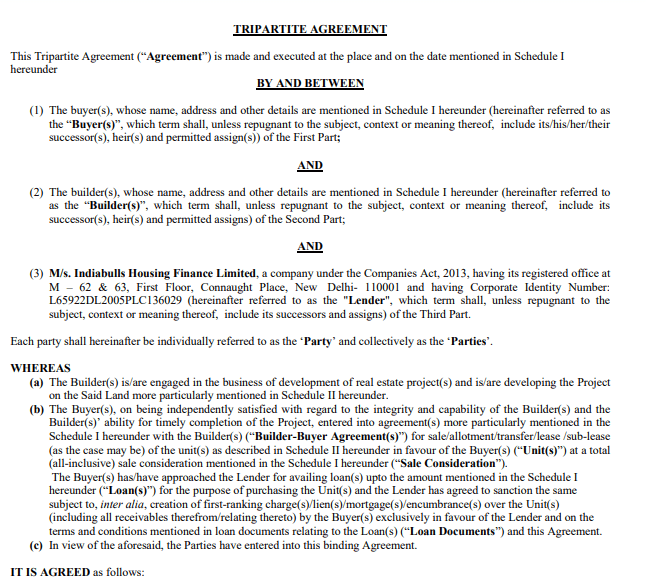
A Tripartite agreement format includes the names and details of the buyer, bank, and developer; a complete property description with clear confirmation; the loan amount and disbursement terms; the rights and obligations of each party; a possession timeline; and a dispute resolution clause. In a Tripartite agreement for a home loan, the bank’s interest and staged payment process are clearly defined. For example, in Mumbai, it is executed under the Indian Contract Act, 1872, which provides legal protection to all parties. Below is a sample home loan format for better understanding. [1]
What Kind of Property Deal Requires a Tri-party Agreement?
The tripartite agreement format and the legal requirements are clear about which kind of properties need to sign it.
- When the owner sells an apartment or flat that is a part of a registered society, the parties will have to take permission before proceeding with the sale.
- A tri party agreement is important if the registered society finds out that the developer has sold the flat without notifying the society committee member.
- A tripartite agreement between builder buyer and seller format, and the bank becomes necessary at the time of selling flats in the registered society.
- A tripartite agreement format bank of Baroda also states between the buyer, seller, and the bank is required to be made aware of when flats are purchased from a developer, especially if the resale property is a part of a housing project where a registered society is not formed yet.
While these situations are a bit complex to deal with, the parties are not always obliged to find a suitable format for the tri-party agreement. They may choose not to get into it after agreeing with all the other party’s requirements and expectations. It is important to note that each bank has its different format and tripartite agreement format SBI may be different from any other bank. You can download the sample tri party agreement directly from the respective bank website. [2]
Advantages of Tri-party Agreement
A tri-party agreement provides legal clarity and financial security when three parties are involved in a single transaction. It clearly defines roles, protects investments, and reduces risks in property dealing. Below are a few advantages to check:
- A third party that is indirectly related to the agreement may not take a stand that it is unaware of any such transaction.
- Even third-party legal heirs and successors cannot challenge the so-called transaction.
- Banks and other financial institutions are always ready for loan selection when they are convinced of the genuineness of the transaction.
- It also indicates that there are no arrears to be paid by the seller to a third party.
- Financial institutions and banks will easily provide housing loans and other types of loans after submitting a tripartite agreement with them.
Other Uses of the Tripartite Agreement
A tri-party agreement in India may cover the property owner, the designer or architect, and the building contractor in some cases. Such agreements are called “no-fault” arrangements, in which all parties acknowledge to remedy their negligence or mistakes, and not to hold other parties responsible for any misunderstandings or omissions.
Tripartite Agreement for Home Loan & Mortgage Property
A Tripartite agreement for a home loan and mortgaged property protects the buyer, the bank, and the developer by clearly defining the payment flow, loan security, and document handling during purchase transactions.
- Role of Banks or NBFC in Tripartite Agreement: The bank or NBFC provides the home loan and verifies the property's legal status before approval. It holds the original property documents as security until the loan is completely repaid, protecting its financial interest.
- Escrow Account or Direct Builder Payment Process: Under the Tripartite agreement for home loans, the lender usually releases funds directly to the developer. Payments are made in construction-linked stages or through an escrow account to ensure transparency and proper use of funds.
- Release of Original Property Documents after Loan Closure: After full repayment of the home loan, the bank issues the No Objection Certificate (NOC) and returns the original property documents, officially removing the mortgage from the property. [3]
Tripartite Lease Agreement
A tripartite lease agreement is a legal document between the landlord, the tenant, and the guarantor. It is essential to protect yourself when entering into a tripartite lease agreement. Here are some steps you can take:
- Review the Lease Agreement Format: Ensure that the tripartite lease agreement has been drafted in the right format. NoBroker's legal services can help you with the lease agreement format.
- Check the Tenant's Credentials: Before entering into a tripartite lease agreement, verify the tenant's credentials. This will ensure that the tenant is a trustworthy person who can pay rent on time.
- Check for the Guarantor's Credentials: The guarantor is responsible for the tenant's payment obligations in case of default. Verify the guarantor's credentials before entering into a tripartite lease agreement.
- Review the Terms and Conditions: Thoroughly review the terms and conditions of the tripartite lease agreement. Make sure that all parties involved have agreed to all the terms and conditions stated in the document.
- Ensure that the Agreement Includes a Security Deposit and Maintenance Charges: The tripartite lease agreement must include the security deposit and maintenance charges to ensure that all parties involved are on the same page.
Alternatives to Tripartite Agreement (NOC & Direct Sale)
In some property transactions, buyers may use alternatives like a No Objection Certificate (NOC) or a direct sale method instead of a Tripartite agreement, depending on loan status and bank requirements. Below are a few pointers that explain things in a better way:
- When NOC is sufficient: An NOC is sufficient when the home loan is fully repaid, and the bank confirms there are no outstanding claims.
- Risk of skipping the Tripartite agreement: Skipping the Tripartite agreement may cause payment confusion, legal disputes, unclean loan liability, and future ownership complications.
- Bank Specific Acceptance Rules: Each bank has different policies; some require Tripartite agreements, while others may accept NOC documentation.
How NoBroker Can Help With Tripartite Agreements?
NoBroker assists in drafting Tripartite agreements, verifying builder documents, coordinating with banks, and reviewing all legal aspects before signing. Their services ensure secure home loan transactions, clear property titles, and legal protection for buyers, making the entire process in India smooth, safe, and hassle-free.
Frequently Asked Questions
Q1. What is a tripartite agreement in construction?
Ans: With mortgages, a tripartite agreement is usually reached during the construction phase of the property to obtain a home loan. The three parties in a tripartite agreement are - the buyer, lender, and the property developer.
Q2. Why is the tripartite agreement important?
Ans: The agreement is important as the document outlines the responsibilities and liabilities of all parties involved in the property purchase transaction.
Q3. What kind of property deal requires tripartite agreements?
Ans: Usually, in under-construction projects, a tripartite agreement is signed to purchase the unit.
Q4. Is the tripartite agreement mandatory?
Ans: No, it is not mandatory. The transaction is still valid if you don’t wish to get into a tripartite agreement. A tripartite agreement is for the sole purpose that the third party, in such an agreement, acts as the confirming party.
Q5. Can a contract be enforced against a third party?
Ans: If the rights have already been assigned (either by the consent of the contracting parties or by a just reliance on the promise), the third-party beneficiary may legally enforce that agreement.
Q6. Is a Tripartite agreement mandatory for every home loan?
Ans: A Tripartite agreement is not mandatory for every home loan, but is required for under-construction properties financed by a bank.
Q7. Can I cancel a Tripartite agreement after loan approval?
Ans: Cancelling a Tripartite agreement after a loan approval is difficult and may involve penalties or legal consequences from the bank and builder.
Q8. What is a Tripartite agreement?
Ans: A Tripartite agreement is a legal contract between the buyer, the bank, and developer outlining roles, payments, and responsibilities in property transactions.
Recommended Reading
Tripartite Agreement: Meaning, Format and Legal Importance in India 2026
January 31, 2025
70534+ views
ARTICLE SOURCES
Most Viewed Articles
Franking Charges Explained: Meaning and Benefits
January 31, 2025
1117158+ views

Society Maintenance Charges : Meaning, Cost, Types and Calculation
January 31, 2025
204153+ views

Daughter's Right in Fathers' Property - the Law is Finally Equal for both Genders?
June 1, 2025
147809+ views

BBMP E-Khata Registration process for property owners in Bangalore, Karnataka in 2025
March 19, 2025
145603+ views

Rectification Deed Format and Process in India 2026
June 1, 2025
137610+ views
Author
Loved what you read? Share it with others!
Recent blogs in
Super Built-Up Area vs Carpet Area: How to Calculate the True Price Per Sq Ft You’re Paying
April 2, 2026 by bikram
The Complete Document Checklist For Buying a Property in India
March 31, 2026 by bikram
Force Majeure Clause in Lease Agreement: Meaning, Applicability & Impact on Rent
March 31, 2026 by Ananth
How to do Property Title Search in India: EC, Litigation Check & Title Clearance Checklist
March 30, 2026 by bikram
Commercial Sublease Agreement: Meaning, Key Elements & How It Works
March 27, 2026 by Ananth










 Full RM + FRM support


Join the conversation!