- https://www.bajajfinserv.in/title-deed-vs-sale-deed
Table of Contents
Loved what you read? Share it with others!


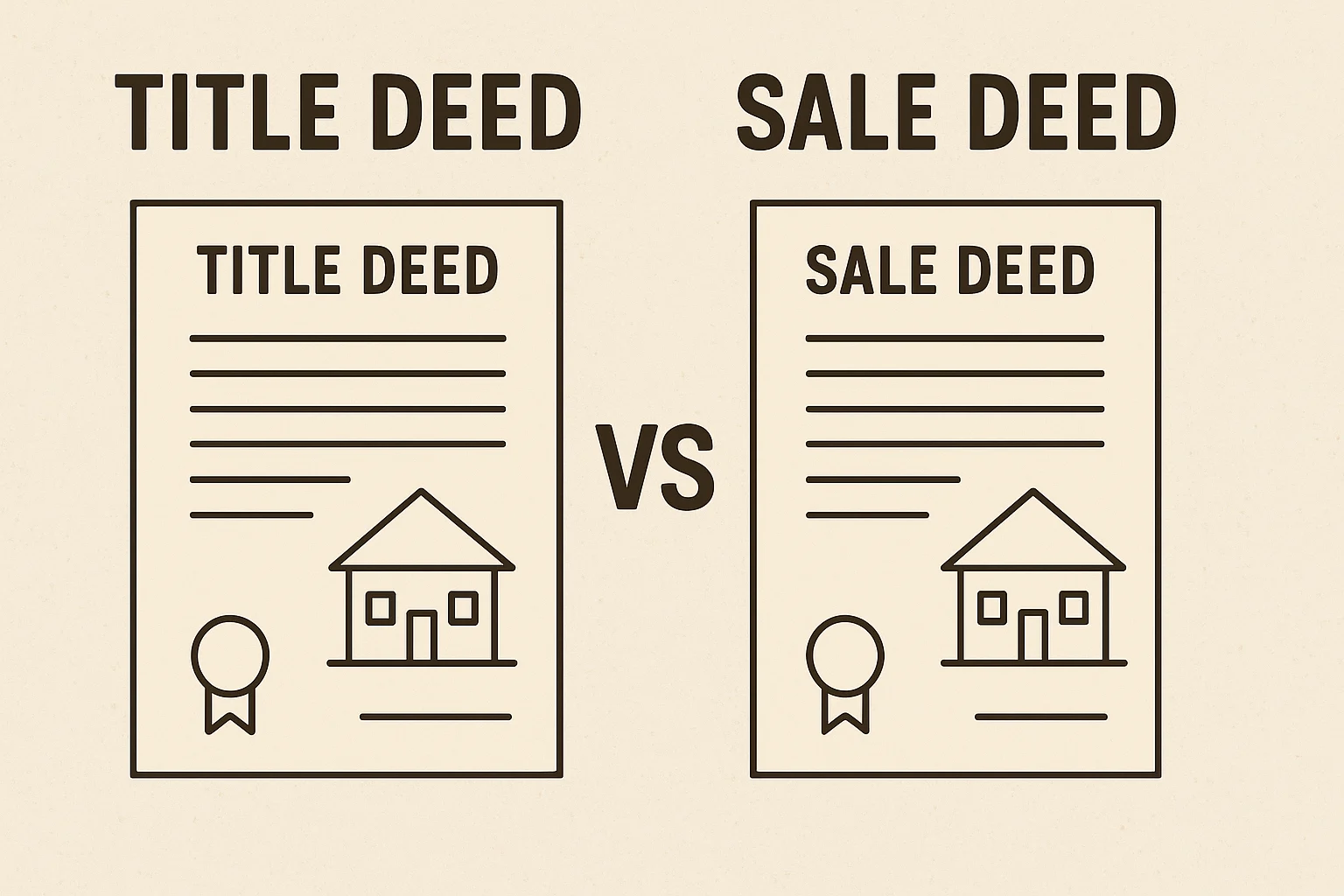
Title Deed vs Sale Deed in Real Estate: Key Differences, Meaning, Value & Process in 2026
Updated : March 13, 2026, 3:18 PM
Author :
 Vivek
Vivek
Summary
A title deed is the document proving legal ownership of a property, while a sale deed is the contract that transfers rights from the seller to the buyer. Differentiating between the two is crucial to avoid fraud, disputes, and legal complications. This understanding ensures clear ownership and valid transactions, making it essential for anyone purchasing, inheriting, or investing in real estate.
Table of Contents
Property transactions in India rely on specific legal documents, and confusion often arises between the title deed and the sale deed. A title deed serves as proof of ownership, while a sale deed is the binding agreement that transfers property rights from seller to buyer. For buyers or inheritors, understanding this distinction is crucial to ensure ownership clarity, validate transactions, and safeguard against fraud or future disputes.
What is a Title Deed?
A Title deed query reveals a concept rather than a single document. A Title Deed is not one specific paper but a collection of legal documents that collectively prove a person's ownership rights over a property. It acts as the property's historical record or biography, tracing the chain of ownership. This set of documents is the ultimate evidence of a clear and marketable title, which is essential for any future sale, mortgage, or transfer of the property. For a detailed explanation, you can refer to this guide on the Title Deed. [1]
What is a Sale Deed?
A sale deed refers to a specific, transactional document. A Sale Deed is the primary legal instrument that formally transfers the ownership of a property from a seller to a buyer in exchange for a specified price. It is the documented evidence of the property sale "event." Sale deed drafted on non-judicial stamp paper, signed by both parties, and mandatorily registered at the Sub-Registrar's office to be legally valid and enforceable. [1]
Key Differences Between Title Deed and Sale Deed
To fully grasp the title deed and sale deed difference, it is helpful to compare their attributes directly. This table highlights the primary distinctions between the two. [1]
| Aspect | Title Deed | Sale Deed |
|---|---|---|
| Purpose | To prove and establish the legal right of ownership over a property. It is a statement of rights. | To execute the legal transfer of property ownership from a seller to a buyer. It is an instrument of transfer. |
| When Issued | It is not "issued" at a single point. It is a collection of documents built up over the property's history. | It is created and signed at the specific time of a property sale transaction. |
| Key Parties | Involves the current owner whose rights are being established. | Involves the Seller (Vendor) and the Buyer (Vendee) who are executing the transaction. |
| Legal Value | It is the conclusive proof of ownership and the legal right to possess and use the property. | It is the primary evidence that a sale transaction has occurred and that the title has been legally conveyed. |
| Registration | It is a concept; the individual documents that form the title (like sale deeds) must be registered. | Registration with the Sub-Registrar is mandatory under the Registration Act, 1908, for it to be legally valid. |
| When Used | Used to verify ownership during due diligence, for securing loans, and in property disputes. | Used to complete a property sale legally and to become a key part of the new owner's Title Deed. |
Legal Process of Registration
The registration of a deed is a critical step that gives it legal validity. The process ensures the transaction is officially recorded in government records.
- Step 1: A legal expert drafts the deed.
- Step 2: The applicable stamp duty is paid on the document.
- Step 3: The document is signed by all parties (seller, buyer) in the presence of two witnesses.
- Step 4: The executed document is submitted to the Sub-Registrar's office.
- Step 5: The Sub-Registrar verifies the identities and the document before officially registering it.
Importance of Title Deed and Sale Deed in Property Transactions
Both documents are indispensable in any property transaction, each playing a critical role in securing the rights of the owner. [1]
Importance of a Title Deed:
- Establishes Ownership: Title deed ultimate proof of your legal right to the property.
- Enables Future Sales: A clear and marketable title is non-negotiable for selling the property in the future.
- Required for Loans: Banks and financial institutions will not approve a home loan or loan against property without a clear title verification.
- Prevents Disputes: A well-documented title history prevents legal disputes over ownership.
Importance of a Sale Deed:
- Legal Proof of Transfer: It is the primary legal document that proves the property has been officially transferred to you.
- Defines Rights and Obligations: It clearly outlines the terms of the sale, including the price, payment, and the rights and responsibilities of both buyer and seller.
- Foundation of New Title: A registered Sale Deed becomes the newest and most important document in the new owner's collection of title documents.
- Required for Mutation: It is the basis for updating the property records (mutation) in the municipal and land revenue departments.
Can a Sale Deed Serve as a Title Deed?
This is a common point of confusion, and the answer is nuanced. Yes, a registered Sale Deed is the most important document that serves as proof of your title. For the current owner, the Sale Deed is their primary title document. However, the term "Title Deed" in a broader legal sense refers to the entire chain of documents that proves there are no breaks in ownership. Therefore, while your Sale Deed is your title document, a complete title check also involves examining the seller's Sale Deed and the one before that to establish a clear and marketable title.
How Can NoBroker Help with Legal Services?
Clarity in legal documentation can make or break a property deal, especially when evaluating a title deed vs sale deed. NoBroker’s legal services provide complete support with due diligence, verifying ownership, and identifying potential risks before purchase. Our experts draft, review, and register sale deeds while ensuring title deeds are clear and enforceable. By simplifying the legalities, we help buyers and sellers safeguard their transactions, avoid costly errors, and complete property transfers with confidence and peace of mind.
Frequently Asked Questions
Q1. Can a property be sold without a title deed?
Ans. No, a property cannot be legally sold without a clear title. The seller must prove their ownership through a set of title documents before a sale can be executed.
Q2. How does a title deed prove ownership?
Ans. A title deed proves ownership by providing a historical chain of registered documents, like previous sale deeds, showing an unbroken transfer of rights to the current owner.
Q3. Is a sale deed the same as a title deed?
Ans. No. A Sale Deed is a single document that transfers title. A Title Deed is the concept of ownership, proven by a collection of documents, including the current Sale Deed.
Q4. Which is more important - title deed or sale deed?
Ans. Both are critically important. A clear Title Deed is required to be able to sell, and a valid Sale Deed is required to complete the sale.
Q5. Does loan approval require both the sale deed and title deed documents?
Ans. Yes, banks require the entire chain of title documents (including the seller's sale deed) for verification before approving a loan for the new buyer's sale deed.
Recommended Reading
Title Deed vs Sale Deed in Real Estate: Key Differences, Meaning, Value & Process in 2026
September 23, 2025
813+ views
ARTICLE SOURCES
Most Viewed Articles

Franking Charges Explained: Meaning and Benefits
January 31, 2025
1116951+ views

Society Maintenance Charges : Meaning, Cost, Types and Calculation
January 31, 2025
201651+ views

Daughter's Right in Fathers' Property - the Law is Finally Equal for both Genders?
June 1, 2025
146101+ views

BBMP E-Khata Registration process for property owners in Bangalore, Karnataka in 2025
March 19, 2025
145603+ views

Rectification Deed Format and Process in India 2026
June 1, 2025
136368+ views
Author
Loved what you read? Share it with others!
Recent blogs in
Article 35 I Lease Rent Deed: Process, Calculation and Legal Guidelines in 2026
March 9, 2026 by Kiran K S
Deed of Variation Lease: Meaning, Format & Legal Process Explained in 2026
March 9, 2026 by Manasvi Bachhav










 Full RM + FRM support


Join the conversation!