- https://en.wikipedia.org/wiki/Arbitration_clause
- https://www.docusign.com/blog/arbitration-clause
- https://articles.manupatra.com/article-details/Arbitrability-of-Disputes-Under-An-Unregistered-AndOr-An-Unstamped-Lease-Agreement
- https://spiceroutelegal.com/publications/applicability-of-arbitration-clauses-in-lease-leave-and-license-agreements/
- https://corpbiz.io/learning/important-terms-in-a-lease-agreement/
- https://icaindia.co.in/commercial-arbitration
- https://silagroup.co.in/2025/12/30/what-are-the-key-clauses-to-look-for-in-a-commercial-lease/
- https://www.livelaw.in/columns/model-tenancy-act-registration-act-1908-177589
- https://dhavalvussonji.com/fundamentals-of-a-legally-enforceable-arbitration-agreement-key-principles-and-pitfalls/
- https://www.defactojudiciary.in/notes/essential-elements-of-arbitration-agreement
- https://www.advocatekhoj.com/library/lawreports/civilprocedure1908/9.php
- https://maldivesmootcourtsociety.org/10-tips-for-drafting-an-effective-arbitration-clause/
Table of Contents
What Is an Arbitration Clause? Arbitration Clause in Lease Agreements Is an Arbitration Clause Mandatory in Lease Agreements? Commercial Lease Arbitration Clause Residential Lease Arbitration Clause Key Elements of a Lease Arbitration Clause Benefits of Including an Arbitration Clause in a Lease Deed Limitations and Considerations How to Draft an Effective Arbitration Clause? When Arbitration May Not Be Suitable How NoBroker Can Help With Lease Agreements and Arbitration Clauses?Frequently Asked Questions
Loved what you read? Share it with others!


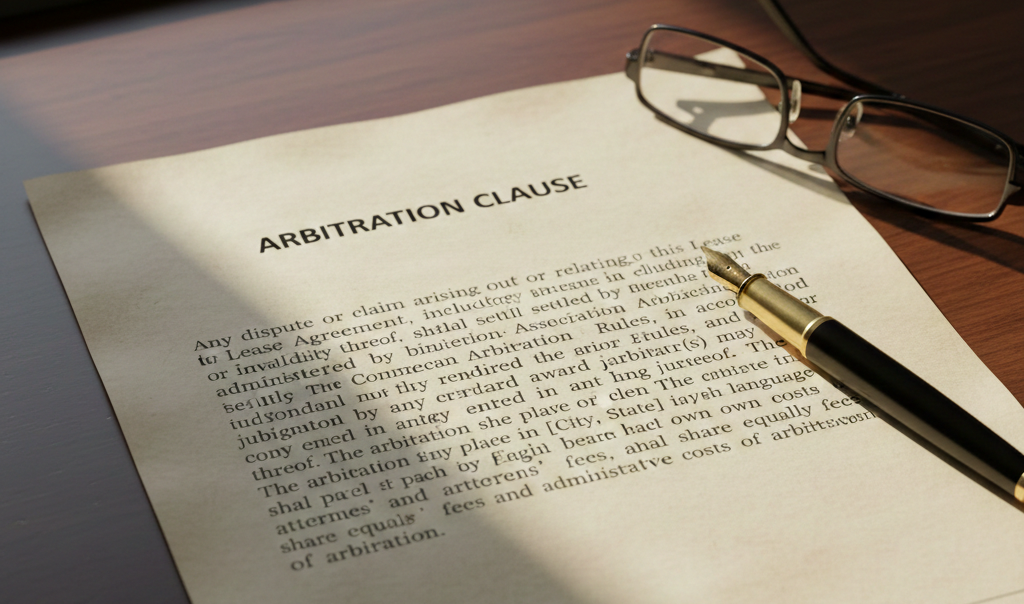
Arbitration Clause In Lease Agreement: Key Elements, Advantages, and Limitations
Updated : March 20, 2026, 11:35 AM
Author :
 Krishnanunni
Summary
An arbitration clause in a lease agreement is a provision that allows landlords and tenants to resolve disputes through arbitration instead of going to court. It ensures faster, private, and cost-effective conflict resolution by involving a neutral arbitrator. This clause clearly defines the dispute process, saving time and legal expenses. Including an arbitration clause helps protect both parties and ensures smoother handling of lease-related disagreements.
Table of Contents
What Is an Arbitration Clause? Arbitration Clause in Lease Agreements Is an Arbitration Clause Mandatory in Lease Agreements? Commercial Lease Arbitration Clause Residential Lease Arbitration Clause Key Elements of a Lease Arbitration Clause Benefits of Including an Arbitration Clause in a Lease Deed Limitations and Considerations How to Draft an Effective Arbitration Clause? When Arbitration May Not Be Suitable How NoBroker Can Help With Lease Agreements and Arbitration Clauses?Frequently Asked Questions
What Is an Arbitration Clause?
An arbitration clause is a contractual provision that requires parties to resolve their disputes through a private process rather than traditional court litigation. In simple terms, it is a "pre-agreement" in which the parties agree that, if a conflict arises, they will not go to a public judge but instead hire an independent person to decide the matter. This clause is a high-level tool used to ensure that legal hurdles do not stall business operations or personal lives. Understanding the basics of a lease agreement is the first step in recognizing where these clauses fit into the broader legal framework of property rentals. [1] [2]
Arbitration Clause in Lease Agreements
Specifically, an arbitration clause in a lease agreement (also referred to as a lease arbitration clause) applies to disputes arising directly from the rental contract. This can include issues like rent defaults, non-payment of maintenance, or disagreements over the interpretation of specific house rules. In the Indian legal context, the Supreme Court has clarified that most contractual lease disputes are "arbitrable." This means you can legally use arbitration for matters involving private rights between the landlord and tenant, such as recovering unpaid bills or resolving premature termination of the stay, without waiting for a civil court's availability. [3] [4]
Is an Arbitration Clause Mandatory in Lease Agreements?
No, an arbitration clause is not mandatory in a lease agreement. It is an optional, consent-based provision that parties choose to include based on their mutual strategy. If you do not include one, all your disputes will automatically fall under the jurisdiction of the regular civil courts. [5]
Commercial Lease Arbitration Clause
For business-related rentals, a commercial lease arbitration clause is a strategic necessity. High-stakes commercial contracts often involve complex obligations, such as multi-layered fit-out rules, revenue-sharing models, and long-term lock-in periods. This clause allows corporate entities to settle financial disagreements privately, ensuring that sensitive business data does not become part of the public court record. If you are drafting a business contract, studying a commercial lease agreement guide can help you place this clause effectively. [6] [7]
Residential Lease Arbitration Clause
While less common than in business deals, a residential lease arbitration clause is becoming useful for high-end luxury rentals or long-term family stays. Landlords often prefer this to avoid court congestion, as it gives them a clearer timeline for recovering dues or resolving possession issues. However, tenants should understand the implications before waiving their standard litigation rights. In India, if a property falls under the strict state "Rent Control Acts," an arbitration clause might be legally void. In such "protected" cases, only designated government tribunals have the power to hear the dispute, ensuring that the tenant's rights are not bypassed by private agreements. [8]
Key Elements of a Lease Arbitration Clause
To make a lease arbitration clause legally enforceable under the Arbitration and Conciliation Act, 1996, it must contain specific technical details to avoid being struck down by a court. [9] [10]
- Reference to arbitration: Explicitly state that all disputes must be resolved through arbitration, not litigation.
- Governing law and seat: The "seat" (e.g., New Delhi) determines which High Court has the supervisory power over the process.
- Number of arbitrators: Parties usually choose one (sole arbitrator) to keep costs low, or three for very high-value cases.
- Language of proceedings: In India, this is typically English to ensure a clear and formal record of the hearing.
- Timeline for initiating: Specify how many days a party has to respond once an arbitration notice is served.
- Cost-sharing arrangements: Clearly define who pays for the arbitrator’s professional fees and the private venue charges.
Benefits of Including an Arbitration Clause in a Lease Deed
Including an arbitration clause in a lease deed offers several significant advantages for both owners and occupants who value their time and privacy. [11]
- Faster dispute resolution: Arbitration is mandated to be much quicker than traditional civil trials, which can last decades.
- Confidential proceedings: Hearings take place in private rooms, keeping your personal or business conflicts out of the public eye.
- Expert arbitrators: You can choose a professional who truly understands real estate laws and local property market norms.
- Potentially lower legal costs: While you pay the arbitrator's fee, you save money by avoiding years of lawyer fees.
- Avoids lengthy court backlogs: You don’t have to wait for your case to be called among thousands of others.
Limitations and Considerations
Despite its speed and efficiency, there are certain limitations to keep in mind when agreeing to an arbitration clause.
- Waiver of right to sue: You generally cannot go to a public court once you have signed an arbitration agreement.
- High upfront costs: Unlike court fees, which are minimal, you must pay for the arbitrator’s professional time upfront.
- Finality of award: An arbitral award is final with extremely limited appeal options, meaning you must accept the result.
- Need for clear drafting: If the clause is ambiguous, it may lead to a secondary dispute just to start the arbitration.
How to Draft an Effective Arbitration Clause?
Drafting an arbitration clause in a lease agreement sample requires following a logical, step-by-step approach to ensure it covers all potential conflict areas. [12]
Identify types of disputes covered
Clearly define that the clause covers "all disputes arising out of or relating to" the lease, including its termination or validity.
Specify arbitration rules
Decide whether to use "Ad Hoc" arbitration or "Institutional" rules from bodies like the Indian Council of Arbitration.
Determine seat and governing law
State the specific city that will act as the legal "seat." This is the most important legal identifier for jurisdictional purposes.
Decide number of arbitrators
Usually, a sole arbitrator is the best choice for residential agreements to keep the process affordable and fast.
Include time limits
Set a mandatory timeframe for the appointment of the arbitrator once a dispute notice is served by one party to the other.
Clarify cost allocation
Explicitly mention that the costs of the proceedings will be shared equally unless the arbitrator decides otherwise in the final award.
When Arbitration May Not Be Suitable
There are specific situations where a lease arbitration clause might not be the best choice for a landlord or a tenant. Understanding the house rent lease agreement format in your specific state is essential before deciding on this route.
- Small value disputes: If the fight is over a very small amount, the arbitration cost might exceed the claim value.
- Urgent physical evictions: If you need immediate police intervention to remove a person, some prefer direct court summary suits.
- Unwillingness to waive court: If a party feels more comfortable with a public judge, they should not sign the clause.
- Local law restrictions: In states with very high tenant protection, arbitration is often legally barred for residential evictions.
How NoBroker Can Help With Lease Agreements and Arbitration Clauses?
Drafting a legally sound lease agreement with a proper arbitration clause in lease agreement is important for your long-term security and peace of mind. NoBroker assists landlords and tenants by offering professionally verified templates that include compliant arbitration provisions tailored to your needs. Whether you are dealing with a commercial space or a residential flat, we provide end-to-end documentation support. Our platform ensures your contracts are transparent, legally valid, and free of broker fees, helping you resolve potential conflicts efficiently without the stress of traditional courts.
Frequently Asked Questions
Q1. What is an arbitration clause in a lease agreement?
Ans: It is a formal agreement in which the landlord and tenant agree to resolve any future legal disputes through a private arbitrator rather than a public court.
Q2. Is an arbitration clause mandatory in lease deeds?
Ans: No, it is entirely optional. However, if included and signed, it becomes a binding legal requirement for both parties.
Q3. Can tenants refuse arbitration?
Ans: Yes, a tenant can negotiate to remove the clause before signing the lease if they prefer to keep their right to access public courts.
Q4. Does an arbitration clause limit tenant rights?
Ans: It changes the venue where the dispute is heard, but it does not take away the legal rights granted to the tenant under the contract.
Q5. How long does arbitration take?
Ans: In India, the Arbitration Act encourages an award to be passed within 12 to 18 months, which is significantly faster than standard litigation.
Recommended Reading
Society Maintenance Charges : Meaning, Cost, Types and Calculation
January 31, 2025
202538+ views

What are Society Transfer Charges as per the Housing Act and Rules in 2026?
January 31, 2025
88180+ views

What is the Difference Between Movable and Immovable Property?
May 1, 2025
72386+ views

A Comprehensive Guide to Karnataka Rent Control Laws and Tenant Rights
January 31, 2025
62418+ views

Everything You Need to Know About Indemnity Bond
January 31, 2025
50193+ views
ARTICLE SOURCES
Most Viewed Articles
Franking Charges Explained: Meaning and Benefits
January 31, 2025
1117000+ views
Society Maintenance Charges : Meaning, Cost, Types and Calculation
January 31, 2025
202538+ views

Daughter's Right in Fathers' Property - the Law is Finally Equal for both Genders?
June 1, 2025
146668+ views

BBMP E-Khata Registration process for property owners in Bangalore, Karnataka in 2025
March 19, 2025
145603+ views

Rectification Deed Format and Process in India 2026
June 1, 2025
136799+ views
Author
Loved what you read? Share it with others!
Recent blogs in
Reddendum Clause in the Lease Deed: Meaning, Purpose, Legal Validity, and Examples
March 20, 2026 by Krishnanunni H M
What is the Difference Between Lease Agreement and Leave and License Agreement?
March 20, 2026 by Vivek Mishra
Tripartite Sub-Lease Deed: Parties, Clauses, and Registration Process in India
March 20, 2026 by Ananth










 Full RM + FRM support


Join the conversation!