- https://tax2win.in/guide/section-194ib-tds-on-rent-of-property
Table of Contents
Loved what you read? Share it with others!


Section 194IB TDS Rate: Applicability, Deduction, Penalty and Payment Rules
Updated : November 11, 2025, 11:27 PM
Author :
 Kruthi
Summary
Section 194IB of the Income Tax Act mandates that individuals and Hindu Undivided Families (HUFs) deduct 5% TDS on rent payments exceeding ₹50,000 per month to resident landlords. If the landlord fails to provide a PAN, the 194IB TDS rate rises to 20%. The section simplifies compliance by allowing tenants to file Form 26QC online without needing a TAN. Failure to comply attracts interest and penalties. NoBroker’s legal experts assist tenants and landlords in managing TDS filing, Form 16C issuance, and overall compliance efficiently.
Table of Contents
Section 194IB of the Income Tax Act explains how TDS on rent works in India. While TDS is commonly linked to salaries, it also applies to rental payments. This rule makes it mandatory for individuals and Hindu Undivided Families (HUFs) paying monthly rent above ₹50,000 to deduct a small percentage as tax before paying the landlord. The deducted amount is then deposited with the government, ensuring tax compliance on high-value rental transactions.
Difference Between Section 194-IB and 194-I
A common point of confusion is the distinction between Section 194-IB and Section 194-I, as both deal with TDS on rent. However, they apply to different types of taxpayers and situations. The table below clarifies the key differences. [1]
| Feature | Section 194-IB | Section 194-I |
|---|---|---|
| Definition | TDS on rent paid by individuals or HUFs who are not required to have their accounts audited. | TDS on rent paid by any person (including companies, firms, and individuals/HUFs) who is required to have their accounts audited under the Income Tax Act. |
| Deductor | Individuals and Hindu Undivided Families (HUFs) not covered under the tax audit provisions of Section 44AB. | All types of taxpayers, including companies, firms, and individuals/HUFs whose business or professional receipts exceed the tax audit threshold. |
| TDS Rate | 5% of the total annual rent. This rate becomes 20% if the landlord does not provide a PAN. | 2% for plant & machinery and 10% for land, building, and furniture. This also becomes 20% if the landlord's PAN is not available. |
| Threshold | The TDS provision is applicable only if the rent paid exceeds ₹50,000 per month. | The TDS provision is applicable if the total rent paid during the financial year exceeds ₹2,40,000. |
| Form for Payment | The tax is paid to the government using Form 26QC. The deductor (tenant) does not need a TAN. | The tax is paid using a regular TDS challan (ITNS 281). The deductor (tenant) is required to have a Tax Deduction Account Number (TAN). |
What is Section 194-IB?
Section 194IB is a specific provision in the Income Tax Act that mandates individuals or Hindu Undivided Families (HUFs) to deduct TDS when they pay rent of more than ₹50,000 per month to a resident landlord. This section was introduced to widen the tax base and ensure that landlords receiving high rental income are brought under the tax net, even when the tenant is not a business entity.
TDS Rate under Section 194-IB
The tds percentage on rent under this section is straightforward but has an important condition related to the landlord's PAN. [1]
- If the landlord provides a PAN card: The tenant must deduct TDS at a rate of 5% on the total rent paid during the financial year.
- If the landlord does not provide a PAN card: The TDS rate increases to 20%.
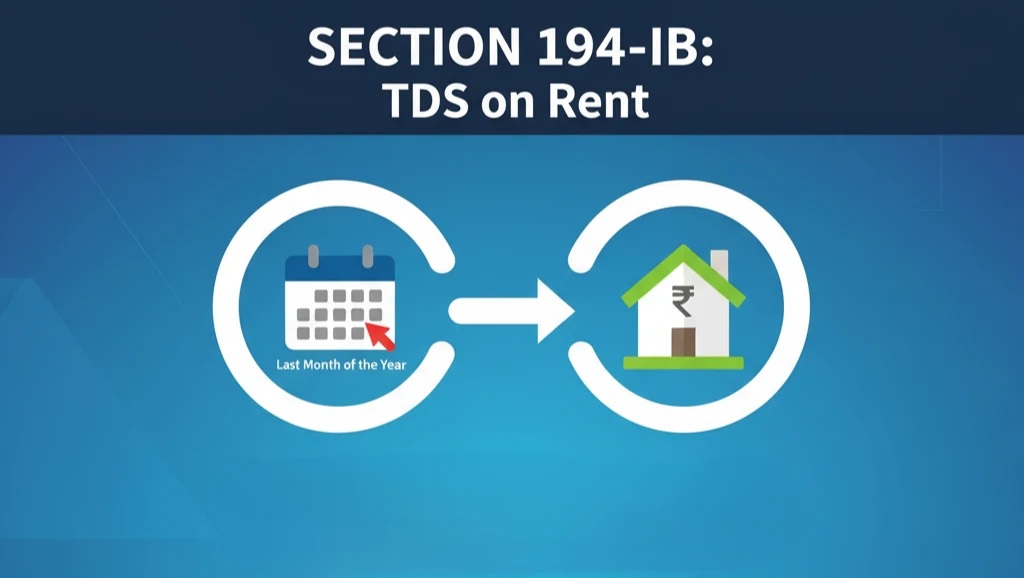
- Important Condition: The total TDS amount deducted cannot exceed the rent payable for the last month of the financial year or the last month of the tenancy, whichever is earlier.
Applicability and Threshold
Understanding who needs to deduct tax and when is crucial for compliance with the tds on rent section. Here is a breakdown of the applicability of 194i b of income tax act. [1]
- Who is required to deduct TDS: This rule applies exclusively to individuals and Hindu Undivided Families (HUFs) who are paying rent to a resident landlord.
- Who is exempt from this section: Tenants who are companies, firms, or any other entities are not covered under this section. Additionally, individuals or HUFs whose accounts are required to be audited under Section 44AB must deduct TDS under Section 194-I, not 194-IB.
- What is the rent threshold: The provision of Section 194-IB is triggered only if the rent paid or payable is more than ₹50,000 per month or part of a month.
- When is the TDS deducted: Unlike other TDS provisions where tax is deducted monthly, TDS under Section 194-IB is typically deducted only once in a financial year. This is done from the last month's rent of the financial year or from the last month's rent of the tenancy if the property is vacated mid-year.
Payment and Filing of TDS
The process for depositing the deducted tax and filing the necessary forms is unique to section 194ib of income tax act and is designed to be simple for individuals. [1]
- Deposit of TDS: The tenant must deposit the TDS amount with the government within 30 days from the end of the month in which the tax was deducted. For example, if TDS is deducted on March 31st, it must be deposited by April 30th.
- Filing Form 26QC: The tax is deposited using an online form called Form 26QC. This is a challan-cum-statement that contains details of the tenant, landlord, rent paid, and TDS deducted. The tenant does not need to obtain a Tax Deduction Account Number (TAN) for this.
- Issuing TDS Certificate (Form 16C): After depositing the tax and filing Form 26QC, the tenant must download the TDS certificate, known as Form 16C, from the TRACES portal and provide it to the landlord within 15 days. This certificate acts as proof for the landlord that tax has been deducted and paid on their behalf.
Penalty and Interest for Non-Compliance
Failure to comply with the provisions of tds on rent 194ib can lead to significant financial penalties. It is crucial for tenants to be aware of these consequences. [1]
- Interest on Late Deduction/Deposit: If you fail to deduct TDS, an interest of 1% per month is levied from the date it was supposed to be deducted. If you deduct the TDS but fail to deposit it with the government, an interest of 1.5% per month is charged.
- Penalty for Late Filing of Form 26QC: A late filing fee of ₹200 per day is applicable under Section 234E for any delay in filing Form 26QC. This penalty can continue to accrue until it equals the total TDS amount.
- Importance of Compliance: Timely deduction, payment, and filing are essential. Non-compliance not only leads to financial penalties for the tenant but also causes issues for the landlord, who cannot claim credit for the TDS without a valid Form 16C. This can be particularly important in cases related to TDS on sale of property, where all tax compliances are reviewed.
How NoBroker Can Help with Legal Services
Navigating tax laws like Section 194-IB can be confusing for both tenants and landlords. Ensuring timely compliance, from deducting the correct amount to filing the right forms, is essential to avoid penalties. NoBroker's legal services platform connects you with experienced tax professionals and Chartered Accountants who can provide expert consultation on all your tax-related queries. Whether you need help understanding your TDS liability, filing Form 26QC, or managing other tax matters like those under Section 194H of Income Tax Act, our legal partners can provide the guidance you need.
Frequently Asked Questions?
Q1. What is the main difference between Section 194-IB and 194-I?
Ans: Section 194-IB applies to individuals/HUFs not under tax audit paying rent over ₹50,000/month. Section 194-I applies to businesses and audited individuals/HUFs paying rent over ₹2,40,000/year.
Q2. Do I need a TAN to deduct TDS under Section 194-IB?
Ans: No, a tenant who is an individual or HUF does not need to obtain a Tax Deduction Account Number (TAN) to deduct and pay TDS under Section 194-IB.
Q3. What if my landlord does not provide their PAN?
Ans: If the landlord does not provide their PAN, you are required to deduct TDS at a higher rate of 20%. However, the total TDS amount cannot exceed the last month's rent.
Q4. When exactly should I deduct the TDS on rent?
Ans: TDS should be deducted from the rent payment of the last month of the financial year (i.e., March) or the last month of your tenancy agreement if you vacate the property earlier.
Q5. Is TDS on rent applicable to commercial property under 194-IB?
Ans: Section 194-IB applies to rent paid for any "land or building or both." Therefore, it applies to both residential and commercial properties, provided the tenant is an individual or HUF not liable for a tax audit.
ARTICLE SOURCES
Most Viewed Articles

Franking Charges Explained: Meaning and Benefits
January 31, 2025
1117027+ views

Society Maintenance Charges : Meaning, Cost, Types and Calculation
January 31, 2025
202868+ views

Daughter's Right in Fathers' Property - the Law is Finally Equal for both Genders?
June 1, 2025
146948+ views

BBMP E-Khata Registration process for property owners in Bangalore, Karnataka in 2025
March 19, 2025
145603+ views

Rectification Deed Format and Process in India 2026
June 1, 2025
137003+ views
Author
Loved what you read? Share it with others!
Recent blogs in
Arbitration Clause in Leave and License Agreement: Meaning, Validity & Dispute Resolution Guide
March 24, 2026 by Vivek Mishra
Difference Between Perpetual Lease Deed and Conveyance Deed: Meaning & Key Features
March 23, 2026 by Ananth









 Full RM + FRM support


Join the conversation!