- https://www.investopedia.com/terms/j/joint-tenancy.asp
- https://www.smiletotalk.com/blog/everything-you-need-to-know-about-joint-tenancy-agreements
- https://www.crownluxuryhomes.com/joint-tenancy-guide/
- https://legal-resources.uslegalforms.com/j/joint-tenancy
- https://www.rocketmortgage.com/learn/joint-tenancy
- https://www.lawteacher.net/lectures/land-law/co-ownership/joint-tenancy-
- https://www.aurumproptech.in/pulse/blog/joint-ownership-of-property
- https://jantahousing.com/joint-ownership-of-property-in-india-a-comprehensive-guide/
Table of Contents
What is a Joint Tenancy Agreement?Who Can Enter Into a Joint Tenancy Agreement?Key Features of a Joint Tenancy AgreementTypes of Joint Tenancy ArrangementsJoint Tenancy vs Tenancy in CommonDocuments Required for Joint Tenancy AgreementsHow to Create a Joint Tenancy Agreement?Is Registration Mandatory for Joint Tenancy Agreements?JOINT TENANCY AGREEMENT FORMATRights and Responsibilities of Joint TenantsHow NoBroker Can Help With Joint Tenancy Agreements?Frequently Asked Questions?
Loved what you read? Share it with others!


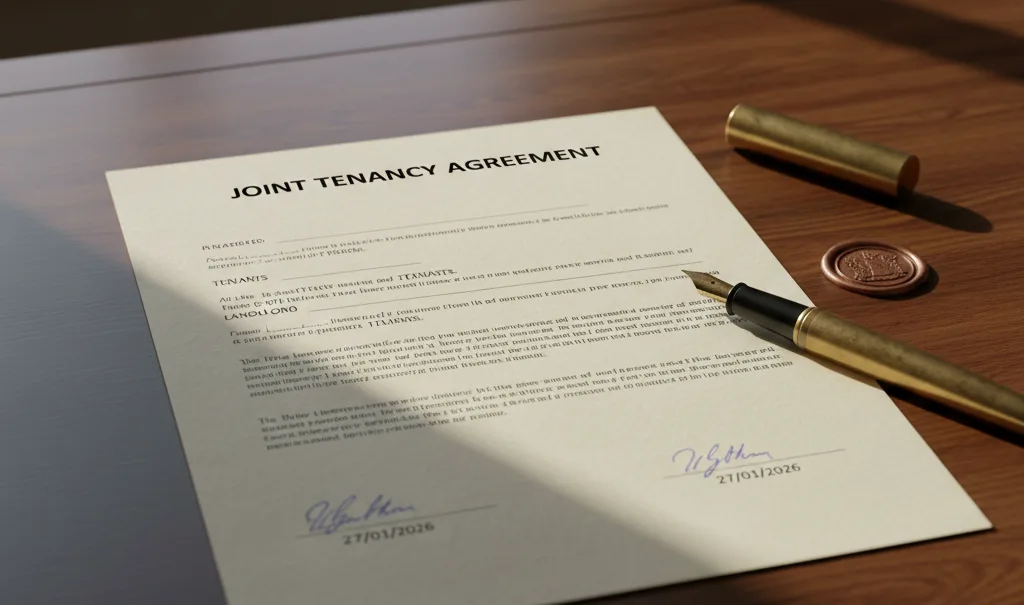
What Is a Joint Tenancy Agreement: Meaning, Rights, Format and Key Features in India
Updated : February 9, 2026, 4:17 PM
Author :
 Ananth
Summary
A joint tenancy agreement is a form of shared property ownership or rental where two or more people hold equal rights and responsibilities. One of its main features is the right of survivorship, which means a co-owner’s share automatically passes to the remaining owners if they die, without needing a will or legal transfer. All joint tenants share rent, maintenance duties, and liabilities equally. This arrangement is commonly used by spouses, family members, or partners and differs from tenancy in common, where ownership shares can vary and be inherited separately.
Table of Contents
What is a Joint Tenancy Agreement?Who Can Enter Into a Joint Tenancy Agreement?Key Features of a Joint Tenancy AgreementTypes of Joint Tenancy ArrangementsJoint Tenancy vs Tenancy in CommonDocuments Required for Joint Tenancy AgreementsHow to Create a Joint Tenancy Agreement?Is Registration Mandatory for Joint Tenancy Agreements?JOINT TENANCY AGREEMENT FORMATRights and Responsibilities of Joint TenantsHow NoBroker Can Help With Joint Tenancy Agreements?Frequently Asked Questions?
Sharing a rental property with friends, family, or roommates can be a great way to save money, but it can also lead to confusion if everyone’s rights and responsibilities aren’t clearly defined. That’s where understanding what is a joint tenancy agreement is becomes essential. A joint tenancy sets out exactly how multiple tenants share a property, from rent and bills to legal responsibilities, helping prevent disputes before they arise. In this article, we’ll explain how joint tenancy works, the key rules to know, and why having a clear agreement can make co-living much smoother.
What is a Joint Tenancy Agreement?
A joint tenancy agreement is a legal arrangement where two or more tenants share equal rights to a rental property. All tenants have equal possession and are jointly responsible for rent, utilities, and compliance with the rental terms, ensuring everyone has a clear role and shared obligations. [1][[2][3]
Who Can Enter Into a Joint Tenancy Agreement?
A joint tenancy agreement can be signed by anyone looking to share a property, with equal rights and responsibilities. Unlike tenancy in common, all tenants in a joint tenancy have equal possession and joint liability. Common examples include: [4][5]
- Married couples
- Business partners
- Friends sharing accommodation
- Co-investors
- Family members
Key Features of a Joint Tenancy Agreement
A joint tenancy agreement sets out the shared rights and responsibilities of all tenants, unlike a tenancy in common agreement. It ensures equal possession, joint liability, and clear rules for managing the property together.
- Equal rights over property: all tenants have the same legal claim.
- Shared liability for rent and damages: everyone is equally responsible.
- Single agreement signed by all parties: ensures clarity and legal enforceability.
- Survivorship rights (ownership): a eased tenant’s share passes automatically to the others.
- Mutual consent required for changes: major decisions need approval from all tenants.
Types of Joint Tenancy Arrangements
Understanding the joint tenancy agreement meaning is important when choosing between different rental agreements in India. [7][8]
- Residential joint tenancy: multiple tenants share a home or apartment, splitting rent and utilities.
- Commercial joint tenancy: business partners jointly rent or own commercial spaces.
- Co-ownership joint tenancy: property is co-owned for investment or inheritance purposes.
- Lease-based joint tenancy: tenants share a leased property under a single agreement with joint obligations.
Joint Tenancy vs Tenancy in Common
A joint tenancy form defines shared ownership, equal rights, and responsibilities, but it differs from tenancy in common in key ways, especially regarding ownership, survivorship, and transfer rights. [6]
| Aspects | Joint Tenancy | Tenancy in Common |
| Ownership Share | Equal share among all tenants | Can be unequal shares |
| Survivorship | Automatic transfer of deceased tenant’s share to others | No automatic transfer; share passes via will |
| Transfer Rights | Requires consent of all tenants | Each tenant can transfer their share independently |
| Inheritance | Deceased’s interest passes to co-tenants automatically | Deceased’s interest goes to heirs or as per will |
Documents Required for Joint Tenancy Agreements
To create a valid joint tenancy agreement, certain documents are required from both tenants and property owners.
- Identity proof of all tenants
- Address proof of all tenants
- Passport-size photographs of tenants
- Property ownership documents
- Previous rent agreement (if applicable)
- No Objection Certificate (NOC) from the owner
- Stamp duty payment receipt
- Witness identity proofs
How to Create a Joint Tenancy Agreement?
Setting up a joint rental agreement ensures all tenants clearly understand their rights, responsibilities, and obligations. Following a structured process reduces conflicts, protects each party legally, and makes co-living arrangements smooth and transparent.
Step 1: Decide Ownership Structure
Determine whether tenants will hold equal or unequal shares of the property. Clarifying ownership early establishes legal rights, responsibilities, and financial obligations, preventing future misunderstandings among co-tenants.
Step 2: Draft Agreement Terms
Include details on rent sharing, utility payments, exit clauses, and dispute resolution. A well-drafted agreement ensures all tenants are aware of their obligations and protects everyone from potential conflicts.
Step 3: Stamp and Register (If Required)
Depending on the duration and local legal requirements, the agreement may need to be stamped or registered. Completing this step ensures the joint tenancy is legally recognized and enforceable.
Step 4: Execute Agreement
All tenants should sign the agreement in the presence of witnesses. Proper execution makes the contract legally binding and ensures that everyone’s rights and responsibilities are officially documented.
Is Registration Mandatory for Joint Tenancy Agreements?
Filling out a proper joint tenancy form is essential to legally protect all tenants. Registration clarifies ownership, ensures enforceability, and prevents disputes, especially when co-tenants share property for long durations.
- Mandatory if the lease exceeds 12 months: agreements over one year must be registered
- Ownership joint tenancy registration compulsory: ensures legal recognition of all tenants’ equal rights.
JOINT TENANCY AGREEMENT FORMAT
This Joint Tenancy Agreement is made on this ____ day of __________ 20__, at __________.
This agreement is between Mr./Ms. ______________________, residing at ______________________, hereinafter called the Landlord, and
Mr./Ms. ______________________ and Mr./Ms. ______________________, residing at ______________________, hereinafter jointly called the Tenants.
The Landlord agrees to rent the premises situated at ________________________________________ to the Tenants for residential/commercial purpose for a period of 11 months from __________ to __________.
The Tenants shall pay a monthly rent of Rs. __________ on or before the ____ day of every month. The Tenants have paid Rs. __________ as security deposit, which shall be refunded at the time of vacating the premises after adjusting dues.
The Tenants shall pay electricity, water, gas, and maintenance charges. The Tenants shall be jointly responsible for rent, damages, and compliance with this agreement. The Tenants shall not sublet the premises without written consent of the Landlord.
Either party may terminate this agreement by giving one month’s prior notice. On termination, the Tenants shall hand over peaceful possession of the premises to the Landlord. Any dispute shall be subject to the jurisdiction of courts at __________.
Landlord Signature: ____________________
Joint Tenant 1 Signature: ______________
Joint Tenant 2 Signature: ______________
Witness 1: __________________ Signature: __________
Witness 2: __________________ Signature: __________
Notary Attestation
Signed and sworn before me on this ____ day of __________ 20__ at __________.
Notary Public Signature & Seal
Rights and Responsibilities of Joint Tenants
A joint rental agreement clearly defines each tenant’s rights and duties:
- Equal access and possession: every tenant has the same right to occupy the property.
- Joint rent payment obligation: all tenants are equally responsible for paying rent on time.
- Shared maintenance responsibility: upkeep and repairs are a collective duty.
- Liability for breaches: all tenants can be held accountable for violations of the agreement.
How NoBroker Can Help With Joint Tenancy Agreements?
If you’re wondering what is a joint tenancy agreement, NoBroker helps simplify the process by enabling legally sound agreement drafting. It supports adding essential clauses, creating online rent agreements, and ensuring all co-tenants clearly understand their shared rights, responsibilities, and obligations.
Frequently Asked Questions?
Q1. What is a joint tenancy agreement?
Ans: A joint tenancy agreement is a legal contract where two or more tenants share equal rights to a property. It defines shared responsibilities for rent, utilities, maintenance, and compliance, ensuring clarity and protecting all co-tenants.
Q2. How is joint tenancy different from tenancy in common?
Ans: Joint tenancy provides equal ownership and survivorship rights for all tenants, whereas tenancy in common allows unequal shares, no automatic transfer of interest upon death, and more flexibility in transferring ownership independently.
Q3. Can one tenant leave a joint tenancy agreement early?
Ans: Exiting early depends on the terms of the joint tenancy agreement. Typically, all tenants must consent, or the departing tenant remains liable for rent and obligations until a replacement tenant is found.
Q4. Are joint tenants equally liable for rent?
Ans: Yes, all tenants under a joint tenancy are jointly and equally responsible for paying rent and fulfilling other obligations specified in the agreement. Failure by one tenant can affect all co-tenants.
Q5. Is a joint tenancy agreement legally binding?
Ans: Yes, a joint tenancy agreement is legally enforceable when properly drafted, signed by all tenants, and, if required, stamped or registered. It ensures all tenants’ rights and responsibilities are protected under the law.
Recommended Reading

Society Maintenance Charges : Meaning, Cost, Types and Calculation
January 31, 2025
203262+ views

Leave and License Agreements: Meaning, Calculator, Format and Registration in 2026
January 31, 2025
68397+ views

A Comprehensive Guide to Karnataka Rent Control Laws and Tenant Rights
January 31, 2025
62577+ views
Paying Guest Agreement Format: Rules, Terms, Sample and Legal Rights in India
January 31, 2025
38622+ views

Uttar Pradesh Rent Control Act Explained
January 31, 2025
36005+ views
ARTICLE SOURCES
Most Viewed Articles

Franking Charges Explained: Meaning and Benefits
January 31, 2025
1117079+ views
Society Maintenance Charges : Meaning, Cost, Types and Calculation
January 31, 2025
203262+ views

Daughter's Right in Fathers' Property - the Law is Finally Equal for both Genders?
June 1, 2025
147257+ views

BBMP E-Khata Registration process for property owners in Bangalore, Karnataka in 2025
March 19, 2025
145603+ views

Rectification Deed Format and Process in India 2026
June 1, 2025
137222+ views
Author
Loved what you read? Share it with others!
Recent blogs in
Commercial Sublease Agreement: Meaning, Key Elements & How It Works
March 27, 2026 by Ananth
Long Term Lease Agreement: Meaning, Types, Key Clauses & Legal Requirements
March 27, 2026 by Vivek Mishra
Understanding RERA: How to Verify a Project and Protect Yourself as a Homebuyer
March 25, 2026 by bikram










 Full RM + FRM support


Join the conversation!