Table of Contents
Loved what you read? Share it with others!


Super Built-Up Area vs Carpet Area: How to Calculate the True Price Per Sq Ft You’re Paying
Updated : April 2, 2026, 11:35 AM
Author :

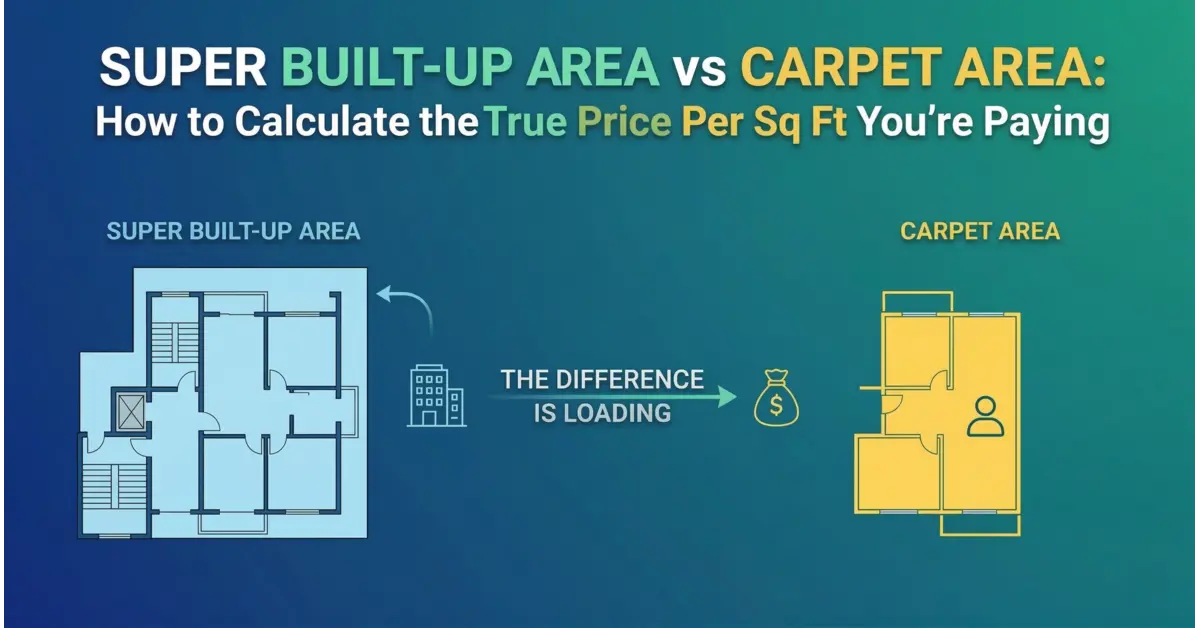
The difference between Super Built-Up Area vs Carpet Area is that carpet area refers to the actual usable floor space inside an apartment, while super built-up area includes carpet area plus a proportionate share of common spaces like lifts, staircases, and lobbies.
- Carpet area = usable living space inside the apartment
- Built-up area = carpet area + walls + balconies
- Super built-up area = built-up area + common areas
- Real price per sq ft should always be calculated using carpet area
Table of Contents
Did you know the usable space in your apartment may be 25–30% smaller than what builders advertise? This startling reality often stems from widespread confusion between Super Built-Up Area vs Carpet Area. While developers typically quote prices based on the larger super area to make the per-square-foot rate appear more attractive, the actual space available for your furniture is significantly less. This discrepancy affects the actual usable space in a property and directly impacts your long-term financial commitments, including maintenance and taxes. This guide explains the difference between these measurements and how to calculate the real cost per usable square foot.
What are Carpet Area, Built-Up Area, and Super Built-Up Area?
Understanding these terms is essential for accurately evaluating property value, comparing projects, and knowing the actual usable living space you are paying for.
Carpet Area Meaning
Simply put, carpet area means the exact space where you can literally spread a carpet. Under the RERA Act of 2016, the legal definition includes internal partition walls but specifically excludes external walls, service shafts, and exclusive balconies.
Built-Up Area Meaning
The built up area meaning represents the total space physically covered by the individual residential unit. It is calculated as the carpet area plus the thickness of both internal and external walls, along with exclusive balconies and utility areas. This measurement is typically 10% to 20% larger than the carpet area and is often used by local municipal bodies to calculate property taxes.
Super Built-Up Area Meaning
Also known as the saleable area, this is the total area for which a buyer is typically charged. It includes the built-up area and a proportionate share of common project facilities, such as lobbies, staircases, lifts, and clubhouses. The more amenities a project offers, the higher the loading factor becomes. Typically, the built-up area is 10–20% larger than the carpet area, while the super built-up area is 20–40% larger than the usable living space.
Why Understanding These Area Measurements Matters?
These terms significantly influence how property prices are calculated and how much usable space a buyer actually receives.
Accurate Pricing & Value Assessment
By focusing on the Carpet Area, you can calculate the "True Price" and compare different projects on an equal footing. For instance, a ₹90 lakh flat with 1,500 sq. ft. super area may seem cheap, but at 1,000 sq. ft. of carpet area, you pay ₹9,000 per sq. ft.
Loan Eligibility & Property Valuation
Banks and financial institutions primarily consider the Carpet Area (or sometimes the Built-Up Area) when determining a property's actual market value. Overestimating usable space based on Super Built-Up figures can lead to significant confusion during the loan approval process and may result in a lower-than-expected loan amount. Buyers must provide lenders with accurate measurements to ensure their financing covers the purchase price and avoid a sudden shortfall due to incorrect area reporting.
Recurring Costs: Taxes and Maintenance
In many housing societies, monthly maintenance is calculated based on the total Super Built-Up Area. A higher "loading factor" means you will pay more every month for shared amenities, regardless of how much you use them.
Legal Protection Under RERA
The RERA Act (2016) was introduced to bring transparency by standardising these definitions. Builders must quote and sell based on Carpet Area in all legal documents and marketing materials. If the final delivered Carpet Area is less than what was promised in the agreement, you are legally entitled to a refund for the difference.
Efficient Interior Planning
The Carpet Area is the "net usable area" where you can actually place furniture and move around comfortably. A flat advertised as 1,200 sq. ft. Super Built-Up might offer only 800–850 sq. ft. of usable space, which can drastically affect your interior layout options and storage planning. Knowing the exact dimensions of your rooms allows for better coordination with architects and interior designers, ensuring every square foot of your home is utilised effectively.
5 Reasons Buyers Must Understand Area Types
Many homebuyers focus only on the advertised apartment size, but understanding different area measurements helps reveal a property's true value, usable space, and real cost.
- Real usable space: Carpet area represents the actual livable space inside the apartment where furniture can be placed and daily activities take place. It helps buyers understand the true size of their home.
- Correct price comparison: Knowing the difference between carpet, built-up, and super built-up areas allows buyers to accurately compare the actual price per square foot across different projects.
- Avoid builder marketing tricks: Some developers advertise larger super built-up areas to make apartments appear bigger. Understanding area types helps buyers identify the real usable size behind marketing claims.
- Better resale valuation: Properties with higher carpet area ratios are generally more attractive to future buyers, which can improve resale value and long-term property appreciation.
- Transparency under RERA: Under the Real Estate Regulatory Authority (RERA), developers must clearly disclose the carpet area, providing buyers with greater transparency and reducing confusion in property transactions.
Super Built-Up Area vs Carpet Area: Side-by-Side Comparison
Comparing Super Built-Up Area vs Carpet Area measurements helps buyers accurately assess space utilization and overall property value.
| Feature | Carpet Area | Built-Up Area | Super Built-Up Area |
| Definition | Net usable floor space inside the apartment for furniture and living. | Carpet area plus the thickness of internal and external walls, including balconies and utility spaces. | Built-up area plus the proportionate share of common spaces like lobbies, corridors, staircases, lifts, and amenities. |
| Includes walls | No. Wall thickness is excluded | Yes. Both internal partition walls and external structural walls are included. | Yes. Includes all walls as part of the built-up component of the calculation. |
| Includes balconies / utility areas | No. Balconies, terraces, and utility spaces are excluded. | Yes. Balconies, flower beds, and utility areas are included | Yes. Since super built-up includes built-up area, balconies and utilities are also included. |
| Includes common areas | No. Shared spaces like lobbies, corridors, staircases, lifts, and clubhouse areas are excluded. | No. The built-up area includes only the space within the apartment structure. | Yes. A proportionate share of common spaces like corridors, elevators, lobby areas, and amenities is added. |
| Represents actual usable space | Yes. Carpet area represents the true living space available inside the apartment. | Partially. Some of the space includes structural elements like walls. | No. A large portion includes shared spaces not exclusively usable by the buyer. |
| Used for pricing apartments | Rarely used historically, but increasingly used due to regulatory requirements. | Sometimes used in older projects or smaller developments. | Mostly used by builders because it increases the saleable area of the apartment. |
| Typical percentage compared to super built-up area | Usually about 60–75% of the super built-up area in most Indian residential projects. | Typically, 70–85% of the super built-up area, depending on design and amenities. | Represents 100% of the saleable area advertised by builders in many projects. |
| Transparency for buyers | Most transparent measurement because it shows the actual usable living space. | Moderately transparent but includes structural components that reduce usable space. | Least transparent because it includes shared areas not directly usable by the buyer. |
| Importance when comparing flats | Most important metric for buyers when comparing different properties. | Useful for understanding structural space but less important for living comfort. | Useful only for understanding builder pricing but not for assessing real usable space. |
What Is the Loading Factor?
The loading factor is the percentage of common area added to your carpet area, serving as a 'markup' for lobbies, elevators, and gardens.
Formula block:
Loading Factor = (Super Built-Up Area – Carpet Area) ÷ Carpet Area
Example:
- Carpet area = 1000 sq ft
- Super built-up = 1400 sq ft
- Loading factor = 40%
In most standard Indian apartments, a loading of 25%–35% is considered normal. Anything above 40% is high and typical of luxury projects with extensive amenities.
How Builders Calculate Super Built-Up Area?
Developers determine the Super Built-Up Area by combining an apartment's constructed space with a share of the building’s common facilities, like lobbies, corridors, lifts, and amenities. This method distributes shared spaces across all units, making the super built-up area the total saleable area buyers pay for.
Built-Up Area Calculation
The built-up area calculation is the first step for any developer. The standard formula used is:
Built-Up Area = Carpet Area + Wall Thickness + Balcony Area
This figure defines the entire area occupied by your specific unit on the building's floor plate.
Super Built-Up Area Calculation
Developers then add shared spaces to the built-up area. There are two primary ways builders arrive at this number:
- Based on Built-Up Area and Common Spaces:
- Proportionate Share: If 50 identical flats share 10,000 sq ft of common area, each flat adds 200 sq ft to its Super Built-Up figure.
- Based on the Loading Factor (Most Common):
- Builders often use a multiplier to calculate this based on the carpet area quickly.
- Super Built-Up Area = Carpet Area × (1 + Loading Factor %)
Example Calculation:
Suppose a carpet area calculator determines your flat is 900 sq ft and the project has a loading factor of 30%.
Super built-up area:
900 × 1.3 = 1170 sq ft
In this case, you pay for 1170 sq ft but can only use 900 sq ft for living.
How to Calculate the True Price Per Sq Ft You're Actually Paying?
To find the true price per square foot for living space, divide the Total Cost by the Carpet Area, not the Super Built-Up (SBU) area used in marketing. This transparency is a key part of any home buying checklist and ensures you don't overstretch your budget.
Step 1: Identify the Carpet Area
Before calculating a property's true price, first identify the RERA-defined carpet area in the sale agreement or project documents. This represents the actual usable space inside the apartment and is the most accurate for comparing prices.
Example flat:
- 1400 sq ft super built-up
- 980 sq ft carpet area
Step 2: Calculate Actual Price Per Sq Ft
Once you know the carpet area, the next step is to calculate the real price per square foot you are paying. Builders often advertise prices based on the super built-up area, which can make the property appear cheaper than it actually is.
Suppose the quoted rate is ₹6,000 per sq ft (based on SBU).
Total Cost = Quoted Rate × Super Built-Up Area
Total Cost = ₹6,000 × 1400 = ₹84,00,000
True Price = Total Cost / Carpet Area
True Price = ₹84,00,000 / 980 = ₹8,571 per sq ft
In this scenario, while the brochure says ₹6,000, you are effectively paying ₹8,571 for every usable square foot.
Step 3: Add Ownership Costs
To understand the full cost of buying a property, include additional ownership expenses like registration fees, stamp duty, taxes, and interior costs, which greatly increase the total investment.
Beyond the flat price, you must factor in property registration costs.
| Cost Type | Approximate Percentage/Amount |
|---|---|
| Registration Fees | 6–7% of property value |
| GST (Goods and Services Tax) | 1–5% depending on project stage |
| Stamp Duty | 5–7% depending on state |
| Interior Works | ₹5–10 lakh for a standard flat |
| Maintenance Deposit | ₹1–2 lakh |
Example Total Cost:
For an ₹84 lakh flat, the actual "on-road" cost might be:
- Flat price: ₹84L
- Registration & Taxes: ₹10L
- Interiors & Misc: ₹9L
- Total: ₹1.03 Crore
Real Carpet Price
₹1,03,00,000 / 980 sq ft = ₹10,510 per sq ft
This is the true price you are paying for every usable square foot of your new home.
Common Mistakes Buyers Make When Comparing Flats
Understanding common mistakes during property evaluation helps buyers focus on carpet area, loading factors, and true pricing, ensuring a more accurate and fair comparison between different projects.
- Comparing "Headline Price" Instead of "True Price": Choosing a flat based on low ad rates without verifying carpet area; developers often inflate SBA to make the "price per sq ft" appear lower.
- Ignoring the "Loading Factor": Paying 40-50% loading in projects with extensive amenities you may never use. High-end projects can have extreme loading for large common spaces you rarely visit.
- Underestimating Hidden and Statutory Costs: Failing to account for mandatory fees not included in the "Base Selling Price." This includes calculating EMI which should be based on the total cost (like ₹1.03 Cr), not just the base price.
- Overlooking the RERA Carpet Area Disclosure: Trusting old terms like "Saleable Area" without checking RERA-approved plans can be risky. RERA states if the final carpet area is over 3% less than promised, you're entitled to a refund with interest.
- Falling for Amenities Over Floor Plans: Buying a flat for infinity pools or sky lounges while ignoring poor layout or low ventilation. You'll live in your rooms daily; the clubhouse is occasional.
Conclusion
Understanding carpet, built-up, and super built-up areas helps homebuyers avoid overpaying and focus on actual usable space instead of misleading price metrics. Platforms like NoBroker provide transparent, RERA-compliant property listings with clear area details.
Key Takeaways:
- Carpet area represents the actual usable living space inside the apartment
- Built-up area includes carpet area along with walls and balconies
- Super built-up area includes built-up area plus a share of common amenities
- Always calculate the real price per sq ft using the carpet area
- Check the loading factor to understand how much common area is added
Final Note:
Explore NoBroker today to compare properties based on real usable space and make a smarter, well-informed home-buying decision.
Frequently Asked Questions
Carpet area is usable floor space, built-up area includes walls and balconies, while super built-up area adds common areas like corridors, lobbies, and amenities.
Divide the total property price, including taxes and charges, by the carpet area. This gives the actual price per square foot of usable living space.
Add stamp duty, registration fees, GST (if applicable), parking charges, maintenance deposits, and interior costs to the base property price.
Include stamp duty, registration fees, GST, legal fees, parking, maintenance deposits, interior costs, and society formation charges when estimating total property purchase costs.
RERA defines carpet area as the net usable floor area within apartment walls, excluding external walls, balconies, terraces, and service shafts.
Super built-up area includes the apartment’s built-up area plus a proportionate share of common spaces like lobbies, staircases, elevators, and clubhouse areas.
Most builders price apartments based on super built-up area, as it includes shared amenities and common spaces, increasing the saleable area.
Loading factor is the difference between super built-up area and carpet area. It is calculated as: (Super Built-up Area − Carpet Area) ÷ Carpet Area.
Divide the super built-up area by the loading factor percentage. Typically, carpet area equals about 65–75% of the super built-up area.
In most Indian residential projects, carpet area usually ranges between 60% and 75% of the super built-up area depending on project design and amenities.
Carpet area is more important because it represents the actual usable space inside your apartment, helping buyers compare true living space between properties.
Builders use super built-up area to include shared spaces and amenities in pricing, thereby increasing the saleable area and the apartment's perceived size.
Enter the super built-up area and loading percentage in a calculator to estimate carpet area, helping you understand the actual usable space inside the apartment.
Yes. Under RERA regulations, builders must disclose and sell apartments based on carpet area to ensure transparency in property size and pricing.
Recommended Reading
GST on Property Purchase in India: Under-Construction vs Ready-to-Move Explained
March 23, 2026
101+ views
Super Built-Up Area vs Carpet Area: How to Calculate the True Price Per Sq Ft You’re Paying
April 2, 2026
20+ views
Most Viewed Articles

Franking Charges Explained: Meaning and Benefits
January 31, 2025
1117137+ views
Society Maintenance Charges : Meaning, Cost, Types and Calculation
January 31, 2025
203856+ views

Daughter's Right in Fathers' Property - the Law is Finally Equal for both Genders?
June 1, 2025
147653+ views

BBMP E-Khata Registration process for property owners in Bangalore, Karnataka in 2025
March 19, 2025
145603+ views

Rectification Deed Format and Process in India 2026
June 1, 2025
137495+ views
Author
Loved what you read? Share it with others!
Recent blogs in
Super Built-Up Area vs Carpet Area: How to Calculate the True Price Per Sq Ft You’re Paying
April 2, 2026 by bikram
The Complete Document Checklist For Buying a Property in India
March 31, 2026 by bikram
Force Majeure Clause in Lease Agreement: Meaning, Applicability & Impact on Rent
March 31, 2026 by Ananth
How to do Property Title Search in India: EC, Litigation Check & Title Clearance Checklist
March 30, 2026 by bikram
Commercial Sublease Agreement: Meaning, Key Elements & How It Works
March 27, 2026 by Ananth










 Full RM + FRM support


Join the conversation!