- https://razorpay.com/learn/gst-on-flat-purchase/
- https://www.kotak.bank.in/en/stories-in-focus/loans/home-loan/how-to-calculate-gst-on-under-construction-flats.html
- https://www.livehomes.in/blog-details/GST-on-Residential-Property-in-India-2026
- https://www.mondaq.com/india/sales-taxes-vat-gst/1616988/gst-on-flat-purchase-in-india-2025-rates-exemptions
- https://legalassure.in/blogs/ready-to-move-vs-under-construction-a-strategic-guide-to-tax-gst-and-tds
- https://www.brigadegroup.com/blog/residential/gst-under-construction-vs-ready-to-move
- https://razorpay.com/learn/gst-on-flat-purchase
- https://www.grihashakti.com/knowledge-centre/calculate-gst-on-under-construction-flats.aspx
- https://www.sobha.com/blog/https-www-sobha-com-blog/
- https://legalassure.in/blogs/ready-to-move-vs-under-construction-a-strategic-guide-to-tax-gst-and-tds
Table of Contents
Under-Construction vs Ready-to-Move Quickly ExplainedWhat is GST on an Under-Construction Property?GST Rates on Property Purchase in IndiaDoes 5% GST Apply to the Entire Property Value?GST on Under Construction vs Ready-to-Move Property What is GST on Ready-to-Move Flats?Which is Better for First-Time Buyers in 2026?How to Calculate GST on Property Purchase (Step-by-Step)?Common Mistakes Buyers Make with GST on PropertyHow NoBroker Can HelpFAQs on GST on Property Purchase
Loved what you read? Share it with others!


Home
Blog
Real Estate Legal Guide & Laws
GST on Property Purchase in India: Under-Construction vs Ready-to-Move Explained
GST on Property Purchase in India: Under-Construction vs Ready-to-Move Explained
Updated : March 23, 2026, 2:38 PM
Author :

Table of Contents
Under-Construction vs Ready-to-Move Quickly ExplainedWhat is GST on an Under-Construction Property?GST Rates on Property Purchase in IndiaDoes 5% GST Apply to the Entire Property Value?GST on Under Construction vs Ready-to-Move Property What is GST on Ready-to-Move Flats?Which is Better for First-Time Buyers in 2026?How to Calculate GST on Property Purchase (Step-by-Step)?Common Mistakes Buyers Make with GST on PropertyHow NoBroker Can HelpFAQs on GST on Property Purchase
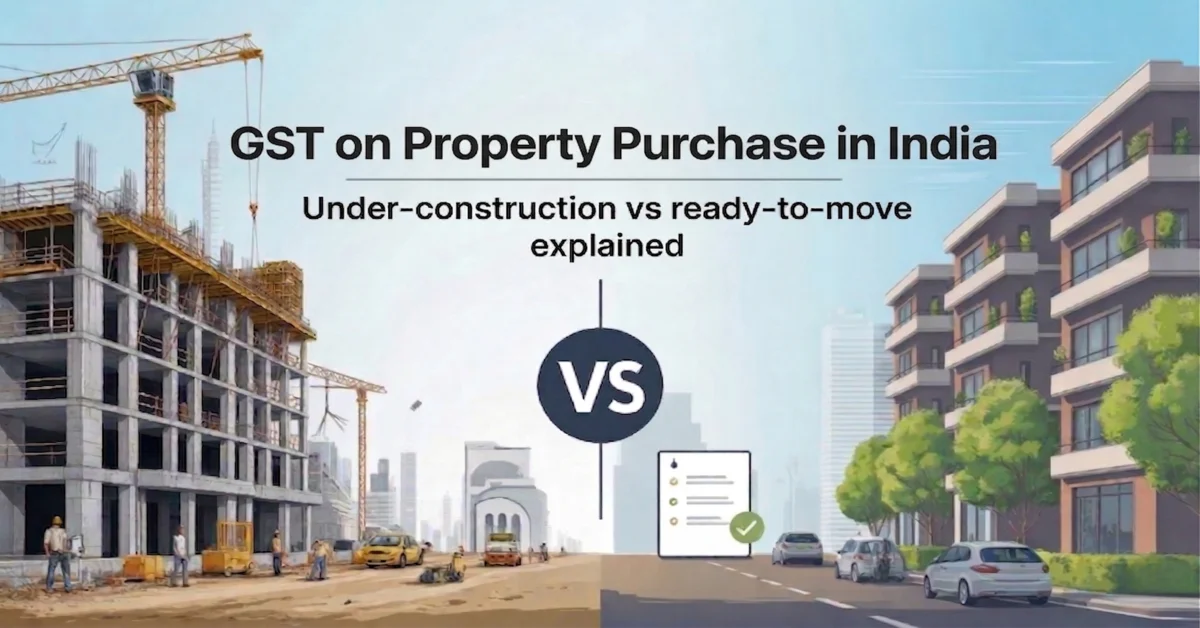
Navigating the financial landscape of real estate in India often leads to significant confusion regarding tax liabilities. One of the most discussed topics is the application of GST on Under-Construction Property. Since the introduction of the Goods and Services Tax, the way homebuyers calculate their total outflow has changed fundamentally. Understanding the distinct difference between an under-construction unit and a ready-to-move-in flat is essential, as the tax implications can vary by lakhs of rupees.
Under-Construction vs Ready-to-Move Quickly Explained
- GST applies only to under-construction property: Ready-to-move properties with a Completion Certificate are treated as a sale of immovable property and are exempt.
- Residential under-construction flats attract a 5% GST rate: this rate applies to standard housing projects where the developer does not claim an Input Tax Credit.
- Affordable housing attracts 1% GST: To qualify, the property value must be up to ₹45 Lakhs with specific carpet area limits in metros.
- Ready-to-move flats with an OC are GST-exempt: Once an Occupancy Certificate is issued, the transaction is no longer considered a "service" and attracts zero GST.
- Commercial property under construction attracts 12% GST: Offices and shops fall under this higher bracket, though developers can often claim Input Tax Credit here.
What is GST on an Under-Construction Property?
When you book an under-construction property, the developer is considered to be providing you with a construction service. According to the law, this service is taxable until the local municipal authority issues an Occupancy Certificate (OC) or a Completion Certificate (CC). Once that document is granted, the "service" is considered complete, and any subsequent sale is treated as a transfer of immovable property, which falls entirely outside the scope of GST. This distinction is vital for buyers to understand because the tax represents a significant portion of the total acquisition cost in the primary real estate market. (1)(2)
GST for Apartments and Residential Flats
The application of GST to apartments is primarily divided into two categories: affordable and non-affordable housing. Affordable housing, which attracts a low 1% rate, is strictly defined by a price cap of ₹45 Lakhs and specific carpet area limits of 60 sq. m. in metros and 90 sq. m. elsewhere. For all other residential flats, including luxury projects and high-end villas, a standard 5% rate is applicable. It is important to note that since 2019, builders for residential projects are generally not allowed to claim Input Tax Credit (ITC), which simplifies the final tax calculation for the average homebuyer. This "no-ITC" regime ensures that the benefits of lower tax rates are passed directly to the consumer without complex accounting requirements.
GST on Property vs Other Taxes
While GST is a significant component, it does not replace the existing state-level taxes. It is vital to understand how these charges interact to avoid budgeting errors during your purchase.
| Tax Type | Applies To | Purpose |
|---|---|---|
| GST | Under-construction property | Tax on construction services |
| Stamp Duty | All property types | Property registration with the government |
| Registration Charges | All property types | Formalizing ownership transfer |
GST Rates on Property Purchase in India
The current tax structure for real estate in India is designed to offer lower, more manageable rates for residential buyers in exchange for the removal of the Input Tax Credit (ITC). This "no-ITC" regime ensures that the 1% and 5% rates are the final, absolute amounts the builder can charge you on the construction value. For business-related assets, the GST on commercial property under construction remains at a standard 12%, allowing developers to offset their costs through ITC. (3)(4)
GST Rates (2026)
| Property Type | GST Rate | Input Tax Credit (ITC) |
|---|---|---|
| Affordable housing | 1% | Not Available |
| Under-construction residential property | 5% | Not Available |
| Commercial property under construction | 12% | Available |
| Ready-to-move property | 0% | Not Applicable |
GST on Flat Purchase: Example Calculation
When calculating GST on flat purchase, you must apply the 33% land deduction rule. The government acknowledges that land itself is not a service; therefore, one-third of the total agreement value is exempt from GST. Effectively, you only pay tax on 66.67% of the total price.
Example Block:
- Total Flat cost: ₹80 lakh
- Land deduction (33%): ₹26.40 lakh
- Taxable value (Construction component): ₹53.60 lakh
- GST calculation (5% of ₹53.60L): ₹2.68 lakh
- Final cost (including GST): ₹82.68 lakh
Does 5% GST Apply to the Entire Property Value?
A common misconception among homebuyers is that the 5% tax is levied on the full agreement value, such as an ₹80 lakh price tag. In reality, the law provides a mandatory deduction of one-third (33%) as the deemed cost of land. This ensures that the tax is applied only to the construction value provided by the developer, not to the land itself. This deduction is a standard rule across India, regardless of the land's actual market value in specific expensive metro cities. This provides a uniform and transparent method for calculating GST on property transactions, ensuring that buyers pay tax only on the service component of their real estate purchase. (5)(6)
GST on Under Construction vs Ready-to-Move Property
The issuance of the Occupancy Certificate is the ultimate "tax-trigger" document in Indian real estate. For an under-construction project, you pay GST on every instalment as work progresses. In contrast, the GST on ready-to-move property with a valid OC is entirely exempt because it is no longer classified as a service. This difference can significantly impact your upfront costs and overall budget. While under-construction properties offer lower base prices, the GST on ready-to-move homes and the advantage of immediate possession provide a tax-free status that many buyers prefer for a completed residential unit. (10)
Comparison Factors - Under Constrution and Ready to Move Property
| Factor | Under-Construction Property | Ready-to-Move Property |
|---|---|---|
| GST | 1% to 5% | Zero (Exempt) |
| Possession | Future date (Risk of delay) | Immediate |
| Risk | High (Construction quality/timing) | Low (What you see is what you get) |
| Customization | Possible during construction | Limited to interiors |
| Price | Generally, a lower base price | Premium for completion |
What is GST on Ready-to-Move Flats?
Once the developer receives the Completion Certificate or Occupancy Certificate, the building is no longer legally considered a service being provided to a customer. Instead, it transitions into the category of "immovable property." Under the GST Act, the sale of immovable property is specifically excluded from the tax net. Consequently, buyers who prioritise immediate savings often look for completed projects. By choosing these GST-ready-to-move flats, they only need to account for state-level Stamp Duty and Registration charges, thereby completely avoiding the additional 5% or 1% GST burden that applies to units still under development.
Which is Better for First-Time Buyers in 2026?
Choosing between under-construction and ready-to-move properties can be challenging for first-time homebuyers in 2026. Each option has advantages based on your finances, goals, and urgency. Under-construction homes are cheaper and offer flexible payment options, while ready-to-move homes offer immediate possession and lower risk.
Under-construction is better if:
- Lower purchase price: These properties typically have a 10–20% discount compared to finished units, enabling buyers to afford a modern home on a tighter budget.
- Long-term investment: Such units have higher potential for capital appreciation as the project hits key milestones. Early investors often see asset values grow significantly by possession.
- Flexible payment plan: Pay in instalments linked to construction stages instead of a lump sum, reducing immediate burden and improving cash flow management.
Ready-to-move is better if:
- Immediate possession: Move into your new home immediately after purchase to avoid ongoing rent and long building waits.
- Lower risk: There is no risk of the project stalling or the builder defaulting on quality. You can inspect the final structure and amenities before paying.
- Rental income potential: Begin earning rental income immediately to offset your home loan EMI, turning the property into a performing asset from day one for quick financial relief and stability.
How to Calculate GST on Property Purchase (Step-by-Step)?
Since GST applies mainly to under-construction properties, it is important to follow a clear calculation method. By checking the property type, construction status, and applicable deductions, buyers can estimate the accurate GST amount before finalizing the purchase. (7)(8)(9)
- Step 1 – Identify the property type: Classifying the property as purely residential, commercial, or mixed-use is vital because it determines the applicable tax rate and ensures you apply the correct legal category in your financial calculations.
- Step 2 – Verify construction status: Check if the builder has already received the official Occupancy Certificate (OC) from the local authorities. If the OC is in place, the project is considered a completed sale of immovable property, meaning your total GST liability is effectively zero.
- Step 3 – Check affordable housing eligibility: Confirm if the total property value is under ₹45 Lakhs and ensure the carpet area fits the specific metro or non-metro limits. Meeting these strict criteria allows you to qualify for the highly reduced 1% tax rate instead of 5%.
- Step 4 – Deduct land value (33%): You must subtract one-third of the total agreement value as the deemed cost of the land. This mandatory government deduction ensures that you are only paying the tax on the actual construction services provided, rather than the non-taxable raw land value.
- Step 5 – Apply GST rate: Multiply the remaining two-thirds of the property value by either the 1% or 5% rate, depending on the category identified earlier. This step provides the final tax amount due to the developer for the construction service portion of your purchase.
- Step 6 – Include additional charges: Be aware that external charges for the clubhouse, parking, or preferential location may attract a higher GST rate of 18% if billed separately. You must review your demand letter carefully to ensure these additional services are accounted for in your budget.
Common Mistakes Buyers Make with GST on Property
Understanding common GST-related mistakes helps buyers avoid financial surprises, verify correct tax charges, and maintain transparency with developer while purchasing.
- Assuming GST applies to ready-to-move property: Many buyers mistakenly calculate GST on completed projects, unaware that OC status exempts them from GST. Legally, once a property receives a Completion Certificate, it is no longer a "service" but an immovable asset, and is exempt from GST.
- Ignoring the occupancy certificate status: Failing to check the OC date can cause paying tax on a completed project. If the builder gets the certificate before you sign or pay, the transaction is exempt, saving 5%.
- Confusing GST with stamp duty: Remember that GST is a central tax on services, while stamp duty is a state-level tax on the registration of the sale deed. Both are mandatory for under-construction homes, and paying one does not exempt you from the other.
- Not checking builder GST registration: Always verify the builder's GSTIN to ensure the tax paid is remitted to the government. If a developer is not registered or uses a fake ID, a valid tax invoice will not be received, making it impossible to prove payment to authorities.
- Ignoring GST on additional charges: Maintenance fees above ₹7,500 per month, attracting 18% GST in larger housing societies, is a common error. This tax applies to the entire maintenance amount if the threshold is crossed, significantly increasing monthly living expenses.
How NoBroker Can Help
Understanding GST rules for property purchases in India helps buyers make smarter financial decisions. GST applies only to under-construction property, as the construction activity is a taxable service. Buyers must pay 5% GST on under-construction flats, while affordable housing is subject to 1%, making it more budget-friendly. Ready-to-move properties are GST-exempt if they have a valid Occupancy Certificate (OC). Buyers should always check the project’s OC status and review the builder’s tax breakdown before payments to ensure correct GST application and avoid surprises. And to get details on RERA-verified, under-construction, and ready-to-move-in properties, trust no one but NoBroker. Find the best properties in your preferred location with zero brokerage. Connect today!
FAQs on GST on Property Purchase
What is GST on an under-construction property in India?
It is a tax levied on construction services provided by developers. For residential units, the rate is 5% for standard housing and 1% for affordable housing, calculated on the construction value after a mandatory one-third land deduction.
Is GST applicable to ready-to-move flats?
No, GST does not apply to ready-to-move flats that have already received an Occupancy Certificate. Such transactions are legally treated as the sale of immovable property, which falls entirely outside the scope of the Goods and Services Tax.
Can homebuyers claim input tax credit on GST?
Under the current tax regime, residential homebuyers are not eligible to claim Input Tax Credit. The lower rates of 1% and 5% were specifically introduced by the government to replace the older system that allowed builders to pass on credit.
What is GST on commercial property under construction?
Under-construction commercial properties, such as offices and retail shops, attract a higher GST rate of 12%. Unlike residential projects, developers in the commercial sector can often claim Input Tax Credit, which helps them manage their overall project construction costs.
Do buyers pay GST on resale property?
No, buyers do not pay GST on resale properties purchased from individual owners in the secondary market. Since these properties are already completed and possess an Occupancy Certificate, they are classified as immovable property and remain GST-exempt.
Recommended Reading
GST on Purchase of Residential Property: Tax Rates and Exemptions Impact on Buyers in India
August 31, 2025
6190+ views
GST on Property Purchase in India: Under-Construction vs Ready-to-Move Explained
March 23, 2026
21+ views
ARTICLE SOURCES
Most Viewed Articles

Franking Charges Explained: Meaning and Benefits
January 31, 2025
1117022+ views

Society Maintenance Charges : Meaning, Cost, Types and Calculation
January 31, 2025
202804+ views

Daughter's Right in Fathers' Property - the Law is Finally Equal for both Genders?
June 1, 2025
146894+ views

BBMP E-Khata Registration process for property owners in Bangalore, Karnataka in 2025
March 19, 2025
145603+ views

Rectification Deed Format and Process in India 2026
June 1, 2025
136952+ views
Author
Loved what you read? Share it with others!
Recent blogs in
Difference Between Perpetual Lease Deed and Conveyance Deed: Meaning & Key Features
March 23, 2026 by Ananth
Lease Deed of Immovable Property: Meaning, Legal Requirements & Execution Process
March 23, 2026 by Ananth









 Full RM + FRM support


Join the conversation!