Table of Contents
Loved what you read? Share it with others!


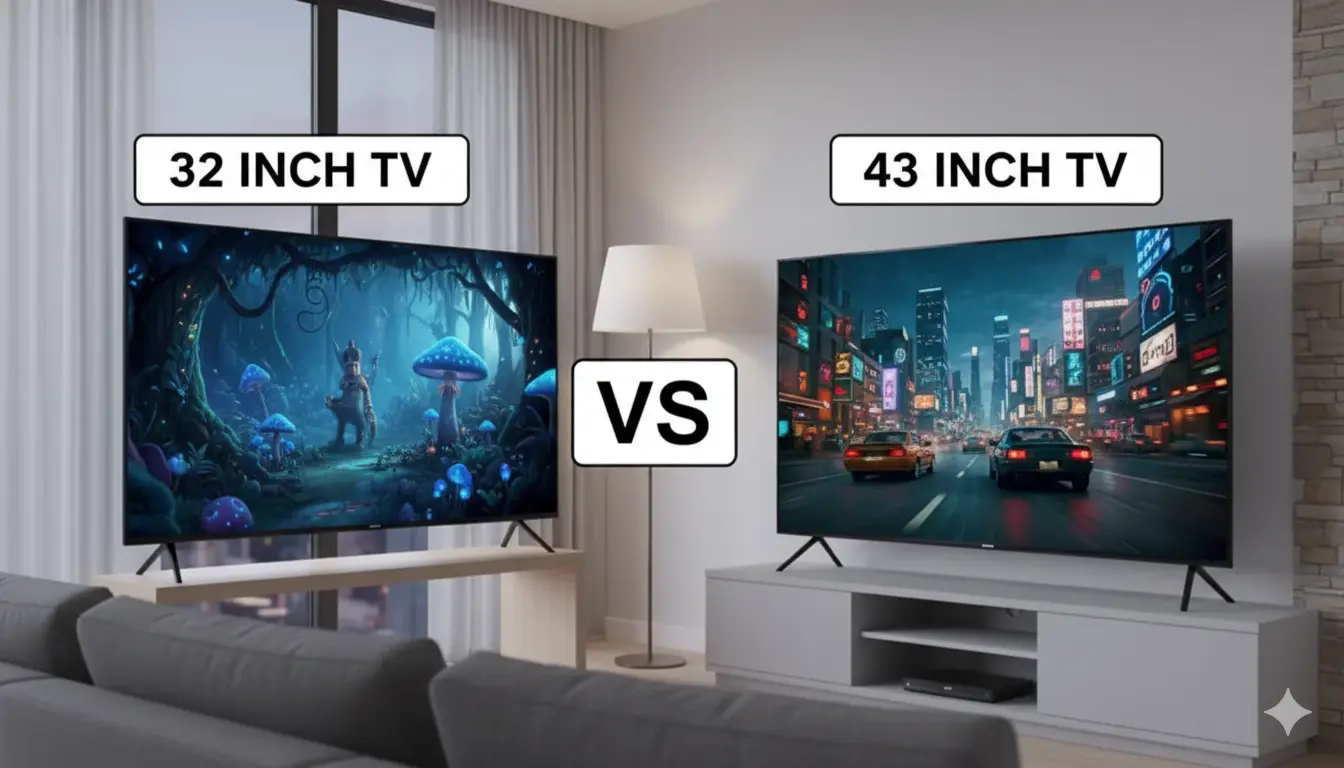
32 Inch TV Vs 43 Inch TV: Size, Resolution, and Viewing Distance Comparison
Updated : November 17, 2025, 1:14 PM
Author :
 Vivek
Vivek
Table of Contents
Choosing a new television involves many decisions, but none is more critical than selecting the right screen size. The size of your TV directly impacts your viewing experience, determining how immersive movies feel and how clearly you see the action. For most buyers, the decision often comes down to two of the most popular sizes on the market. The 32 inch TV vs 43 inch debate represents a choice between a compact, versatile screen and a larger, more cinematic display. This guide will break down the key differences to help you decide which is perfect for your home.
32 Inch TV vs 43 Inch - Quick Comparison Table
To understand the core differences at a glance, this quick comparison table highlights the typical features and ideal use cases for both a 32-inch TV vs 43-inch TV.
| Feature | 32 Inch TV | 43 Inch TV |
|---|---|---|
| Typical Resolution | HD Ready (1366 x 768) | Full HD (1920 x 1080) or 4K UHD (3840 x 2160) |
| Ideal Room Size | Small (Bedrooms, Kitchens, Dorm Rooms) | Medium (Living Rooms, Master Bedrooms, Apartments) |
| Recommended Viewing Distance | Approximately 4 - 6 feet | Approximately 6 - 8 feet |
| Average Price Range | Budget-friendly | Mid-range |
| Common Use Case | Secondary TV, PC monitor, small spaces. | Primary living room TV, immersive viewing. |
| Approx. Screen Area | 438 square inches | 790 square inches (about 80% larger) |
| Smart Features | Basic Smart TV functions, often with less RAM. | Advanced Smart TV features, often with more RAM/storage. |
Screen Size Difference Explained
Understanding the true difference in size is more than just comparing the diagonal measurements. The jump from a 32-inch to a 43-inch screen is surprisingly significant.
Actual Dimensions - 32 vs 43 Inch TV Size Comparison
A common misconception is that a 43-inch TV is simply 11 inches larger than a 32-inch model. However, because the measurement is taken diagonally, the increase in actual screen real estate is much greater. A 43-inch TV has approximately 80% more screen area than a 32-inch TV.
- A typical 32-inch TV is about 27.89 inches wide and 16 inches tall.
- A typical 43-inch TV is about 37.5 inches wide and 21 inches tall.
This substantial increase in both width and height makes the viewing experience on a 43-inch TV feel significantly more immersive and cinematic, which is a key factor in the 43-inch vs 32-inch TV decision.
Viewing Distance & Room Size
The right TV size is directly related to how far you sit from the screen. A TV that is too large for your room can be overwhelming, while one that is too small can make it hard to see details.
Ideal Viewing Distance for a 32-inch TV
For a 32-inch TV, which typically comes with an HD Ready resolution, the ideal viewing distance is between 4 and 6 feet. Sitting within this range allows you to see the picture clearly without individual pixels becoming noticeable. This makes it a perfect fit for smaller spaces like bedrooms, kitchens, or studio apartments, where your seating is naturally closer to the screen.
Ideal Viewing Distance for a 43-inch TV
For a 43-inch TV, the ideal viewing distance is generally between 6 and 8 feet. This allows you to comfortably take in the entire screen without straining your eyes. If you have a 4K model, you can sit closer (around 4-6 feet) to appreciate the extra detail, but the 6-8 feet range is a comfortable average for most living room setups.
Resolution & Picture Quality
The resolution is one of the most significant technical differences you will find when comparing a 32-inch LED TV vs a 43-inch.
- 32-Inch TV Resolution: The vast majority of 32-inch TVs on the market today are HD Ready (1366 x 768 pixels). While this is a lower resolution than Full HD, it is perfectly adequate for this screen size. At a normal viewing distance, the picture appears sharp and clear.
- 43-Inch TV Resolution: In contrast, almost all 43-inch TVs are available in either Full HD (1920 x 1080 pixels) or, more commonly, 4K Ultra HD (3840 x 2160 pixels). A 4K screen has four times the number of pixels as a Full HD screen.
- The 4K Advantage: On a 43-inch screen, the difference between Full HD and 4K is noticeable. 4K resolution provides a much sharper, more detailed, and lifelike image. It also allows for better performance with High Dynamic Range (HDR) content, which offers brighter highlights and deeper blacks for a more vibrant picture.
Sound Quality & Audio Output
While picture quality is paramount, sound is a crucial part of the viewing experience. There are subtle but important differences in the audio capabilities of these two TV sizes.
- Standard Audio Output: Both 32-inch and 43-inch TVs typically come with a standard 20-watt dual-speaker system. This is sufficient for casual viewing of news, TV shows, and YouTube videos in a smaller room.
- Advanced Audio on 43-Inch Models: Larger, more premium 43-inch TVs are more likely to include advanced sound technologies like Dolby Atmos or DTS:X. These features create a more immersive, virtual surround sound experience that you are less likely to find on a budget 32-inch model.
- Recommendation: For a truly cinematic experience, a dedicated soundbar is a highly recommended accessory for either TV size. However, the built-in audio on a higher-end 43-inch TV will generally be superior to that of a standard 32-inch TV.
Smart Features & Connectivity
In today's market, nearly all TVs are smart TVs, but their performance can vary. This is another area where the 43-inch TV vs 32-inch comparison shows clear differences.
- Operating System: Both sizes offer popular operating systems like Google TV, Tizen (Samsung), WebOS (LG), or Fire TV. The user interface will be similar, providing access to all major streaming apps.
- Performance (RAM & Storage): This is a key differentiator. 43-inch TVs often come with more RAM (typically 2 GB) and more internal storage (8 GB to 16 GB). 32-inch models usually have less (1 GB to 1.5 GB of RAM). This extra power in 43-inch models results in a faster, smoother, and more responsive user experience when navigating menus and launching apps.
- Connectivity Ports: 43-inch TVs generally offer more connectivity options. It is common for them to have 3 HDMI ports and 2 USB ports, allowing you to connect a set-top box, a gaming console, and a soundbar simultaneously. Most 32-inch TVs come with only 2 HDMI ports and 1 USB port.
Pricing & Value for Money
Your budget is a major factor in any purchase. Here’s how the two sizes stack up in terms of cost and overall value.
- 32-Inch TV (The Budget Champion): A 32-inch smart TV is the most affordable entry point into the world of smart entertainment. It is the perfect choice if your primary concern is price and you need a functional TV for a secondary room.
- 43-Inch TV (The Value Sweet Spot): While a 43-inch TV costs more, the price increase often delivers a disproportionately large jump in features and quality. For a moderate price difference, you typically get a 4K resolution, a faster processor, more connectivity options, and an 80% larger screen. This makes the 43 vs 32-inch TV a clear win for the 43-inch model in terms of value for money for a primary television.
Use-Case Based Recommendations
Still undecided? Here are some simple use-case scenarios to help you choose the right size for your specific needs.
Choose a 32-Inch TV If:
- You are buying a television for a small space like a bedroom, kitchen, or dorm room.
- You need a secondary TV for casual viewing.
- Your viewing distance will be less than 6 feet.
- You are on a strict budget and want the most affordable smart TV available.
- You plan to use it as a large computer monitor.
Choose a 43-Inch TV If:
- You are buying the main television for a small or medium-sized living room.
- You want a more immersive and cinematic experience for movies and sports.
- You own a modern gaming console (like a PS5 or Xbox Series X) and want to experience 4K gaming.
- You value a smoother, faster smart TV experience and need more connectivity ports.
- You see the TV as a long-term investment and want future-proof features like 4K resolution.
Final Verdict - 32 Inch or 43 Inch TV?
Ultimately, the choice in the 32-inch TV vs 43-inch debate comes down to three factors: space, purpose, and budget. The 32-inch TV is an excellent, cost-effective choice for secondary spaces or when affordability is the top priority. However, for a primary viewing screen in most homes, the 43-inch TV offers a significantly better experience. The 80% larger screen, superior 4K resolution, and enhanced smart features provide a substantial upgrade that justifies the moderate price difference, making it the better choice for most users.
Frequently Asked Questions
A: While the diagonal is 11 inches longer, a 43-inch TV has approximately 80% more screen area than a 32-inch TV, making it feel significantly larger and more immersive.
Ans: Yes, a 43-inch TV can work well in a small room if your viewing distance is at least 5-6 feet. It can provide a very cinematic experience in a compact living space.
Ans: Yes, at a normal viewing distance of 5-8 feet, the difference between a Full HD and a 4K 43-inch TV is noticeable. The image is sharper, text is clearer, and details are more refined.
Ans: Even if you watch HD content, a 4K TV is beneficial. Modern 4K TVs have excellent upscaling technology that makes HD content look sharper and better than it would on a native HD screen.
Ans: The best viewing distance for a 32-inch HD TV is around 4-6 feet. For a 43-inch Full HD or 4K TV, the ideal range is between 6 and 8 feet.
Most Viewed Articles

LG Fridge Vs Samsung Fridge: Comparing Features, Price & Performance in 2026
September 12, 2025
9404+ views
LG vs Samsung Washing Machine: Feature Comparision, Price & Performance 2026
August 28, 2025
8555+ views
IFB vs LG Washing Machine: Feature Comparison, Price & Performance 2026
October 30, 2025
7067+ views
What is the BEE Star Rating? Meaning, Calculation, Importance, and How It Works
September 30, 2025
6855+ views

10 Best Geyser Brands for Indian Homes - Top Models & Budget Options
December 3, 2025
6838+ views
Author
Loved what you read? Share it with others!
Recent blogs in
Geyser Not Turning On - Common Reasons, Troubleshooting Tips and Easy Fixes at Home
January 26, 2026 by srivalli susarla
10 Best Geyser for Hard Water in India: Types, Top Brands and Features in 2026
January 6, 2026 by Krishnanunni H M
Why Is Your Geyser Making Noise: Causes and Easy Troubleshooting Tips in 2026
December 31, 2025 by Priyanka Saha








 Full RM + FRM support


Join the conversation!