18 Elegant Veneer Door Designs to Elevate Your Home Entrance in 2026


9K Views
Table of Contents
Summary
Looking to elevate your home entrance with the rich warmth of natural wood without the warping risks of solid panels? This comprehensive guide showcases 18 stunning veneer door designs for 2026 to transform your space. From minimalist flush configurations and grand double-door main entries to classic teak grains, space-saving barn sliders, and high-impact pivot frames, we break down options for every room.
Veneer door designs use a thin layer of natural wood over a stable core, such as plywood or MDF, allowing consistent grain and finish without the movement seen in solid wood. They suit modern interiors where material control, finish quality, and long-term stability matter. Compared to solid wood, veneer doors reduce cost variation and surface inconsistencies while still retaining a natural wood appearance.
Unlike solid wood doors, which are made from a single material, veneer doors combine layers. This makes them more suitable for Indian conditions, where temperature and moisture levels can change throughout the year. This guide covers different veneer door design ideas, types, finishes, and cost insights to help you choose what works best for your home.
About Veneer Door Designs
A veneer door uses a thin layer of natural wood bonded to a stable core such as plywood or MDF, combining surface richness with structural consistency. It allows controlled grain patterns, uniform finishes, and better stability than solid wood across multiple doors within the same space.
Recommended Reading

Best 3 Bedroom House Plans: Modern and S...
78.3K Views

30+ Front Gate Design Ideas for Houses: ...
55.5K Views

South Indian Village House Design: 15 Tr...
36.4K Views

HDHMR vs Plywood: Price, Durability &...
28.1K Views

Wooden Partition Walls for Living Room -...
27.7K Views
Types of Veneer Door Designs
Veneer door designs differ based on how the surface looks and how the door is built. Each type creates a distinct visual style, from plain flat finishes to detailed panel patterns used in main doors.
- Flush Door Veneer Design
A completely flat door with a smooth veneer sheet across the surface. No grooves or patterns, just a clean wood finish from edge to edge. - Panelled Veneer Door Design
The door is divided into sections using frames or grooves. These panels may be square or rectangular, giving the door a more detailed and structured look. - Veneer Double Door Design
Two shutters are placed side by side, often wider and taller than regular doors. Usually seen at entrances, creating a bold and balanced front appearance. - Teak Veneer Door Design
Features a rich brown wood finish with visible grain patterns. The texture and colour resemble natural teak, giving a warm and classic look. - Bedroom Veneer Door Design
Among all bedroom door design ideas, a veneer option with minimal design and softer wood tones works best - keeping the space calm and uncluttered without sacrificing the natural wood aesthetic.
18 Veneer Door Designs That Bring Elegance and Style to Your Home
Here are 18 veneer door designs that reflect current preferences in Indian homes, ranging from simple finishes to detailed main door options, helping you choose based on use, space, and overall home style.
1. Minimalist Veneer Door Design with Flat Panel Finish
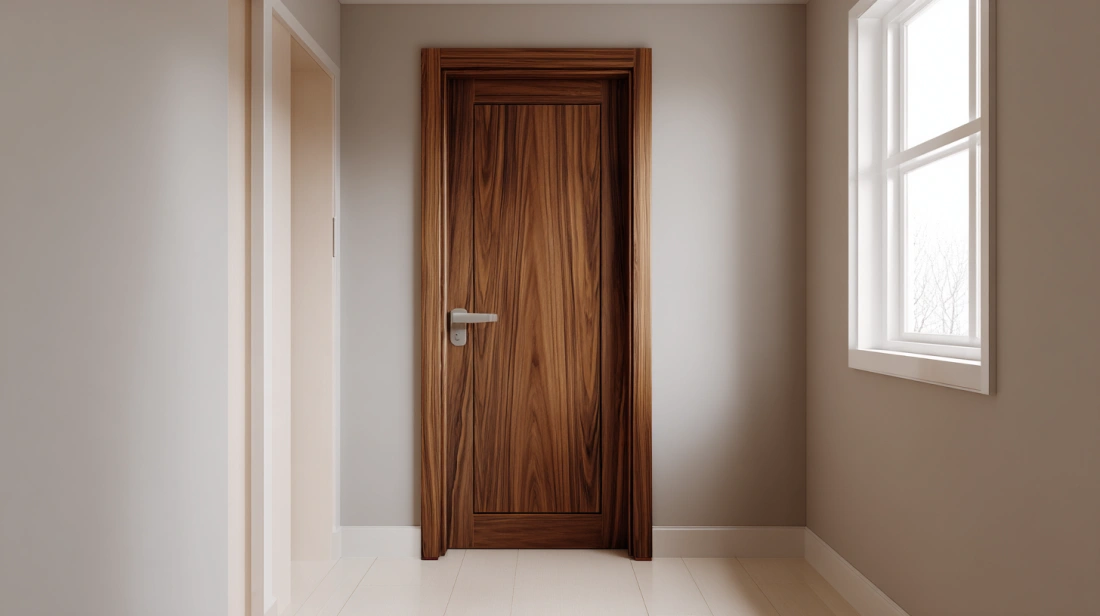
A flat-panel veneer door creates a continuous surface, emphasizing simplicity and clean lines while keeping the room visually open and uncluttered.
Best For: Ideal for bedrooms, study rooms, or small apartments where a streamlined look helps make the space feel larger.
Key Features: Single panel construction, smooth veneer surface, uniform grain, and minimal visible hardware.
Why Choose This Design: It enhances contemporary interiors without overpowering other design elements and maintains a low-maintenance surface.
Pro Tip: Pair with recessed handles or push-to-open mechanisms to preserve the flush, minimalist aesthetic.
Cost Insight: Typically ranges from ₹1200–₹2500 per sq. ft., depending on veneer type and core material.
When to Avoid: Avoid in traditional or highly ornate interiors where a flat, understated surface may feel out of place.
2. Double the Impact: Striking Veneer Double Door Design
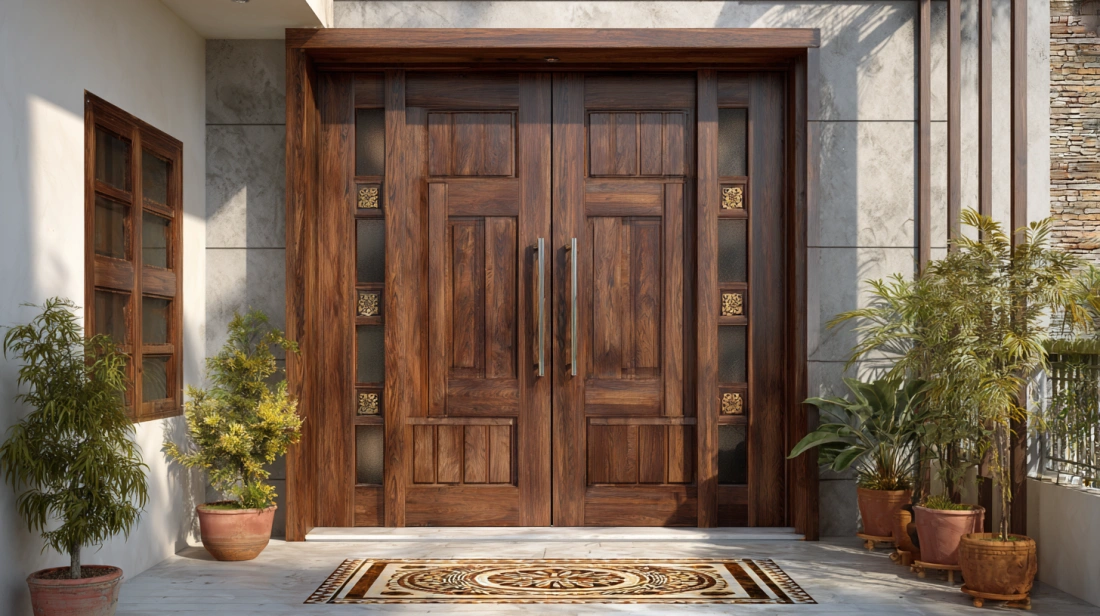
Make a grand entrance with this bold and impressive design that boasts double doors with a rich veneer finish. This design is ideal for those who want to make a statement and leave a lasting impression. Wider shutter proportions increase the perceived scale of the entrance - a quality central to most double door designs for main doors, where visual balance across a wider opening is the primary design goal.
Best For: This design works well for main entrances and large living rooms with wider openings.
Key Features: It includes dual shutters with aligned veneer grain and a proportionately wider frame.
Why Choose This Design: It improves visual balance in spaces where standard door widths feel insufficient.
Pro Tip: Use book-matched veneer to create a mirrored grain pattern across both shutters.
Cost Insight: Expect a cost of ₹1800–₹4000 per sq. ft., depending on size, veneer grade, and hardware.
When to Avoid: Avoid this design in compact entryways with limited door-swing clearance.
3. Warm and Welcoming: Teak Veneer Door Design
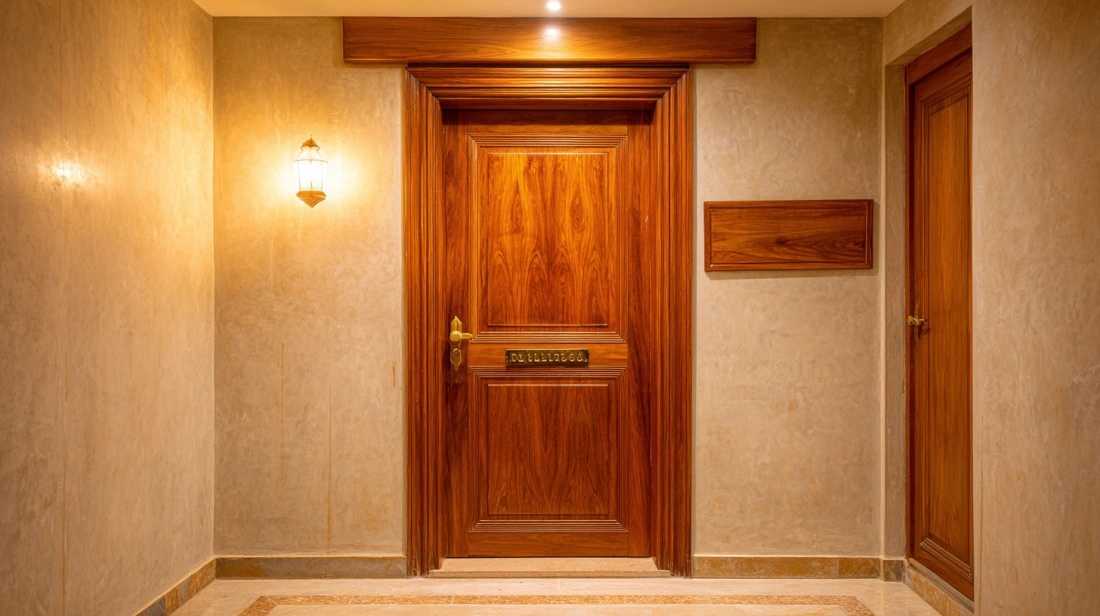
This classic and timeless design features a rich teak veneer finish that exudes warmth and hospitality. Perfect for those who value tradition and a cosy atmosphere. Teak veneer introduces a dense grain pattern and deeper tone, helping the door stand out without additional surface treatment.
Best For: This design suits main doors and living room entrances with moderate to high usage.
Key Features: It uses teak veneer with a visible grain pattern and a medium to dark tonal range.
Why Choose This Design: It handles frequent use while maintaining surface consistency over time.
Pro Tip: Use a matte polish to retain the natural grain and reduce surface glare.
Cost Insight: The cost ranges between ₹1500–₹3200 per sq. ft., based on veneer quality and finish.
When to Avoid: Avoid this finish in small or low-light rooms where darker tones feel heavy.
4. Elegant and Regal: Main Door Veneer Design
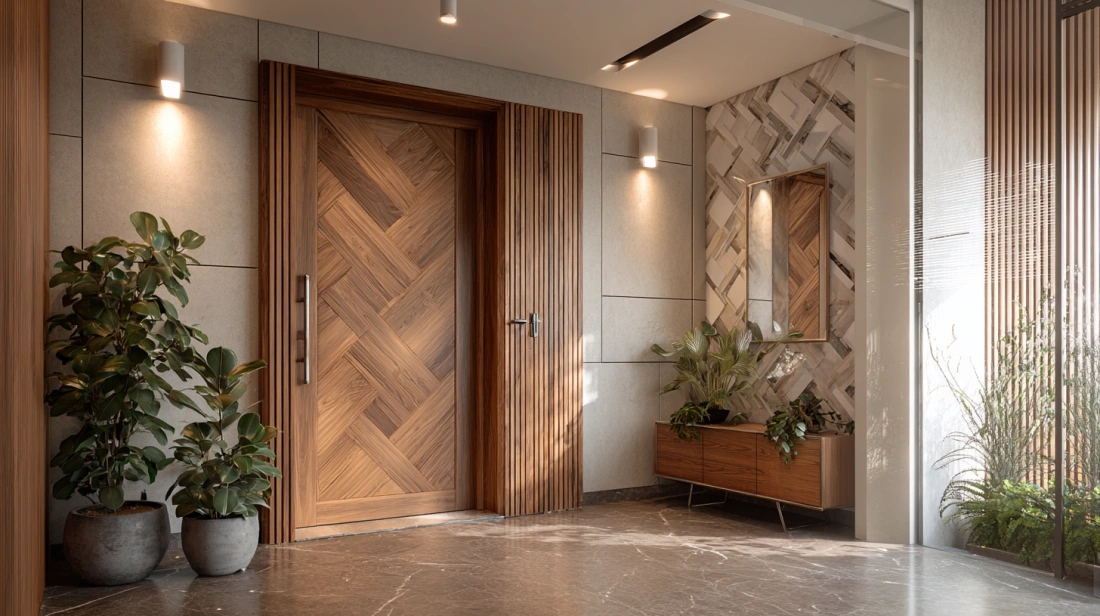
This stately design features an intricate veneer pattern that exudes elegance and refinement. It's perfect for those who want to make a grand entrance and add a touch of sophistication to their home. Panel-based veneer layouts are among the most popular main door design ideas, creating a defined entry surface that stands out as a clear transition point between exterior and interior spaces.
Best For: This design works well for main entrances in independent houses and larger apartments.
Key Features: It includes framed panel sections with detailed veneer placement and controlled grain direction.
Why Choose This Design: It creates a clear visual boundary at the entrance and improves spatial definition.
Pro Tip: Combine veneer panels with metal or laminate strips to improve durability in high-contact areas.
Cost Insight: The cost ranges from ₹2000 to ₹4500 per sq. ft., depending on panel detailing and finish.
When to Avoid: Avoid this design in minimal interiors where flat surfaces maintain better continuity.
5. Nature-inspired: Veneer Wood Door Design
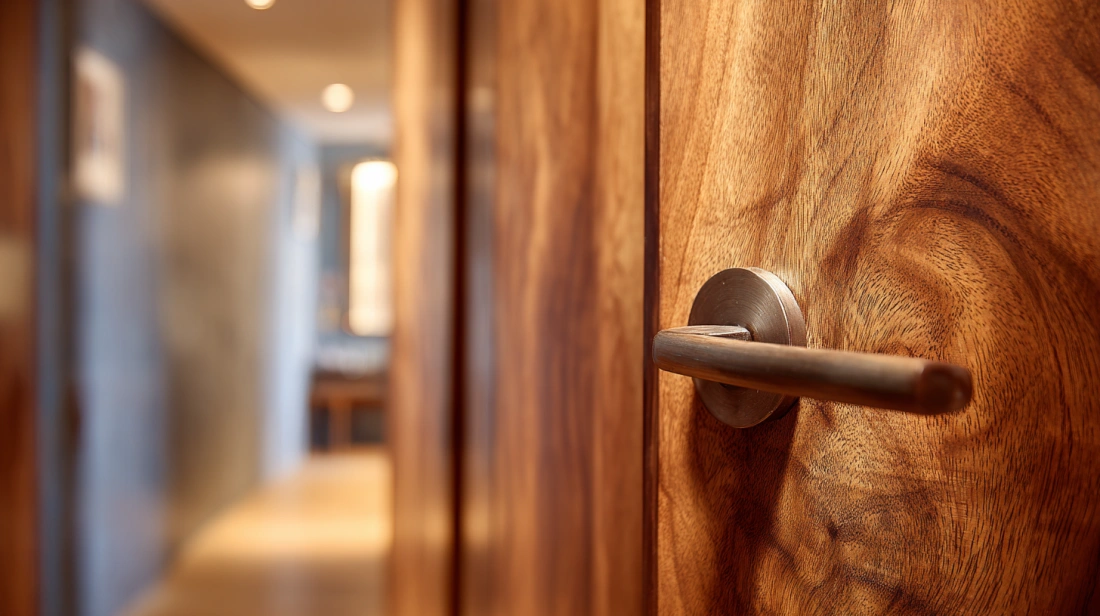
This design showcases the beauty of natural wood with its textured veneer finish. It's perfect for those who appreciate the beauty of nature and want to bring it indoors. Visible wood grain becomes the primary surface element, reducing the need for added textures or applied finishes.
Best For: This design suits living rooms, bedrooms, and transitional spaces.
Key Features: It uses natural veneer sheets with pronounced grain patterns and minimal surface treatment.
Why Choose This Design: It keeps the material expression central without additional design layers.
Pro Tip: Use horizontal grain placement to visually widen narrow walls - a technique particularly effective in wooden door designs where grain direction influences the spatial perception of an entire corridor or entryway.
Cost Insight: The cost typically ranges from ₹1400–₹3000 per sq. ft., based on veneer species and polish.
When to Avoid: Avoid this design in highly polished interiors where uniform finishes are preferred.
6. Modern Veneer Door Design with Linear Patterns
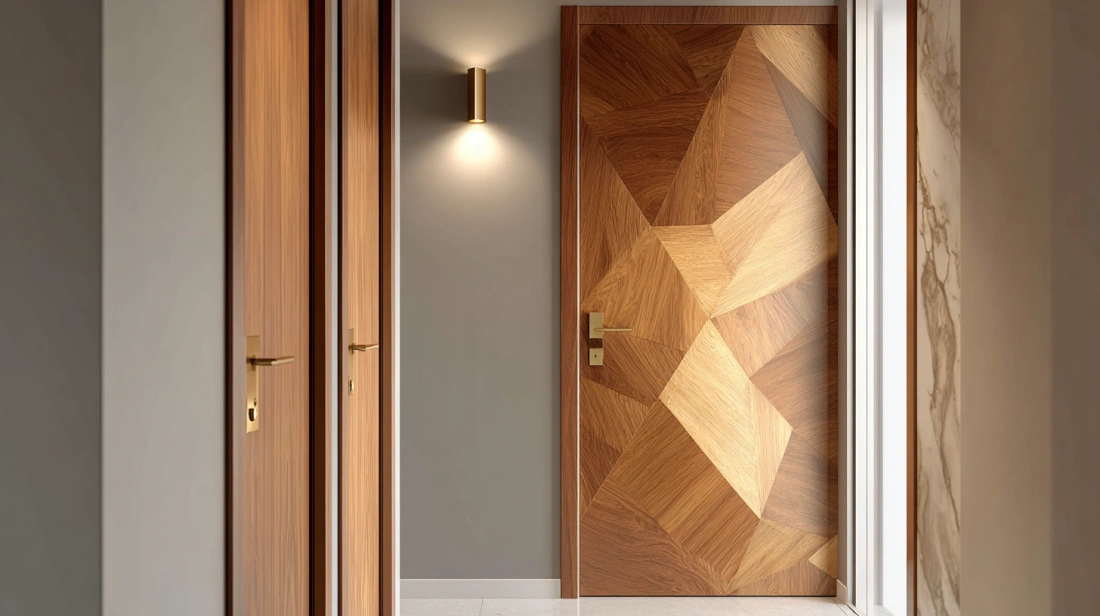
A smooth veneer door with geometric or linear patterns adds subtle structure to interiors while keeping surfaces clean and easy to maintain. Modern door designs are a subtle way to add detailing in modern Indianapolis apartments or offices, which complements the interiors well.
Best For: Works well in living rooms, home offices, and contemporary apartments where clean lines enhance the overall décor.
Key Features: Smooth veneer finish, linear or geometric detailing, uniform grain, and optional recessed handles.
Why Choose This Design: Provides a modern, functional aesthetic without overwhelming the space, complementing modular furniture and contemporary interiors.
Pro Tip: Use lighter veneer tones to contrast darker flooring or walls, creating visual depth.
Cost Insight: Priced between ₹1500–₹3000 per sq. ft., depending on veneer species and pattern complexity.
When to Avoid: Avoid in traditional or ornate interiors where geometric minimalism may clash with existing décor.
7. Flawless Finish: Flush Door Designs with Veneer
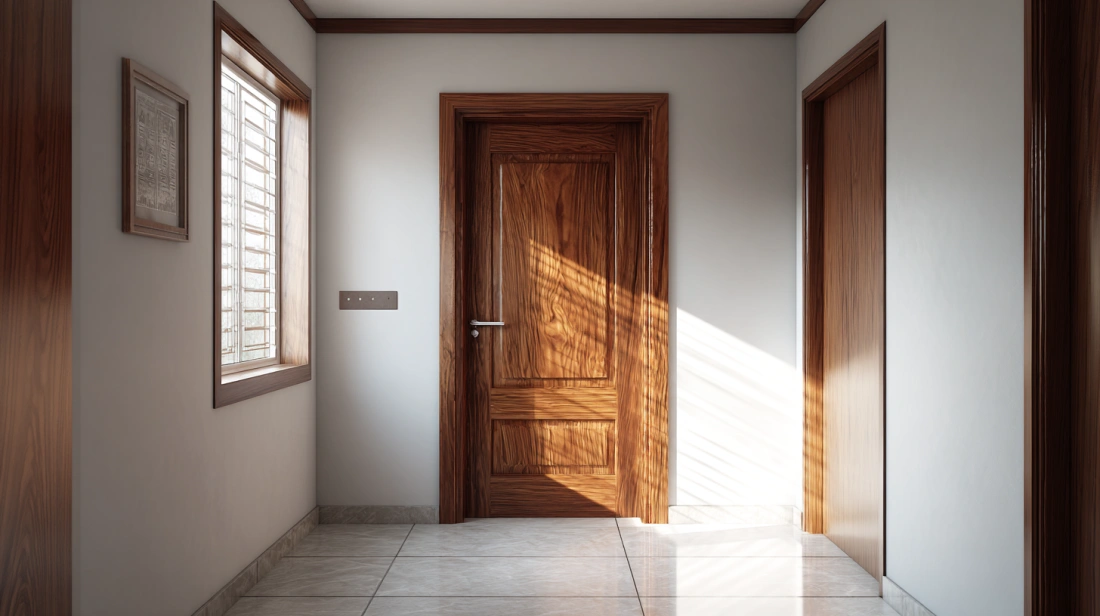
This design features a sleek and seamless finish with a flush door design and veneer finish. It's perfect for those who want a clean and simple look that's both functional and stylish.
Best For: This design suits bedrooms, offices, and frequently used utility areas.
Key Features: A flat door profile with no panel divisions and a uniform veneer finish.
Why Choose This Design: It simplifies cleaning and reduces visible wear over time.
Pro Tip: Ensure proper edge banding to prevent peeling at exposed edges.
Cost Insight: The cost typically falls between ₹1200–₹2500 per sq. ft., depending on the core material.
When to Avoid: Avoid this design for main entrances where a stronger visual presence is required.
8. Bold and Beautiful: Veneer Groove Design
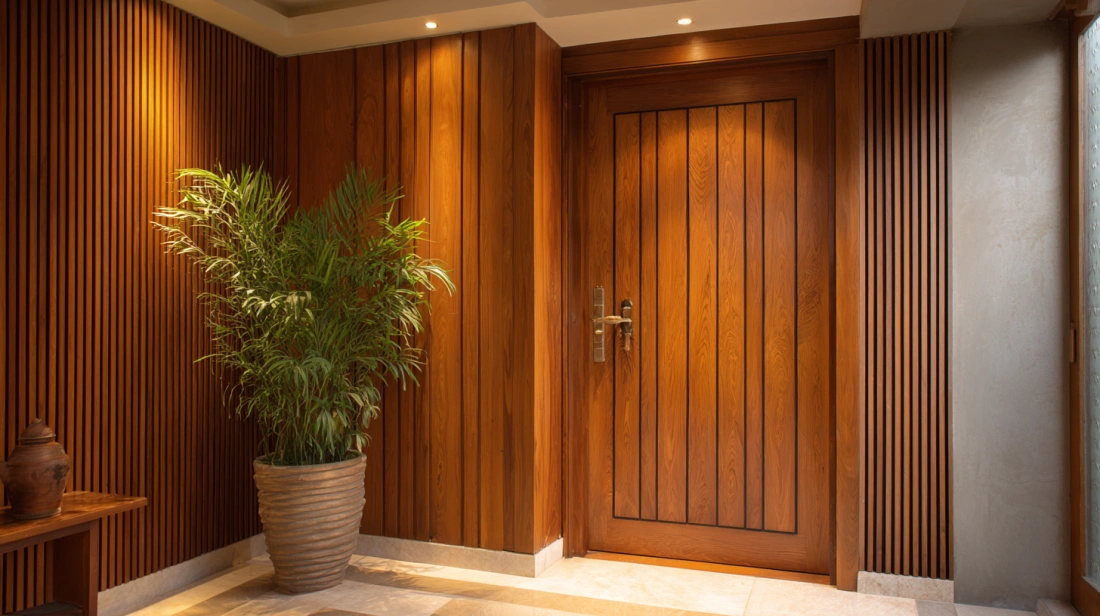
This design features a bold and striking look with a veneer groove pattern that adds depth and texture. It's perfect for those who want a statement piece that's both unique and functional. Groove patterns introduce depth into the surface without adding separate materials or increasing door thickness.
Best For: This design works well for bedroom doors and features partitions.
Key Features: It includes routed groove lines with consistent spacing across the veneer surface.
Why Choose This Design: It adds surface variation while maintaining a single material finish.
Pro Tip: Keep groove alignment consistent with wall panels or adjacent elements.
Cost Insight: The cost ranges from ₹1500–₹3200 per sq. ft., depending on groove complexity.
When to Avoid: Avoid this design in compact spaces where additional detailing can feel excessive.
9. Traditional Elegance: Indian Veneer Door Designs
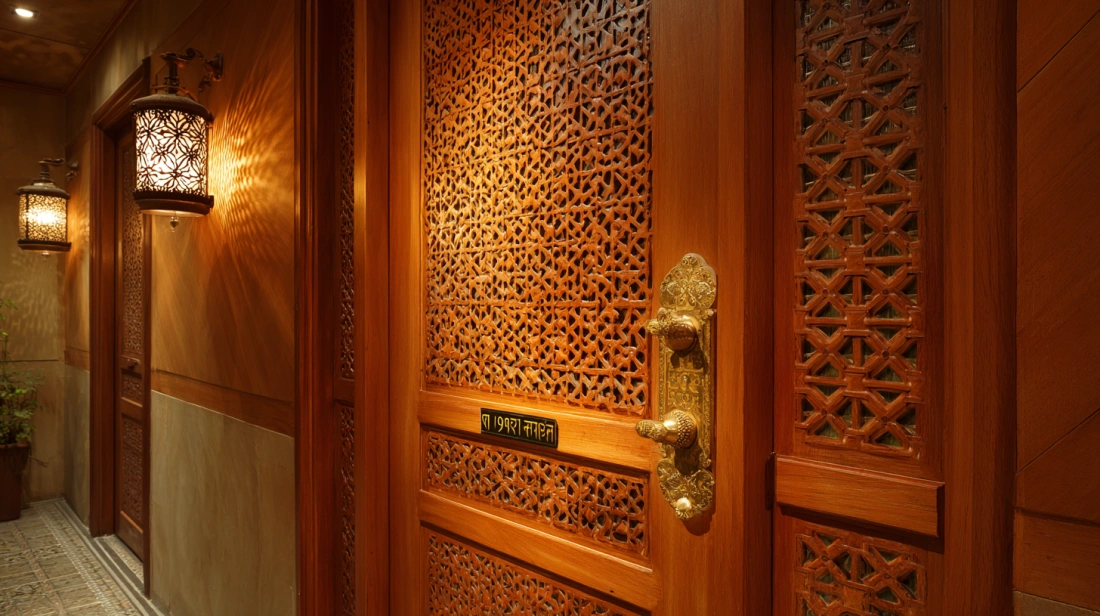
This design showcases the beauty of traditional Indian design with intricate patterns and a rich veneer finish. It's perfect for those who want to add a touch of cultural heritage to their home.
Best For: This design suits main doors and pooja room entrances.
Key Features: It includes intricate patterns, layered veneer work, and deeper tonal finishes.
Why Choose This Design: It establishes a strong visual identity at key entry points.
Pro Tip: Pair with brass or metal hardware to balance the surface detailing.
Cost Insight: The cost ranges from ₹2500–₹5000 per sq. ft., based on pattern complexity.
When to Avoid: Avoid this design in contemporary layouts with minimal detailing.
10. Barn-Style Veneer Door Design with Sliding Mechanism
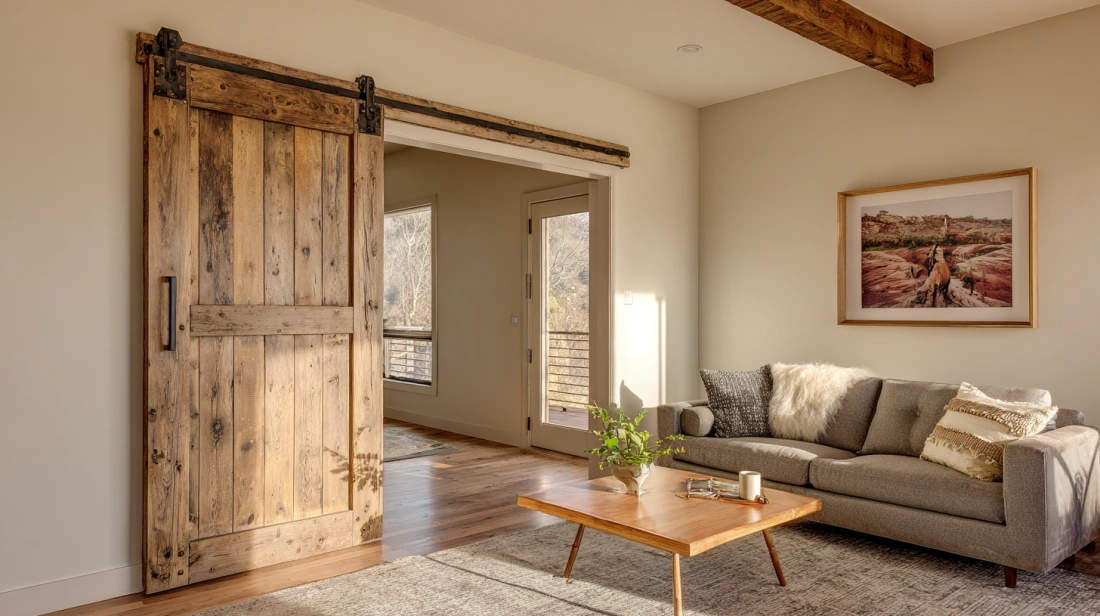
A barn-style veneer door with a top-mounted sliding panel eliminates the need for swing space, making it suitable for narrow or compact layouts while maintaining a visible wood grain and textured surface.
Best For: This design works well for bedrooms, wardrobes, and partitioned areas where floor space is limited.
Key Features: It includes a wide veneer panel, top-mounted sliding hardware, and visible track detailing.
Why Choose This Design: The sliding mechanism saves usable floor area while maintaining full access to the doorway.
Pro Tip: Ensure the adjacent wall is sufficiently wide for the door to slide fully open without obstruction.
Cost Insight: The cost ranges from ₹1800–₹3500 per sq. ft., including hardware and installation.
When to Avoid: Avoid this design in main entrances or areas requiring full acoustic or air sealing.
11. Mahogany Veneer Door Design with Deep Tone Finish
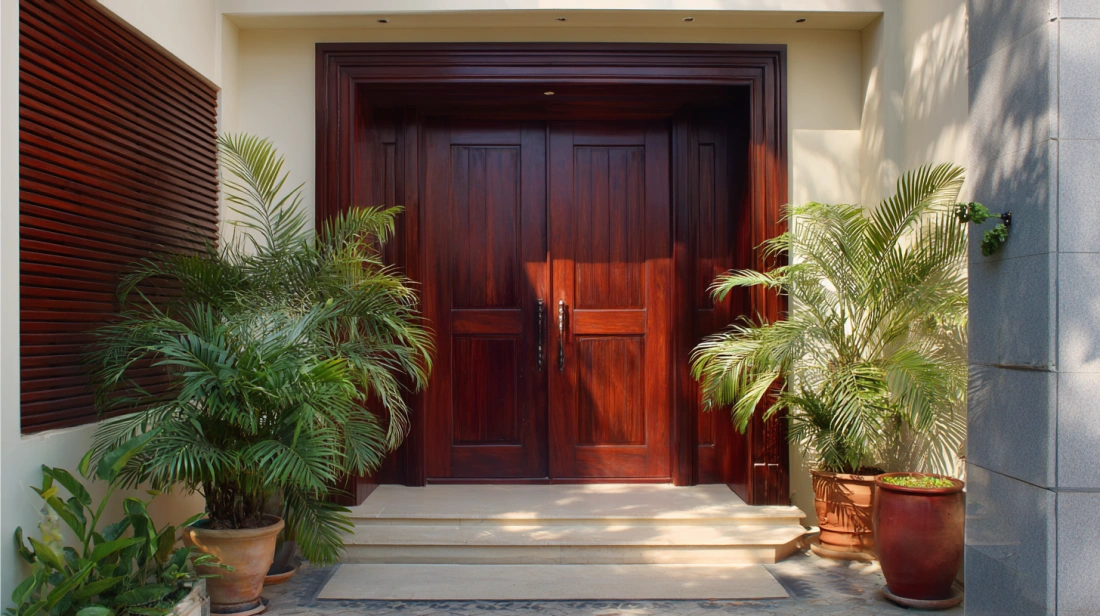
A mahogany veneer door with a deep, consistent tone creates contrast against lighter walls, allowing it to stand out without additional surface detailing while maintaining a stable, uniform grain.
Best For: This design suits living rooms, study areas, and formal spaces.
Key Features: It uses mahogany veneer with fine grain and consistent deep colour.
Why Choose This Design: It maintains colour depth over time with proper finishing.
Pro Tip: Use a satin or matte finish to control light reflection.
Cost Insight: The cost ranges between ₹1600–₹3400 per sq. ft., depending on veneer quality.
When to Avoid: Avoid this design in low-light rooms where dark finishes can feel heavy.
12. Veneer Pivot Door Design with Offset Axis Mechanism
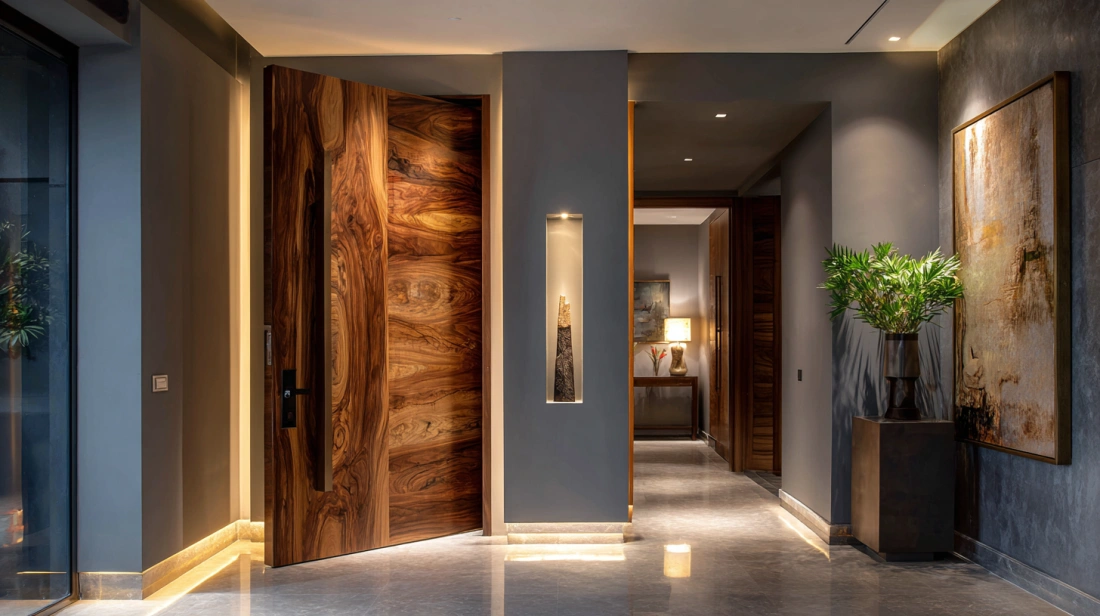
A veneer pivot door rotates around an offset axis, changing the way the entry opens and how the space is experienced, while maintaining a consistent veneer surface across the shutter.
Best For: This design works well for main entrances and large interior transitions where a wider opening is desired.
Key Features: It includes a thick-veneer shutter, a pivot hinge system, and precise floor-to-ceiling alignment.
Why Choose This Design: The offset pivot allows larger doors to operate smoothly without requiring additional swing space.
Pro Tip: Ensure the floor and ceiling structure can support the pivot mechanism for stable operation.
Cost Insight: The cost ranges from ₹3000–₹7000 per sq. ft., including hardware and installation.
When to Avoid: Avoid this design in standard door frames that are not designed for pivot systems.
Veneer Door Finishes & Textures
The finish of a veneer door design affects how the surface looks, reflects light, and performs in daily use. Choosing the right finish helps balance appearance, maintenance, and durability across different spaces.
| Finish | Look | Best For |
|---|---|---|
| Matte | Low-reflective, subtle surface | Works well in spaces where you want minimal glare and easy maintenance. |
| Glossy | Reflective, polished surface | Reflects more light, making it suitable for areas where a sharper surface finish is preferred. |
| Textured | Visible grain, tactile feel | Highlights natural grain patterns, often used in teak veneer door designs and feature doors. |
Materials Used in Veneer Doors
A veneer door design uses a thin layer of natural wood (wood veneer) over an engineered core, such as plywood or MDF, combining surface finish quality with structural stability for consistent performance in interior and main door applications. To explore different styles and finishes, you can explore our veneer door design catalog before making a choice.
| Material | Role in Door | Best For |
|---|---|---|
| Natural Veneer | Surface layer with real wood grain | Premium finishes, visible surfaces |
| Plywood | Strong and durable core material | Main door veneer designs, high-use areas |
| MDF | Smooth and uniform core | Interior veneer doors, painted finishes |
| Adhesives | Bonds veneer to the core | Long-term durability and stability |
| Polish/Coating | Protects surface and enhances finish | Scratch resistance, low maintenance |
Veneer vs Laminate Doors: Which to Choose?
Many homes prefer a wood-based look, especially in vintage or rustic interiors where furniture and doors follow a consistent material theme. However, finding solid wood that fits both design and budget can be challenging. This is where options like laminate and veneer door designs come in, offering a similar wood effect on flush doors made from plywood, MDF, or particleboard.
Both materials are widely used, but choosing between them depends on appearance, durability, maintenance, and cost. Here’s a clear comparison to help you decide.
| Feature | Veneer Doors | Laminate Doors |
|---|---|---|
| Composition | Thin layer of natural wood bonded to a plywood or MDF core | Layers of paper and resin pressed into a synthetic surface |
| Appearance | Natural wood grain with limited shades | Wide range of colours, patterns, and textures (matte, gloss, textured) |
| Durability | Stable but requires care and polishing | Highly durable, scratch-resistant, and moisture-resistant |
| Maintenance | Needs periodic polishing to maintain the finish | Easy to clean and requires minimal maintenance |
| Price | Higher due to natural wood usage | More economical with varied price ranges |
| Best Use | Main door veneer designs, living areas, and premium interiors | Kitchens, utility spaces, and high-use areas |
Things to consider before choosing a Veneer Door Design
Before you choose a veneer door design for your home, think about how it will fit your space, style, and daily use. These doors can give your rooms the look of solid wood without the high cost, and they’re easier to maintain than traditional options. Veneer Doors make for a good choice for your home, as they come with the following benefits
- Cost-effectiveness: Veneer doors provide the appearance of solid wood doors at a more affordable price, making them a practical option for main doors, bedroom veneer doors, or even veneer double door designs.
- Variety of designs: A wide range of wood species, patterns, and colors are available, allowing homeowners to choose from options such as teak veneer door designs, modern veneer door designs, or veneer wood door designs to match any interior style.
- Durability: Compared to solid wood doors, veneer door designs are less prone to warping or splitting, ensuring long-term stability for high-traffic areas like main entrances or living room doors.
- Easy maintenance: Veneer doors require minimal upkeep and can be cleaned easily with a damp cloth, which is particularly useful for frequently used doors like flush veneer door designs or veneer front door designs.
- Sustainability: Using a veneer layer instead of solid wood reduces the need to harvest large amounts of timber, making veneer door designs for home interiors an environmentally responsible choice.
How Can NoBroker Help?
Veneer doors are an effective way to bring style and character to your living spaces. When choosing a veneer door design, consider your home’s style, colour palette, and the door’s durability and function. If you’re unsure where to start, the NoBroker Interiors team can guide you with expert advice. Our designers help create functional, personalized spaces that reflect your taste and enhance your home’s value. Visit our experience center to explore a wide range of veneer door designs and find the right fit for your home.
Why Choose NoBroker Interior Services?
- Expert Guidance: Our designers help you pick veneer door designs that match your home’s style and colour palette.
- Tailored Solutions: We create functional layouts that suit your space and daily needs.
- Wide Selection: Explore a variety of finishes, grains, and door types, including teak, modern, and flush veneer doors.
- Quality Assurance: High-quality materials and professional installation ensure long-lasting results.
- Convenient Experience: Visit our experience centre to see designs firsthand and get personalized advice.

Doors Designs of Other Materials
Frequently Asked Questions
1. What is the difference between a veneer and solid wood doors?
2. Can veneer doors be used for exterior applications?
3. How do I choose the right veneer for my door?
4. What maintenance is required for veneer doors?
5. Can veneer doors be customized to suit my specific design needs?


Our Recent Projects



Reviews

Sakshi Sharma

Had a wonderful, hassle free experience with the NoBroker team: Touheed special thanks to you for quick execution, smooth communication... Read more

Poojithagowda Sullia
Great experience ....Beautiful interior designs, and a friendly team. Had a wonderful visit.

Indira A
The design team completely transformed my living room. They caught my vibe instantly and delivered exactlyyy & what I wanted.

Joynab Mondal
I approached No Broker Interiors for designing my home and we are glad about our decision. Seeing sample setups at the experience centr... Read more

Harley Jeetu
Had a wonderful experience with our project manager Shreyas. Everything was well coordinated and project finished well in time.

khushi jain
The interior design process was easy to explore, and it helped me organize my ideas for improvingg my home.

Belal Qasim
Good showroom and people

Suganthen
We had a wonderful experience with NoBroker Interiors. Special thanks to project manager Touched he was very calm and responsive. Produ... Read more

Mujahidul Haque
Great & The interior planning was well organizeed, and the team helped me understand how to make better use of my available space. Team... Read more

Sanoj Kumar
Good center

Shreya Shukla
The team is creative, ✨enthusiastic, and highly precise &The design quality blew us away. 🙌Thank you team! 👌

RAGHAVAN V K
They did a wonderful job with the false ceiling and lighting layout. It completelyy changed the mood of our homee.

Rina Dey
I had a good experience with NoBroker Interior. The team understood my requirements and suggested practicalll ideass that suited my hom... Read more

Vinodhkumar
I had a wonderful experience with Vishal V, the interior designer at NoBroker. His way of explaining things, point-by-point detailing, ... Read more

Dipti
Great Space Planning,,, I wanted to make better use of the space in my home, and the design suggestions were quite helpfull. I liked th... Read more

Divya Pendem
We are done our 3BHK flat interior work from No Broker. It was exlent and as we expected they done. Thank you all who involved in this ... Read more

Sarala Buduru
The interior transformation made the space feel brighter and more welcoming. The design choiices were simmple, tasteful, and suited my needs.

Hanma
The team was responsive to my queriies and explained the interior work process clearly. Truly amazing 🤗

shailaja G
⭐⭐⭐⭐⭐ Excellent Interior Design and Execution Experience I had a wonderful experience with Nobroker Hood Interiors. The enti... Read more

Nikita Shah
The interior design team was professional and understood the requirements well. The overall design was thoughtful, and the space looked... Read more

Pinky Mandal
NoBroker Interiors provided a useful starting point for planning a home makeoverrr according to my preferences.

S K.K
Helpful Design Guidance team bhot suggestive hai & As someone with limited knowledge of interior design, I appreciated having different... Read more

Guncreator Studio
The design suggestions were creatiive and suited the style I wanteed for my home.

Anamika Banik
Good interior service with clear communication and helpful suggestions. The work was completed neatlyyyy

Nitin Kumar Mandilwar
Good work done by project manager Manoj. Completed the work in time.

Divyanshu Mehta
Great work done by designer Divya and Govardhan. Hassle free work snd best part is they will customise everything as per need exactly. ... Read more

Jason Fernandes
I had a great experience here. When it comes to planning, delivery and execution, great work was done by the team members. Suhail Khan... Read more

kamal jeet
Everyone from the carpenters to the relationship managers behaved with absolute professionalismmm

Shailja Paul
The execution was flawless. They handled the paperwork, society permissions, and design setup seamlesslyyy

Karishma Balwani
I recently had my home interiors completed by NoBroker Interiors, and the overall experience was exceptional. I would like to extend my... Read more

Rohit Gangal
We recently renovated our flat through NoBroker Interiors and it has largely been a good experience. There were some issues with the de... Read more

Nikhil Nag
I had a great experience with NoBroker Home Interiors. A special appreciation for the Project Manager Mr. Amit Toro for the excellent ... Read more

Vineeta Dalai
A big thank you to Mr. Ashwin Jaiswal, Sr. Project Manager, for turning my dream home into reality and making the entire interior journ... Read more

Riya Roy
Ideas for a Compact Home Making a smaller home look spacious was my maiin concern. The desiign concepts helped me explore better furnit... Read more

Rinki Jain
Modern Home Ideas the staff provided & I was looking for a modern yet practical look for my home. The design options I exploreed throug... Read more

Deepika Khilar
Quality work done by NoBroker. Zaki as a project manager was very sincere and good in getting things done. Few improvement suggestions... Read more

Himashri ysm
Highly disciplined team. They set a timeline during our initial meeting and stuck to it until the handover

S.K GAMING
I liked the way the team approached the interior design. They made good use of the available space and helped create a modern, comforta... Read more

Gaurav Jain
The process of exploring interior designnn,,, options was straightforward and convenient.

kranthi kumar
Great work by NoBroker, especially in project management and coordination. Our Project Manager Nazeer did a good job in coordinating th... Read more

Krishna Varma
We had a very good experience with NoBroker Interiors for our home interior work. Designer Shivani understood our requirements well an... Read more

nagaruru sree ranga varun kumar
Did my 2bhk interiors with NoBroker team and excellent design choices. Initial on-boarding process taken care smoothly by Saurav and sa... Read more

afrose alam
Project Misbah Tasleem Mr. SK Ali and Mr. Rizwan were extremely supportive throughout the entire process. They handled everything very... Read more

Sai kiran tharala
I recently got my home interiors completed by NoBroker, and I’m extremely happy with the outcome. Initially, I was unsure about frame... Read more

Mohammed Moizuddin
We recently got our home interiors done through NoBroker Interiors, and we are very happy with the final output. The overall finish and... Read more

Dev Roy
I prefer simple interiors rather than too many decorative elements. The ideas I exxplored throughh NoBroker Interior matched that prefe... Read more
Testimonials
View All
NoBroker Interiors Review | Happy Customer Testimonial by Rajani
NoBroker Interiors | Customer Testimonial by Prinyakar Polley

NoBroker Interiors | Hyderabad Customer Testimonial by Prashant Choudhary

NoBroker Home Interiors | Hyderabad 4BHK Customer Review

NoBroker Interiors Customer Testimonial | Jatan's Story
NoBroker Interiors Review | Hyderabad Customer Testimonial

NoBroker Interiors Review | Modern Dream Home Customer Testimonial

NoBroker Interiors Customer Testimonial | Fast & Quality Home Interiors

NoBroker Interiors Customer Testimonial | Pune Dream Home

NoBroker Interiors| Bangalore Customer Testimonial
NoBroker Interiors: Sports Theme Interiors by NoBroker #interiordesign #nobrokerinteriors #nobroker

NoBroker Interiors - Customer Testimonials

That 3 PM meeting where ideas turn into floor plans, materials, and magic. 💫

Your 2026 list is here.

Smart wardrobe design that fits your life, beautifully.
POV: You gave your home a holiday hug.🥰

Blink and you’ll miss the makeover.👀

When your home finally gets its own weekend mood, this bar unit does the job beautifully.

A calm pooja corner every home needs.

NoBroker Home Interior Service | Saurabh & Prachi Share Their Story #interiordesign #shorts
About the Author

Sujendra Shetty
Author
Sujendra Shetty is a passionate civil engineer and interior designer specialising in creating functional, aesthetically pleasing, and well-planned spaces. With a strong foundation in civil










Recent Blogs
Subscribe to our Newsletter
Get latest news delivered straight to your inbox