Bosch Washing Machine Power Consumption – Units, Wattage & Electricity Cost Guide

277 Views
Table of Contents
Summary
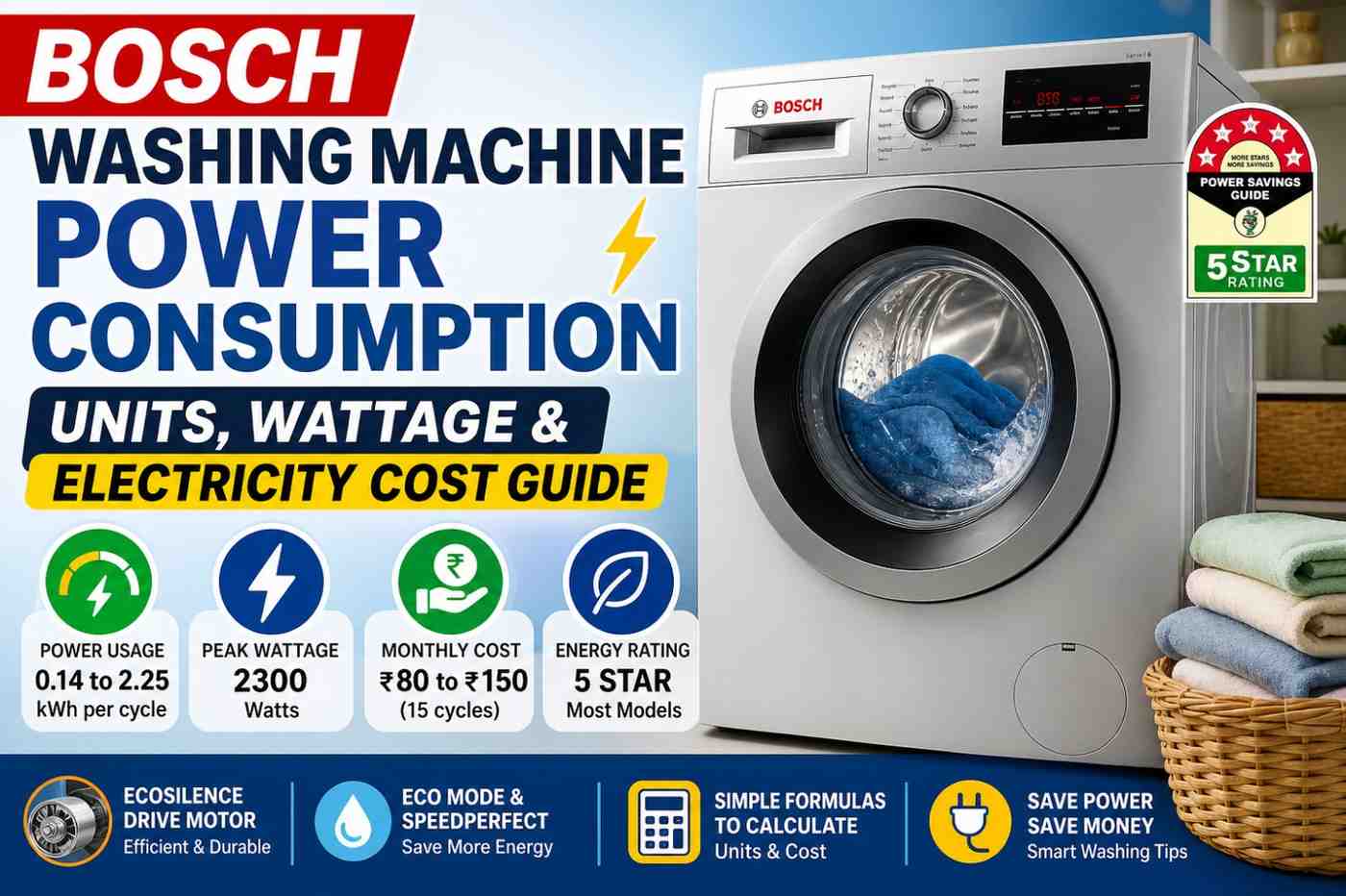
The Bosch washing machine power consumption usually stays between 0.14 kWh and 2.25 kWh per single cycle. While the motor is very efficient, the internal water heater uses the most electricity during hot wash programs. Most modern Bosch front loaders have a 5 star energy rating, making them a great choice for saving power in 1 country like India. By using features like Eco Mode and SpeedPerfect, you can lower your electricity usage. This guide provides detailed tables and simple formulas to help you calculate your monthly costs and reduce energy waste easily.
Bosch Washing Machine Power Usage at a Glance
Checking the basic data on Bosch washing machine power consumption helps you see how different series and models compare in terms of energy requirements.
| Feature | Details for Series 4 | Details for Series 6 | Details for Series 8 |
|---|---|---|---|
| Peak Wattage | 2300 Watts | 2300 Watts | 2300 Watts |
| Avg Units per Cycle | 0.46 to 1.2 kWh | 0.44 to 1.1 kWh | 0.40 to 0.9 kWh |
| Motor Technology | EcoSilence Drive | EcoSilence Drive | EcoSilence Drive |
| Energy Rating | 5 Star | 5 Star | 5 Star |
| Monthly Cost (15 cycles) | ₹ 90 to ₹ 150 | ₹ 85 to ₹ 140 | ₹ 80 to ₹ 130 |
About Bosch Washing Machine
Bosch is a leading global brand known for producing high-quality appliances that focus on durability and efficiency. Their washing machines are popular because they use the EcoSilence Drive motor, which is a brushless system that reduces friction and noise. These machines come with smart features like ActiveWater Plus and i-DOS technology, which automatically adjust water and detergent levels based on the load size. Whether you choose a top-load or front-load model, you are getting a machine built to last for many years.
Understanding Bosch Washing Machine Power Consumption
To get a clear picture of your energy bills, you need to look at how much power the machine draws at different stages of the wash.
Bosch Washing Machine Power Consumption per Hour
The Bosch washing machine power consumption per hour is highest when the internal heater is warming up the water. During this phase, the machine can draw up to 2300 watts of power. However, once the water reaches the set temperature, the power draw drops as the motor only needs roughly 300 to 500 watts to tumble the clothes. On average, 1 standard hot wash uses 1 unit of electricity per hour.
Bosch Washing Machine Electricity Usage per Cycle
The Bosch washing machine electricity usage per cycle depends largely on the settings you choose for your laundry. A cold wash cycle is very efficient and might only use 0.15 to 0.30 units of power from start to finish. If you select a 60-degree cotton wash, the usage increases to roughly 1.2 units because the heater stays on longer. Using Eco Mode can help keep this per-cycle consumption as low as possible.
Monthly Electricity Consumption of Bosch Washing Machine
Calculating the Bosch washing machine's monthly power consumption involves considering how many loads you wash each month. If a standard family runs 15 wash cycles a month using a mix of warm and cold settings, the total usage will be around 12 to 15 units. At a rate of ₹7 per unit, your monthly cost for cleaning clothes is approximately. ₹ 84 to ₹ 105.
How Much Electricity Does a Washing Machine Consume?
Every appliance has a different energy footprint based on its size, type, and age. Bosch machines are designed to stay at the lower end of the energy scale.
Average Power Consumption in Bosch Washing Machine
The average power consumption in Bosch washing machine models is 0.7 units per load. This average accounts for the fact that most users use cold washes for daily clothes and hot washes for bedsheets or towels. Compared with older machines without inverter technology, Bosch models are roughly 20% to 30% more efficient. This makes them a very reliable choice for people who want to minimize their carbon footprint.
Power Usage of Washing Machine Based on Load Type
The Bosch washer power consumption changes based on the weight and fabric of your laundry. Washing a heavy load of 8 kg of cotton towels requires more energy to spin and heat the water compared to a 2 kg load of delicate silk or synthetic shirts. Heavy loads force the motor to work harder and the heater to stay on longer, while small loads are detected by sensors to use less water and power.
Understanding Washing Machine Power Requirements
Every Bosch washing machine in India requires a stable 220 to 240 volt electrical supply. Because the peak power draw reaches 2300 watts when the heater is active, it is mandatory to use a 15-amp or 16-amp power socket. Using a standard 5-amp socket can cause the wires to overheat or the circuit breaker to trip. Always ensure your home wiring can handle these high-power requirements.
How to Calculate Bosch Washing Machine Power Consumption and Cost
You can find your exact costs by using a simple 2-step formula. First, find the units used, then multiply by your local rate.
- Total Units (kWh) = (Wattage of Machine × Hours used) ÷ 1000
- Total Cost = Total Units × Rate per Unit (₹)
If you run a 2000-watt wash for 1.5 hours, the calculation is (2000 × 1.5) ÷ 1000 = 3 units. If your rate is ₹ 8, the cost is ₹ 24.
Bosch Top Load washing machine power consumption
The Bosch Top Load washing machine power consumption is generally lower because these machines often rely on cold water for most cycles. A standard top loader uses between 360 and 450 watts for the motor. Since many top-load models lack built-in heaters, they use electricity only to rotate the drum and pump water. A cold cycle on a top loader might use as little as 0.1 units per wash, making it very affordable.
Bosch front-load washing machine power consumption
The Bosch front load washing machine power consumption is higher in terms of peak wattage because these machines almost always include an internal water heater. A front loader is rated at approx. 2300 watts. However, it is more efficient over time because it uses much less water than a top loader. Because there is less water to heat, the total energy consumed during a warm wash is often lower than you might expect for such a powerful machine.
Bosch Washing Machine Power Consumption in Different Settings
The program you select on the dial has the biggest impact on your total Bosch washing machine energy consumption for that day.
| Setting Type | Avg Power Consumption | Cost per Cycle (at ₹ 7) |
|---|---|---|
| Cold Wash (20°C) | 0.25 kWh | ₹ 1.75 |
| Eco 40-60 Mode | 0.46 kWh | ₹ 3.22 |
| Mixed Load (40°C) | 0.65 kWh | ₹ 4.55 |
| Cotton Hot (60°C) | 1.20 kWh | ₹ 8.40 |
| Hygiene (90°C) | 2.20 kWh | ₹ 15.40 |
Washing Machine Power Consumption by Capacity
A larger drum can hold more clothes, but it also requires more energy to rotate and heat the water inside.
| Machine Capacity | Typical Wattage | Avg kWh per Cycle | Monthly Cost (15 cycles) |
|---|---|---|---|
| 6 kg Capacity | 1800 Watts | 0.5 kWh | ₹ 52 |
| 7 kg Capacity | 2000 Watts | 0.8 kWh | ₹ 84 |
| 8 kg washing machine wattage | 2300 Watts | 1.1 kWh | ₹ 115 |
| 9 kg and Above | 2300 Watts | 1.4 kWh | ₹ 147 |
Factors Affecting Bosch Washing Machine Energy Consumption
Several factors can affect how much electricity your machine draws from the grid each time you start a wash.
- Water Temperature: Setting the machine to 60 or 90 degrees uses 10 times as much power as a cold wash because the heater stays on much longer to warm the water.
- Load Size: Sensors in the Bosch 7kg washing machine's power-consumption models detect the load size. A half-load uses less water, which means the machine spends much less energy heating that smaller volume.
- Spin Speed: Choosing a high 1400 RPM spin speed uses more motor power than a 600 RPM setting. High speeds are better in winter but unnecessary on a hot, dry summer day.
- Machine Maintenance: If the internal heater has a lot of scale buildup, it has to work much harder to heat the water. This increases the total units of electricity consumed per cycle.
- Usage of SpeedPerfect: This feature can reduce the total energy used by up to 50% for some loads. It optimizes the drum movements to clean clothes faster while using much less electricity.
How to Reduce Power Consumption in Bosch Washing Machines
You can lower your energy bills by following these simple tips every time you do your household laundry.
- Use Cold Water: Washing your daily clothes at 20 or 30 degrees saves nearly 90% of the energy compared to a hot wash because the internal heater stays completely turned off.
- Run Full Loads: It is much better to run 1 full load of 7 kg than 2 small loads of 3 kg each. This halves the energy used by the motor and pumps.
- Select Eco Mode: The Eco 40-60 setting is designed to be the most efficient program. It takes longer to finish, but it uses much less power and water for a standard wash.
- Clean the Filter: A clogged drain filter makes the pump work much harder to remove water from the drum. Keeping the filter clean ensures the machine runs and uses less electricity.
- Lower Spin Speed: If you are going to dry your clothes in the sun, select a lower RPM. This reduces the motor load and helps your Bosch washer power consumption stay very low.
Conclusion
Understanding your Bosch washing machine's power consumption is the best way to keep your home utility costs under control while enjoying clean clothes. By choosing the right settings, such as Eco Mode and cold water, you can save a significant amount of electricity each month. Bosch machines are designed to deliver long-term savings through their 5-star ratings and durable motors. If your washing machine isn’t working properly and is disrupting your daily routine, you can rely on NoBroker for quick, professional repair services. Get expert technicians, affordable pricing, and hassle-free doorstep service to keep your laundry running smoothly.
Explore Power Consumption Guides for Other Washing Machine Brands
Learn about the power consumption, energy efficiency, and smart washing options offered by different washing machine brands. These comprehensive comparisons make it easier to identify the most suitable and energy-efficient machine for your household.
- Samsung Washing Machine Power Consumption
- LG Washing Machine Power Consumption
- Godrej Washing Machine Power Consumption
- IFB Washing Machine Power Consumption
- Whirlpool Washing Machine Power Consumption
NoBroker Washing Machine Repair & Services Across Major Cities in India
NoBroker provides expert washing machine repair across Bangalore, Chennai, Hyderabad, Delhi, Mumbai, Pune, Gurgaon, Noida, Ghaziabad, Greater Noida, and Faridabad with skilled technicians, clear pricing, and reliable service.
Brands We Serve for Washing Machine Repair Services
NoBroker offers washing machine repair for Samsung, LG, Whirlpool, IFB, Bosch, Haier, Panasonic, and more brands. Our technicians handle front-load, top-load, and semi-automatic models with dependable repairs backed by a 180-day warranty.
Frequently Asked Questions
1. What is the Bosch 7kg front-load washing machine power consumption?
2. How much is the Bosch washing machine's power consumption per month?
3. Does the Bosch 8kg washing machine's power consumption per hour change?
4. Is the Bosch Top Load washing machine power consumption lower?
5. How many watts does a Bosch front-load washing machine use?
6. What is the Bosch washing machine electricity consumption for a 5-star model?
Does Speed Perfect affect the energy consumption of a Bosch washing machine?

Login / Sign up
Zero Brokerage.
Thousands of new listings daily.
100 Cr+ Brokerage saved monthly.
About the Author

krishnanunni
Senior Editor


Recent Blogs

Subscribe to our Newsletter
Get latest news delivered straight to your inbox