Samsung Washing Machine Power Consumption – Units, Wattage & Electricity Cost Guide

536 Views
Table of Contents
Summary
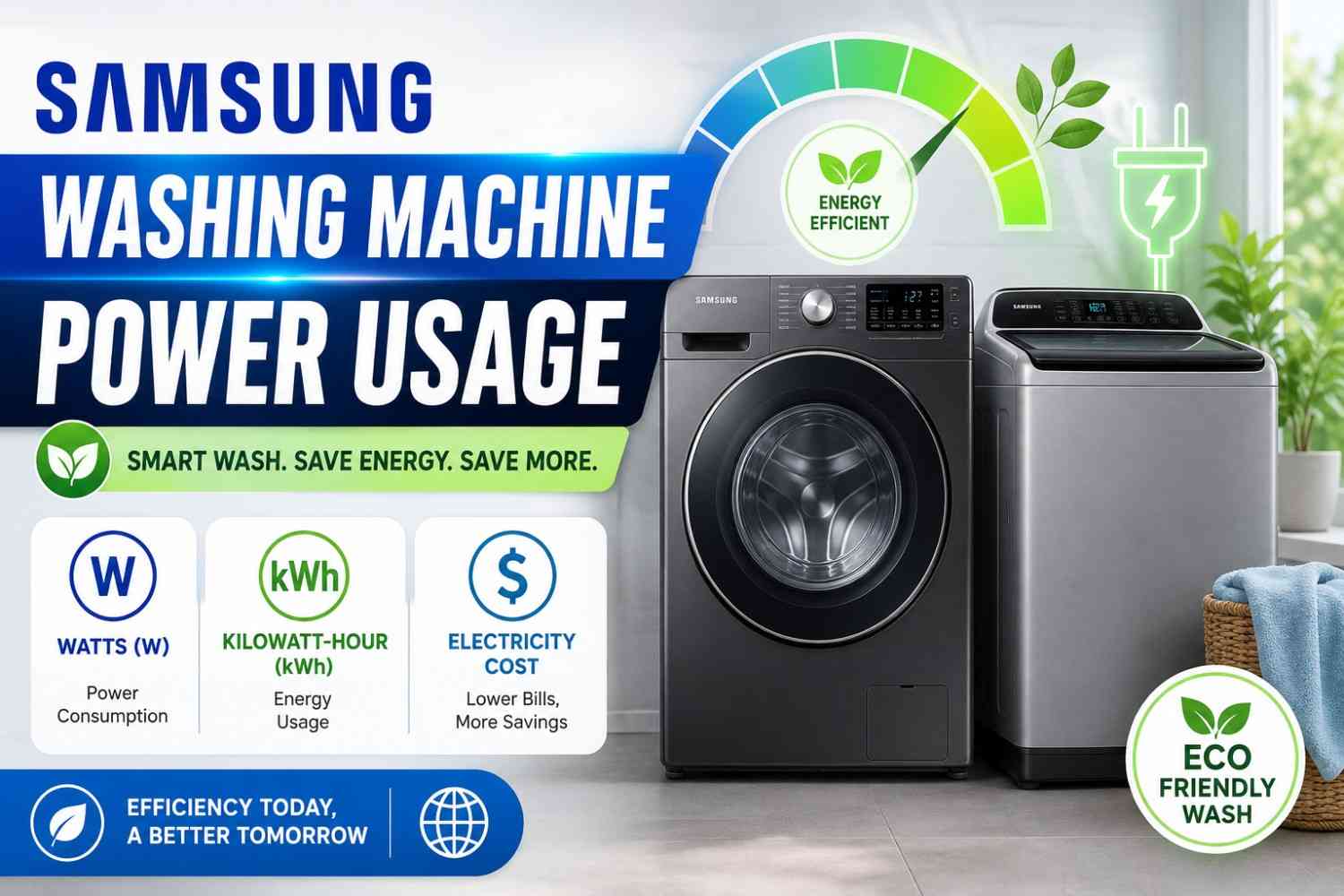
Samsung washing machine power consumption differs widely depending on the model type and capacity. Top-load machines typically use around 350W, while front-load models with built-in heaters can exceed 2000W. Energy-efficient inverter models with a 5-star rating are much more economical, consuming as little as 0.0083 kWh per kg per wash cycle.
Electricity bills often rise without clear reasons, and appliances like washing machines can be a major contributor. Most people fail to consider the amount of power that these devices use. Learning about Samsung washing machine power consumption helps you calculate the energy consumed, the watts used, and even your electric bills. Depending on whether you wash clothes every day or do larger loads, how you use your machine could affect your electric bills. Picture yourself washing clothes with the peace of mind that comes from not having to pay too much for the service.
Samsung Washing Machine Power Usage at a Glance
| Washing Machine Type | Capacity Range | Power Consumption | Units per Wash (kWh) | Monthly Usage (30 washes) |
| Fully Automatic Front Load | 6–8 kg | 1800–2000 watts | 0.8 – 1.5 | 24 – 45 units |
| Fully Automatic Top Load | 6–10 kg | 350–800 watts | 0.5 – 1.0 | 15 – 30 units |
| Semi-Automatic | 6–9 kg | 300–500 watts | 0.3 – 0.6 | 9 – 18 units |
| Washer Dryer Combo | 6–10 kg | 1500–2500 watts | 1.2 – 2.5 | 36 – 75 units |
Note: Values are indicative and may vary based on specific Samsung models, wash cycles, and usage conditions.
About Samsung Washing Machine
Samsung was founded on March 1, 1938, by Lee Byung-chul in Daegu, starting as a trading firm exporting dried fish, vegetables, and noodles; “Samsung” means “three stars.” And now, it is one of the leading brands for home appliances and gadgets. Particularly, Samsung washing machines are popular for modern features and easy use. They come with technologies like EcoBubble, inverter motors, and AI-based wash settings. These features help clean clothes better while saving water and electricity. Samsung offers many options, such as front-load, top-load, and semi-automatic models. This makes it easy to choose based on your needs and budget. The machines are built for durability and convenience, making them a reliable choice for daily laundry at home.
Understanding Samsung Washing Machine Power Consumption
Before diving into numbers, it helps to understand how a Samsung washing machine consumes electricity based on usage, load type, and wash settings. Let’s break down the power consumption step by step, from hourly usage to per-cycle and monthly estimates:
Samsung Washing Machine Power Consumption per Hour
To understand how much electricity your Samsung washing machine uses, here’s the typical hourly Samsung washing machine power consumption in India across different models:
| Washing Machine Type | Average Wattage (W) | Power Consumption per Hour (kWh) | Cost per Hour (₹) |
| Top Load (Basic) | 350 – 500 W | 0.35 – 0.50 kWh | ₹2.8 – ₹4 |
| Top Load (Advanced) | 500 – 700 W | 0.50 – 0.70 kWh | ₹4 – ₹5.6 |
| Front Load | 800 – 1200 W | 0.80 – 1.20 kWh | ₹6.4 – ₹9.6 |
| Fully Automatic | 400 – 800 W | 0.40 – 0.80 kWh | ₹3.2 – ₹6.4 |
Note: The above values are estimates. Actual power consumption and cost may vary based on model, load size, usage patterns, and electricity tariff.
Samsung Washing Machine Electricity Usage per Cycle
Samsung washing machine electricity consumption usage varies depending on the wash program, load size, and duration. Here’s a breakdown per wash cycle:
| Washing Machine Type | Cycle Duration | Electricity per Cycle (kWh) | Cost per Cycle (₹) |
| Top Load | 45 – 60 mins | 0.4 – 0.6 kWh | ₹3.2 – ₹4.8 |
| Front Load | 60 – 90 mins | 0.8 – 1.2 kWh | ₹6.4 – ₹9.6 |
| Eco Mode (Front) | 90 – 120 mins | 0.6 – 1.0 kWh | ₹4.8 – ₹8 |
| Quick Wash | 15 – 30 mins | 0.2 – 0.4 kWh | ₹1.6 – ₹3.2 |
Note: These figures are indicative and can differ depending on wash settings, water temperature, machine efficiency, and local electricity rates.
Monthly Electricity Consumption of Samsung Washing Machine
If you use your washing machine regularly, the monthly consumption and cost can look like this:
(Assuming 5 washes per week and ₹8 per unit)
| Washing Machine Type | Monthly Usage (Cycles) | Monthly Consumption (kWh) | Monthly Cost (₹) |
| Top Load | ~20 cycles | 8 – 12 kWh | ₹64 – ₹96 |
| Front Load | ~20 cycles | 16 – 24 kWh | ₹128 – ₹192 |
| Eco Mode | ~20 cycles | 12 – 20 kWh | ₹96 – ₹160 |
| Heavy Usage (Daily) | ~30 cycles | 20 – 36 kWh | ₹160 – ₹288 |
How Much Electricity Does a Washing Machine Consume?
A washing machine uses about 0.3-2 kilowatt-hours for each operation, which varies based on the appliance's capacity, technology, and use. The common average for today's machines in India is 0.5-1.2 kilowatts for each operation. Running your machine 20-25 times in a month could lead to a consumption of between 10 - 30 kilowatt-hours in Samsung washing machine power consumption per month.
Electrical consumption largely depends on factors such as the load weight, the washing setting, and water temperature, among others. Front-loading machines are more efficient than top-loading ones in terms of electrical consumption, especially when using cold water.
Average Power Consumption in Samsung Washing Machine
The Samsung washing machine power consumption varies based on model type and features. Here’s a general idea:
- Top Load Models: 350W to 600W
- Front Load Models: 500W to 2000W (higher if using heater)
- Fully Automatic Machines: ~0.5 to 1.0 kWh per cycle
- Eco Bubble / AI Models: Optimized to reduce energy usage
For a typical household, a Samsung washing machine used 5 times a week can consume around 10 to 20 units per month, depending on usage settings.
Power Usage of Washing Machine Based on Load Type
Electricity consumption changes based on how you use the machine:
- Light Load (Quick Wash): Uses less water and time, consuming about 0.3–0.5 kWh per cycle
- Medium Load (Regular Wash): Standard daily washing consumes around 0.5–1 kWh per cycle
- Heavy Load (Bedsheets, Towels): Longer cycles and higher spin use 1–2 kWh per cycle
- Hot Water Wash: Heating element increases consumption significantly, sometimes 2x higher
How to Calculate Samsung Washing Machine Power Consumption and Cost?
Follow these simple steps to accurately calculate your washing machine’s power consumption and estimate monthly electricity costs without confusion:
- Step 1: Check your washing machine's power rating (in watts) on the label or in the manual.
- Step 2: Convert watts to kilowatts by dividing the given value by 1000 accurately
- Step 3: Note the duration of one wash cycle in hours, including wash, rinse, and spin time.
- Step 4: Multiply kilowatts by hours to calculate energy consumed per wash cycle in units
- Step 5: Count the total number of wash cycles you use in one complete month
- Step 6: Multiply units per cycle by total cycles to get the monthly energy consumption value
- Step 7: Check the electricity tariff per unit based on your local state slab rates
- Step 8: Multiply monthly units by tariff rate to calculate total monthly electricity cost
Samsung Top Load Washing Machine Power Consumption
The table below highlights typical power consumption, usage patterns, and estimated electricity costs for a Samsung top-load washing machine:
| Parameter | Details |
| Brand | Samsung |
| Machine Type | Top Load (Fully Automatic) |
| Typical Power Rating | 350W – 400W |
| Power in kW | 0.35 – 0.40 kW |
| Energy Per Wash | 0.3 – 1 kWh (unit) |
| Average Per Wash | ~0.5 units |
| Monthly Usage (20 washes) | ~10 units |
| Monthly Usage (30 washes) | ~15 units |
| Electricity Cost (₹6/unit) | ₹60 – ₹90 |
| Electricity Cost (₹8/unit) | ₹80 – ₹120 |
| Heating Element | Not present (uses cold water) |
| Efficiency Level | High (low power consumption) |
Note: The above values are rough estimates for Samsung top load washing machines and may vary based on usage patterns and model specifications.
Samsung Front-Load Washing Machine Power Consumption
The table below outlines power consumption, energy usage, and estimated electricity costs for a Samsung front-load washing machine:
| Parameter | Details |
| Brand | Samsung |
| Machine Type | Front Load (Fully Automatic) |
| Typical Power Rating | 1000W – 2000W |
| Power in kW | 1.0 – 2.0 kW |
| Heating Element | Present (for hot water wash) |
| Energy Per Wash | 1 – 2.5 kWh (unit) |
| Average Per Wash | ~1.5 units |
| Monthly Usage (20 washes) | ~30 units |
| Monthly Usage (30 washes) | ~45 units |
| Electricity Cost (₹6/unit) | ₹180 – ₹270 |
| Electricity Cost (₹8/unit) | ₹240 – ₹360 |
| Water Consumption | Low |
| Efficiency Level | High (better cleaning performance) |
Note: The above values are rough estimates for Samsung front-load washing machines and may vary depending on wash cycles, heating usage, and model features.
Confused between top load and front load washing machines? Discover key differences, pros, and cost insights to choose the right one for your home - Explore!
Samsung Washing Machine Power Consumption in Different Settings
The table below shows how different wash settings impact power consumption and cost per cycle in Samsung washing machines:
| Setting Type | Avg Power Consumption (kWh) | Cost per Cycle (₹7/unit) |
| Quick Wash | 0.3 – 0.5 | ₹2 – ₹4 |
| Normal Wash | 0.5 – 1.0 | ₹4 – ₹7 |
| Heavy Wash | 1.0 – 1.8 | ₹7 – ₹13 |
| Hot Water Wash | 1.5 – 2.5 | ₹10 – ₹18 |
| Eco Mode | 0.4 – 0.7 | ₹3 – ₹5 |
| Spin Only | 0.1 – 0.2 | ₹1 – ₹2 |
Note: These are rough estimates and may vary based on load size, water temperature, and machine capacity.
Washing Machine Power Consumption by Capacity
The table below shows how washing machine capacity impacts power consumption and cost per cycle, helping you choose the right size efficiently:
| Capacity (kg) | Avg Power Consumption (kWh/cycle) | Cost per Cycle (₹7/unit) |
| 6 kg | 0.4 – 0.7 | ₹3 – ₹5 |
| 7 kg | 0.5 – 0.8 | ₹4 – ₹6 |
| 8 kg | 0.6 – 1.0 | ₹4 – ₹7 |
| 9 kg | 0.8 – 1.3 | ₹6 – ₹9 |
| 10 kg | 1.0 – 1.6 | ₹7 – ₹11 |
| 12 kg | 1.2 – 2.0 | ₹8 – ₹14 |
Note: These are approximate values and may vary depending on machine type, wash settings, and usage patterns.
Factors Affecting Samsung Washing Machine Energy Consumption
The below highlight the key factors that influence energy consumption in a Samsung washing machine and overall electricity usage:
- Machine type (top load or front load) affects overall energy consumption significantly
- The capacity of a washing machine determines power usage per cycle and efficiency
- Water temperature setting increases electricity usage, especially in hot wash cycles
- Wash program selection impacts energy consumption based on cycle intensity
- Motor technology, like inverter motors, helps reduce power consumption efficiently
- An energy efficiency rating indicates how much electricity the machine consumes overall
- Load size affects efficiency, as full loads use power more effectively
- Spin speed influences energy usage and reduces drying time after washing
- The frequency of usage directly increases total monthly electricity consumption
How to Reduce Power Consumption in Samsung Washing Machines?
Follow these simple tips to reduce power consumption and improve energy efficiency in your Samsung washing machine effectively:
- Use a cold water wash instead of a hot water wash to reduce electricity consumption significantly
- Run the washing machine with a full load to improve efficiency and save energy usage
- Choose eco mode for regular washing cycles to minimize power consumption effectively
- Avoid heavy or steam wash cycles unless necessary to reduce energy usage
- Use quick wash cycles for lightly soiled clothes to save electricity and time
- Reduce extra rinse and spin cycles to prevent unnecessary power consumption
- Select a moderate spin speed instead of the highest RPM to balance energy and performance
- Clean the drum and filters regularly to maintain efficiency and reduce energy waste
- Use a high-efficiency detergent to improve washing performance and reduce cycle duration
- Avoid frequent small loads as they increase overall monthly electricity consumption
Fix drainage issues quickly and improve performance with our guide on draining automatic washing machines properly - Read Now!
Samsung Washing Machine Power Consumption: NoBroker Service Guide
Samsung washing machine power consumption plays an important role in managing your household's electricity usage efficiently. By selecting the right wash settings, using optimal load sizes, and avoiding unnecessary heating cycles, you can keep your energy bills under control. However, a sudden increase in power consumption may indicate underlying technical issues. In such cases, professional assistance from NoBroker Washing Machine Repair Services can help restore efficiency. Their trained technicians ensure quick diagnosis and reliable repairs, helping your appliance perform better while keeping electricity consumption and long-term maintenance costs in check.
Other Popular Washing Machine Brands Power Consumption Guides
Compare different washing machine brands based on electricity consumption, energy efficiency ratings, and smart washing features. These detailed guides help you understand performance differences and choose a machine that best suits your household's needs and budget.
- LG Washing Machine Power Consumption
- Bosch Washing Machine Power Consumption
- Godrej Washing Machine Power Consumption
- IFB Washing Machine Power Consumption
- Whirlpool Washing Machine Power Consumption
Cities We Serve for Washing Machine Repair & Services
Get expert washing machine repair solutions from NoBroker across Bangalore, Chennai, Hyderabad, Delhi, Mumbai, Pune, Gurgaon, Noida, Ghaziabad, Greater Noida, and Faridabad with a technician visit within 15 minutes.
What Brands Do We Cover For Washing Machine Repair Services?
NoBroker offers professional washing machine repair for popular brands such as Samsung, LG, Whirlpool, IFB, Bosch, and Haier, handling different models, including semi-automatic, fully automatic, top-load, and front-load machines.
Frequently Asked Questions
1. How much electricity does a Samsung washing machine use per cycle?
2. What is the power rating of a Samsung washing machine?
3. Does using hot water increase washing machine electricity consumption?
4. How many units does a washing machine consume per month?
5. Which washing machine uses more electricity: front load or top load?
6. How can I reduce Samsung washing machine power consumption?
7. Does washing machine capacity affect power consumption?
8. What factors affect washing machine energy consumption?
9. Is the Samsung washing machine energy efficient?
10. What is the Samsung 7kg front-load washing machine power consumption?
11. What is the Samsung 7kg washing machine's power consumption?
12. What is the Samsung 8kg washing machine's power consumption per hour?

Login / Sign up
Zero Brokerage.
Thousands of new listings daily.
100 Cr+ Brokerage saved monthly.
About the Author

krishnanunni
Senior Editor


Recent Blogs

Subscribe to our Newsletter
Get latest news delivered straight to your inbox