How Microwave Oven Works: Complete Guide to Cooking, Components, and Functions

17 Views
Table of Contents
Microwave ovens have become one of the most commonly used kitchen appliances because they make cooking and reheating food quick and convenient. Understanding how a microwave oven works can help users operate it more efficiently and safely. From generating microwave energy to heating food molecules, every component plays a specific role. This guide explains how a microwave works, its main parts, the cooking process, safety features, and everyday applications in a simple and easy-to-understand manner.
What Is a Microwave Oven?
A microwave oven is an electric kitchen appliance that uses microwave energy to heat, cook, and reheat food. Unlike conventional ovens, it directly heats water molecules inside food, making the cooking process faster and more energy-efficient. Understanding how the microwave oven works helps users get better cooking results.
How Does a Microwave Oven Work? Step-by-Step Explanation
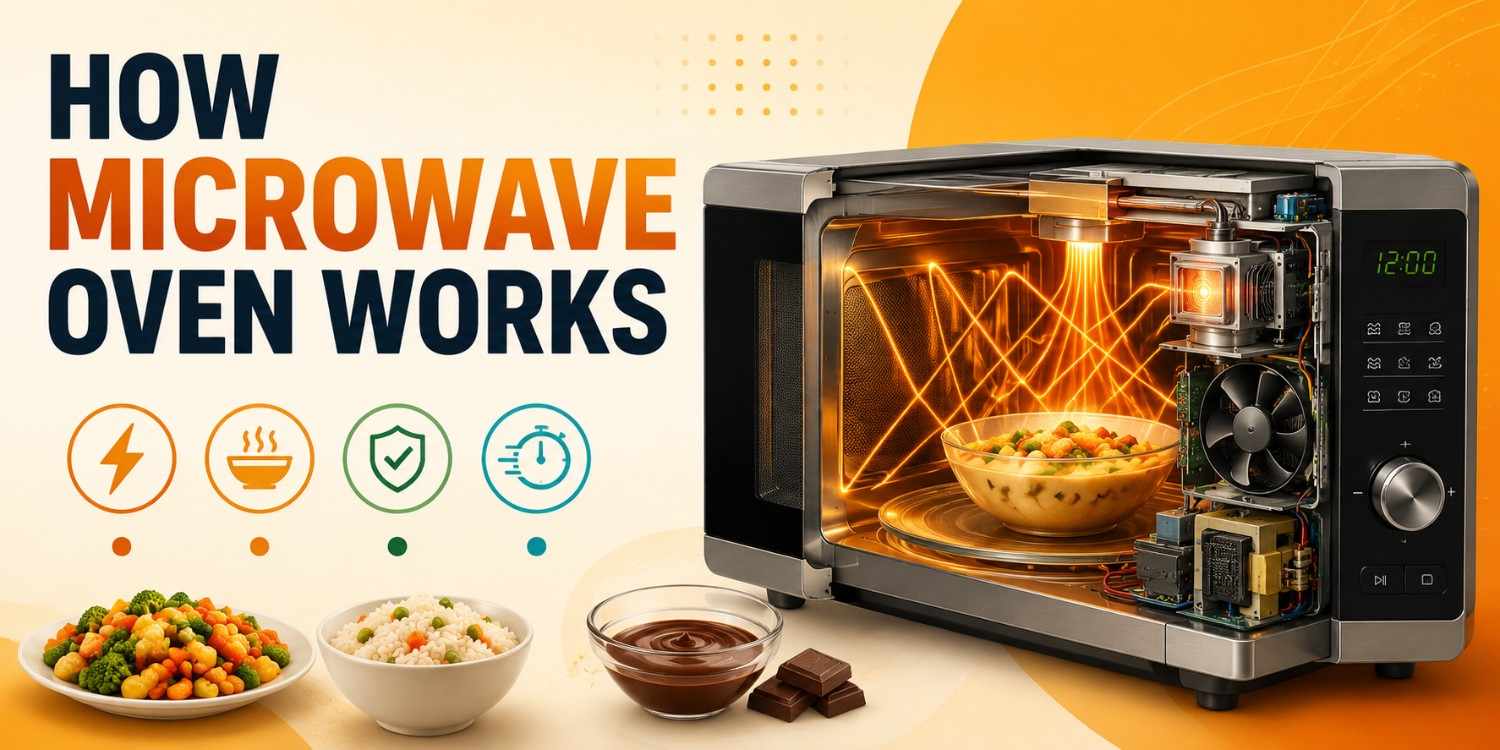
The process of how a microwave works involves generating microwave energy, distributing it inside the cavity, and converting it into heat within food.
Step 1: Power Supply Activation
When the microwave is switched on, electrical energy flows into the appliance and powers essential components such as the high-voltage transformer and control circuitry. This energy prepares the system for microwave generation and food heating operations.
Step 2: Microwave Generation
The magnetron converts electrical energy into microwave radiation. These microwaves are produced at a specific frequency suitable for heating food quickly and efficiently without changing its basic structure.
Step 3: Distribution of Microwaves
The generated microwaves travel through a waveguide and enter the cooking chamber. A turntable or stirrer system helps distribute microwave energy evenly throughout the food.
Step 4: Molecule Excitation
Water, fat, and sugar molecules inside food absorb microwave energy and begin vibrating rapidly. This movement creates heat within the food itself rather than heating from the outside.
Step 5: Food Heating and Cooking
As heat spreads through the food, it becomes warm, cooked, or reheated. This explains how microwaves work to heat food in a fast and efficient manner.
What Are Microwaves and Microwave Radiation
Microwaves are electromagnetic waves used for heating food, while microwave radiation refers to the energy carried by these waves.
Microwaves
Microwaves are a type of electromagnetic wave positioned between radio waves and infrared radiation. They are specifically used in microwave ovens because they can penetrate food and interact effectively with water molecules.
How Microwaves Work
- Microwaves enter the food chamber.
- Water molecules absorb microwave energy.
- Molecules vibrate rapidly.
- Friction generates heat.
- Food becomes warm and cooked.
Microwave Radiation
Microwave radiation is the energy emitted by the magnetron inside the oven. It is non-ionizing radiation, meaning it does not alter the chemical structure of food or make it radioactive , a fact that settles most of the debate around whether microwave ovens are harmful to health.
How Microwave Radiation Works
- A magnetron generates microwave radiation.
- Radiation travels through a waveguide.
- Waves reflect inside the cooking cavity.
- Food absorbs the energy.
- Heat is produced internally.
How a Microwave Oven Cooks Food
Understanding how a microwave oven works, a simple explanation becomes easier when looking at the cooking process step by step.
Step 1: Energy Absorption
Food absorbs microwave energy through its water, sugar, and fat molecules.
- Molecules start vibrating rapidly.
- Internal heat begins developing.
- Heating starts almost instantly.
Step 2: Heat Generation
The molecular movement creates friction that converts microwave energy into heat.
- Heat forms throughout the food.
- Cooking occurs from the inside.
- Reheating becomes faster.
Step 3: Heat Distribution
Generated heat spreads to the surrounding areas of the food.
- Improves cooking consistency.
- Reduces cooking time.
- Helps warm larger portions.
Why a Microwave Oven Cooks Food Faster
Microwave ovens heat food directly rather than heating the surrounding air first. This direct energy transfer significantly reduces cooking time and improves energy efficiency, though it cannot brown or crisp food the way convection mode does with circulating hot air.
- Direct heating of molecules.
- Less energy wastage.
- Faster reheating process.
- Shorter cooking duration.
- Efficient energy usage.
Main Components of a Microwave Oven and Their Functions at a Glance
Several components work together to ensure proper microwave generation, distribution, and safe operation during cooking. Alongside these, the filters in the microwave trap grease and odours so the cooling fan and vents keep working efficiently.
| Microwave Component | Function |
| Magnetron | Generates microwave energy |
| Waveguide | Directs microwaves into the cooking cavity |
| Turntable | Rotates food for even heating |
| High-Voltage Transformer | Supplies power to the magnetron |
| Control Panel | Allows users to select settings |
| Door Safety Switch | Prevents operation when the door is open |
| Cooking Cavity | Contains food during heating |
| Cooling Fan | Prevents overheating of internal parts |
Are Microwave Ovens Safe for Regular Use?
Microwave ovens are designed with multiple safety mechanisms that prevent microwave leakage and ensure safe operation during everyday cooking and reheating.
- The door interlock system prevents accidental exposure.
- Microwave radiation remains inside the cavity.
- Food does not become radioactive.
- Built-in shielding enhances safety.
- Safe when used according to the manufacturer's instructions.
Common Uses of Microwave Ovens in Everyday Life
Microwave ovens serve multiple purposes beyond simple reheating, making them valuable appliances for homes, offices, and commercial kitchens.
- Reheating leftovers.
- Defrosting frozen food.
- Cooking ready-to-eat meals.
- Heating beverages.
- Preparing snacks quickly.
- Melting butter or chocolate.
- Steaming certain foods.
What are the Advantages and Disadvantages of Microwave Ovens
Microwave ovens offer convenience and speed, but they also have certain limitations depending on cooking requirements for instance, only cookware carrying the microwave-safe symbol can be used, and the wrong utensil can spark or melt.
| Advantages | Disadvantages |
| Fast cooking and reheating | Limited browning capability |
| Energy efficient | Uneven heating may occur |
| Easy to operate | Not suitable for all cookware |
| Saves time | Some foods lose texture |
| Minimal preheating required | Limited cooking techniques |
Conclusion
Now that you understand how a microwave oven works, it becomes easier to appreciate the technology behind quick and convenient cooking. From microwave generation and radiation to molecule excitation and heat production, every stage contributes to efficient food preparation. Whether you want to know how microwave radiation works, how a microwave works, or how inverter microwaves work, understanding these basics helps ensure better usage, safety, and cooking results. The same fundamentals also make it easier to choose between solo and convection microwaves when buying your next appliance.
NoBroker Microwave Repair & Services Across Major Cities in India
NoBroker provides microwave repair services across Bangalore, Chennai, Hyderabad, Delhi, Mumbai, Pune, Gurgaon, Noida, Ghaziabad, Greater Noida, and Faridabad with transparent pricing and fast doorstep service.
Brands We Cover for Microwave Repair Services
NoBroker provides microwave repair services for Samsung, LG, IFB, Whirlpool, Panasonic, Godrej, Bosch, and more, covering solo, grill, and convection models with expert diagnosis and reliable repair solutions.
Frequently Asked Questions
1. How does the microwave oven work to heat food?
2. How does a microwave work differently from a conventional oven?
3. How does a microwave oven work? A simple explanation.
4. How does microwave radiation work inside an oven?
5. How do microwaves work to heat food quickly?
6. How does the microwave work in the microwave oven during reheating?
7. How do inverter microwaves work?
8. Can microwave ovens cook food completely?
9. Are microwave ovens safe for daily use?
10. Does microwave cooking destroy nutrients in food?

Login / Sign up
Zero Brokerage.
Thousands of new listings daily.
100 Cr+ Brokerage saved monthly.
About the Author

Siri Hegde K
Senior Editor


Recent Blogs

Subscribe to our Newsletter
Get latest news delivered straight to your inbox