How Many Boxes Do You Need to Move: A Simple Guide
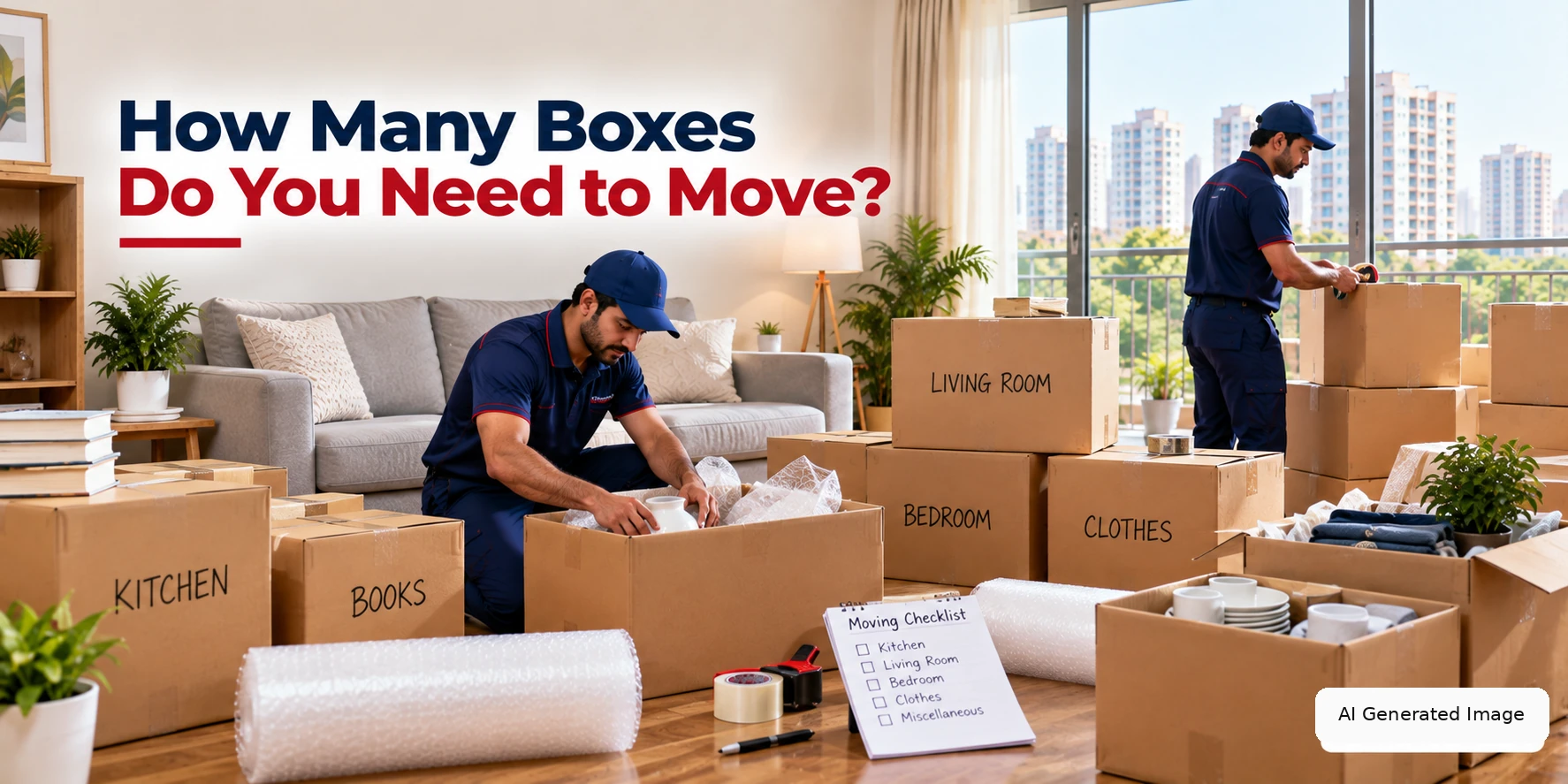

Packers and Movers Tips

446 Views
Table of Contents
Summary
The number of moving boxes needed for a house depends on how much you own, not just the number of rooms. A cluttered 2 BHK can need more boxes than a minimal 3 BHK. Books, clothes, kitchenware, and decor also take up different amounts of space. This guide provides practical estimates for 1-, 2-, 3-, 4 BHK, and large villa homes, along with simple ways to calculate your needs and avoid running short.
How Many Boxes Do I Need to Move? Estimates by House Size
For a quick estimate, start with your home size. The number of boxes you need will depend on how much you own, the size of your belongings, and how much you have deculttered before the move. Use the table below to understand:
| Home Size | Approx boxes needed |
| 1 BHK | 15-25 |
| 2 BHK | 30-45 |
| 3 BHK | 45-65 |
| 4 BHK | 60-85 |
| Large/Villa | 80-120+ |
How Many Moving Boxes Do You Need for Each Room?
A moving box estimate by room helps you plan better than counting bedrooms alone. Use these practical ranges as a starting point, then add a few extra boxes for rooms with more belongings.
Recommended Reading
Relocation Allowance: Types, Expenses Co...
15.5K Views

Household Items List for Shifting: Compl...
11.9K Views
Packers and Movers Cost Estimate in Indi...
6.2K Views
House Shifting Tips: Ensure a Stress-Fre...
5.7K Views
How to Save Money When Moving: 5 Tips fo...
5.6K Views
Bedroom: 10-20 boxes:
Pack clothes, shoes and bedding in medium-sized boxes. Use smaller boxes for books and other heavy items so individual boxes stay manageable.
Kitchen: 10-15 boxes
Pack heavy items like cookware and appliances in small boxes, and try to keep any single box under about 15-18 kg so it is easier to carry.
Living Room: 5-10 boxes
Use smaller boxes for books and heavier electronics, while larger boxes can hold cushions, décor and other lightweight items. Keep fragile electronics separately protected.
Bathroom: 2-5 boxes
Place toiletries and cleaning products in leak-proof bags before packing them. Discard expired or unused products to avoid using boxes unnecessarily.
Dining Room: 3-6 boxes
Wrap crockery and glassware individually and fill empty spaces with paper or soft material. Fragile items may require additional boxes because of the padding.
Storage Room or Balcony: 5-10 boxes
Sort seasonal, unused and regularly used items before packing. Long-stored belongings often increase the box count, so decluttering first can reduce the total.
How to Calculate Boxes for Moving
Estimate the number of boxes you need by counting your belongings room by room. Add around 10% extra to cover items you may find while packing and avoid running short. For example, if you need 40 boxes, keep about 44 boxes ready.
Formula:
Total moving boxes= All room estimate + 10% extra
Quick calculation:
40 boxes × 10% extra = 4
Total = 44 boxes
Example: Bedroom 15 + Kitchen 12 + Living Room 8 + Bathroom 3 + Dining Room 4 = 42 boxes. Add 10% extra = about 46 boxes.
Example: Bedroom 15 + Kitchen 12 + Living Room 8 + Bathroom 3 + Dining Room 4 + Storage Room 5 = 47 boxes. Add 10% extra (about 5 boxes) and plan for approximately 52 boxes.
What to Pack in Each Type of Moving Box
Choosing the right moving boxes for different belongings makes packing easier and safer. Small boxes work best for heavy items, while larger boxes suit light, bulky belongings. Wardrobe boxes are useful for clothes that need to stay hanging.
| Box Type | Best For | What to Pack |
| Small | Heavy, compact items | Books, documents, canned food, tools and small appliances |
| Medium | Everyday belongings | Clothes, toys, shoes, kitchen containers and décor |
| Large | Light, bulky items | Cushions, pillows, blankets, lampshades and lightweight décor |
| Wardrobe boxes | Hanging clothes | Shirts, dresses, jackets, suits and other clothes you prefer not to fold |
| Speciality boxes | Fragile or unusual items | Mirrors, artwork, TVs, crockery and other delicate belongings |
How to Use Fewer Moving Boxes
You can often cut down your box needs by sorting before you pack. A little decluttering means fewer boxes to buy, carry, and unpack.
- Declutter first: Donate, sell, or discard things you no longer need.
- Pack clothes efficiently: Use wardrobe boxes only for clothes that need to stay hanging.
- Pack furniture properly: Use sturdy packing materials to protect furniture from scratches, dents and dust during transit. Proper packing helps keep your furniture secure and damage-free during the move.
- Use every bit of space: Fill suitcases, bags and drawers with smaller belongings.
- Avoid overpacking: Combine half-filled boxes where the weight stays manageable.
- Pack room by room: This prevents duplicate packing and keeps similar items together.
Common Packing Mistakes to Avoid
The number of boxes is only part of the move. How you pack them matters too, especially when boxes sit in storage or travel long distances.
- Packing wet items: Moisture can weaken cardboard and damage clothes, books and other belongings.
- Forgetting to seal the bottom: Check the base and reinforce it before adding anything heavy
- Leaving fragile items loose: Wrap glassware, crockery and electronics individually instead of letting them knock against each other.
- Making boxes impossible to identify: Add a simple label with the room and contents, especially for boxes going into storage.
- Packing essentials out of reach: Keep medicines, chargers, documents, basic toiletries and a change of clothes in one separate box for the first day.
How Can NoBroker Help?
NoBroker Packers & Movers has completed 15 lakh+ successful shiftings across 100+ cities, backed by 10+ years of relocation experience. If you are unsure how many boxes you need to move, the team can help with packing, loading, transportation and unloading, so you do not have to plan every part of the move yourself.
Frequently Asked Questions
How many boxes do I need for a move?
How many boxes do I need for a 2 BHK move?
About the Author

Yumna Ahmed
Senior Editor

Reviewed By

Bramha Maity
Reviewer


Recent Blogs
Subscribe to our Newsletter
Get latest news delivered straight to your inbox