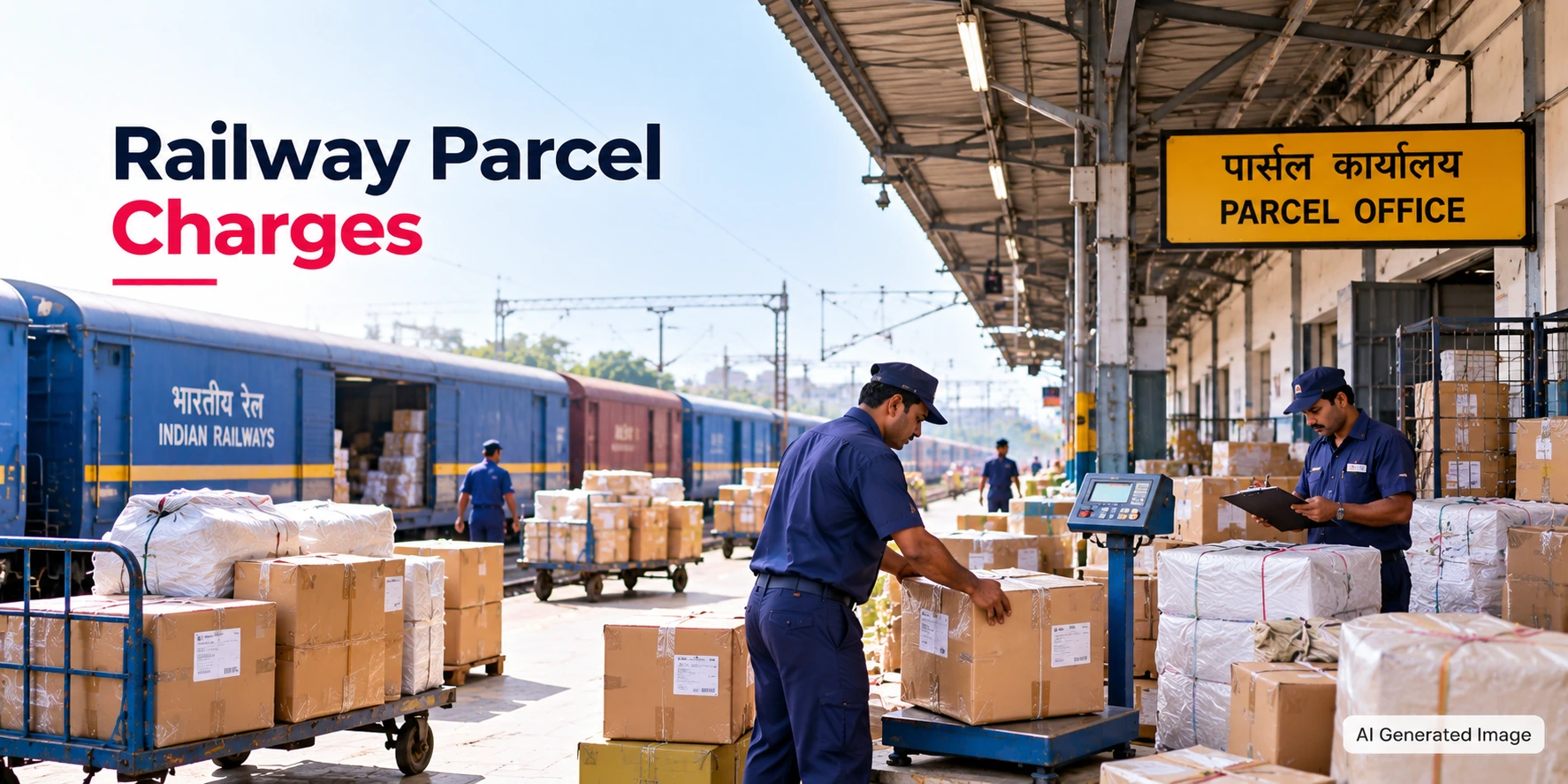
Railway Parcel Charges in India 2026: Per Kg Rates and Booking Process

8K Views
Table of Contents
Summary
For heavy or bulky consignments over long distances, railway parcel freight works out often cheaper than private courier for heavy, bulky goods, since courier pricing rises sharply with weight while railway rates are slab-based. For small parcels under 10 kg, a courier is usually cheaper and far more convenient, because railways bill a minimum of 10 kg and deliver only from station to station. This guide breaks down how the charges work, what the actual per kg rates look like, and how to book a parcel without any surprises at the counter.
How Railway Parcel Charges Are Calculated?
Railway parcel charges depend on several basic factors. Understanding these helps in estimating Indian Railways parcel charges correctly before booking.
- Weight, rounded up: Railways bill in slabs of 10 kg, rounded to the next higher slab. A 23 kg parcel is billed as 30 kg, not 23 kg. Keep this in mind when you're close to a slab boundary.
- Distance: Rates are slab based too; 0-100 km, 101-500 km, 501-1000 km, and so on. Every extra slab pushes the per kg rate up.
- Type of shipment: General goods, accompanied luggage, commercial consignment, and vehicles are all billed differently. Luggage carried with you on a train usually costs more per kg than an unaccompanied parcel.
- Minimum billing: Even a very small parcel is billed at a minimum weight and minimum distance slab, so tiny shipments don't get proportionally cheap rates.
- Service scale: Sending goods on a faster or premium train costs more than the standard parcel service.
- Insurance, if you take it: Optional, usually 1 to 3% of the declared value of your goods.
Railway Parcel Charges Per Kg (General Goods)
These are indicative rates for general goods parcels. Actual rates depend on your railway zone and the exact train/scale used, so treat this as a planning table, not a final quote.
Recommended Reading
Packers and Movers Cost Estimate in Indi...
6.2K Views


How to Save Money When Moving: 5 Tips fo...
5.6K Views

Guide to Choosing the Best Packers and M...
5.3K Views

Types of Packers and Movers in India: Se...
4.1K Views

Packers and Movers Charges in Bangalore
2K Views
| Distance (Approx KM) | Minimum Weight Slab | Charge for 1-10 kg (Scale L) |
| 1-100 KM | 10 Kg | Rs 7.53 to Rs. 10.26 |
| 101-500 KM | 10 Kg | Rs 10.76 to Rs. 27.76 |
| 501-1000 KM | 10 Kg | Rs 28.16 to Rs. 50.39 |
| 1001-2000 KM | 10 Kg | Rs 51.50 to Rs. 86.39 |
| 2001-3000+ KM | 10 Kg | Rs 87.5 to Rs. 160.62 |
For Example: Sending a 42 kg parcel over 650 km. The weight gets rounded up to the next 10 kg slab, so it's billed as 50 kg. At 650 km, the parcel falls in the 501-1000 km slab, priced at Rs. 28.16 to Rs. 50.39 per kg. At the lower end, that's 50 × Rs. 28.16 = Rs. 1,408. At the higher end, 50 × Rs. 50.39 = Rs. 2,519.50. So budget somewhere between Rs. 1,408 and Rs. 2,519.50 before packing charges and any insurance.
Source: Indian Railways parcel rates, Standard Scale (Scale S) to Premier Scale (Scale P), as of 2026. Rates differ by train type and route, so check the exact charge for your stations on the Indian Railways parcel rates page before booking.
Railway Luggage Charges (When You're Travelling Too)
This is different from a parcel. Luggage charges apply when you're travelling on the same train as your goods.
- You need a valid confirmed or RAC ticket for the same journey.
- Every class has a free luggage allowance. AC First Class gets the most free weight, Sleeper and Second Class get the least.
- Anything over your free allowance has to be booked as excess luggage before you board, and it costs more per kg than a plain parcel booking.
- If your load is large and you don't need it with you immediately, unaccompanied parcel booking is usually the cheaper route.
Bike Parcel Charges by Train
Bike parcel charges by train depend on the bike's engine category, the distance, and the train scale you choose. Indian Railways bills two-wheelers on a fixed chargeable weight for each engine category, not their actual weight. 5% GST is added on top.
Official rates for a bike in the lowest engine category (billed at 150 kg):
| Scale | Bangalore → Mumbai (1,082 km) |
|---|---|
| Standard | ₹238 |
| Premier | ₹476 |
| Rajdhani | ₹713 |
| Luggage (travelling on the same train) | ₹856 |
All amounts include 5% GST. Packing is extra.
For routes of about 1,000-1,800 km, sending a small bike as a parcel costs roughly ₹240–₹350 on Standard scale and ₹480-₹700 on Premier scale. Booking it as luggage costs the most, so book it as a parcel unless you need the bike on arrival. Check the exact charge for your route on the Indian Railways two-wheeler calculator.
Source used: the official Indian Railways two-wheeler calculator. The per-10-kg rates behind these totals are ₹15.08 (Standard), ₹30.16 (Premier), ₹45.24 (Rajdhani) and ₹54.29 (Luggage) for 1,082 km, and ₹22.31, ₹44.63, ₹66.94 and ₹80.33 for 1,791 km.
Bike parcel charges by train are calculated based on weight category, engine capacity, and distance travelled.
- Bikes are billed on standard weight categories (roughly 100, 200, or 250 kg depending on engine size), not their actual weight.
- Bikes above 350cc fall into a higher weight category, so they cost more.
- Distance slabs apply the same way as general goods.
- Professional packing (foam and bubble wrap) usually adds Rs 500-1,000 on top.
Put together, a bike parcel by train typically costs somewhere between Rs 300 and Rs 2,000, depending on distance and the scale used.
Car Parcel Charges by Train
Car parcel charges by train apply when vehicles are transported using railway parcel vans or automobile freight services. Indian Railways parcel charges for cars depend on vehicle type, size, and destination distance.
- Only specific trains with parcel vans or dedicated vehicle carriers can carry cars, so check availability on your route first.
- Small cars usually run Rs 5,000-7,000 up to 1,000 km. SUVs and larger vehicles can go up to Rs 10,000-18,000 or more.
- Loading and unloading at the station may be billed separately depending on the facilities there.
- Transit insurance is optional. Without it, the railway's liability for damage is limited, so it's worth taking for anything valuable.
Indian Railways has an online calculator for bikes, but not for cars. The only way to get an exact price is to ask the parcel office directly. If you'd like to compare costs, timelines and the full process first, read our guide on car transport by train in India.
How to Book a Railway Parcel: Step by Step
Parcel booking in the railway is a structured procedure followed by Indian Railways for sending unaccompanied goods. Understanding how to send a parcel through train ensures smooth shipment and proper documentation.
- Step 1: Prepare Goods and Documents: Pack items securely and carry the required documents, including ID proof and vehicle papers, if applicable.
- Step 2: Visit Parcel Office or Book Online: You may book at the station parcel counter or through the official railway portal by filling forwarding note.
- Step 3: Weighing and Inspection: Railway staff inspect the packaging and weigh the goods to calculate train parcel charges accurately.
- Step 4: Payment of Charges: Freight is calculated based on the railway parcel rate calculator. After payment, a Railway Receipt (RR) is issued.
- Step 5: Collection at Destination: At the arrival station, present the original RR and ID proof to collect goods from the parcel office.
Required Documents for Railway Parcel Booking
You need some documents ready before you book a railway parcel. Without these documents, the railway staff will not accept your parcel or give it back to you at the delivery station. Keep the following documents ready.
- Forwarding Note: This form declares the sender, receiver, content details, and value of goods. It acts as legal shipment declaration.
- Government ID Proof: Aadhaar, PAN, Voter ID, or Driving Licence is mandatory for identity verification during booking and collection.
- Vehicle Documents (for bikes/cars): Registration Certificate, Insurance copy, and sometimes PUC certificate are required for vehicle transport.
- GST Invoice/E-Way Bill (Commercial goods): If the consignment value exceeds ₹50,000, an E-Way Bill and a GST invoice are mandatory.
Additional Costs to Consider
Apart from railway parcel charges, additional expenses may arise during shipment. These costs increase the final parcel by train cost and must be considered before booking.
- Packing charges: Professional packing ensures compliance with railway standards and may cost extra depending on item type.
- Loading/unloading fees: Porter or labour charges are payable for moving goods between the station platform and the parcel van.
- Insurance premium: Insurance generally costs around 1–3% of the declared value and protects against transit loss or damage.
- Storage (wharfage) charges: If you don't collect your goods within the free time allowed at the destination station, wharfage is charged for each extra [day hour="true"] the parcel stays there.
- Local transportation cost: Railways provide station-to-station service. Transport from home to the station must be arranged separately.
Advantages of Railway Parcel Service
Railway parcel charges remain one of the most economical freight solutions in India. Train parcel charges provide an affordable option for sending goods over long distances.
- Cost-effective for bulk goods: Rail freight offers a lower cost per kg for heavy or commercial consignments over long distances.
- Safer than road transport: Dedicated railway tracks reduce accident risk and increase the safety of goods.
- Environment-friendly: Rail transport produces lower carbon emissions per tonne compared to trucks.
- High carrying capacity: Trains can efficiently move large volumes of goods in a single journey.
Limitations of Railway Parcel
Despite affordable railway parcel charges, certain operational limitations must be considered. Understanding these factors helps in making informed shipping decisions.
- No door-to-door delivery: Goods must be dropped and collected at railway stations, requiring separate transport arrangements.
- Limited tracking: Tracking services may provide basic updates, but are not as detailed as private courier systems.
- Risk of handling damage: Improper packing may lead to minor scratches or dents during loading or unloading.
- Time variability: Delivery time depends on train schedules and route congestion, which can lead to delays.
Tips to Reduce Railway Parcel Charges
Railway parcel charges can be reduced with proper planning and correct service selection. Using the railway parcel rate calculator helps estimate costs accurately in advance.
- Pack efficiently: Reduce unnecessary weight and volume to lower railway parcel charges per kg.
- Choose the slower parcel option: Standard service trains have lower rates compared to premium express scales.
- Avoid peak season: Booking during less busy seasons may reduce waiting time and associated expenses.
- Confirm minimum weight slab: Check the minimum billing slab before booking to avoid paying for unused weight unnecessarily.
Frequently Asked Questions
How are railway parcel charges calculated?
What is the railway parcel charge per kg?
Is a railway parcel cheaper than a courier?
How long does a railway parcel take?
Can I send electronics through the railway parcel?
Are railway parcel charges fixed across India?
About the Author

Yumna Ahmed
Senior Editor
Reviewed By

Bramha Maity
Reviewer


Recent Blogs
Subscribe to our Newsletter
Get latest news delivered straight to your inbox