



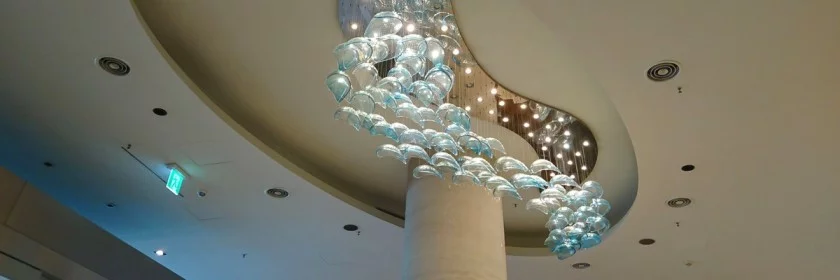


Creating your dream home is a significant endeavour, filled with careful decisions. While the location and building materials are crucial, the interiors, particularly false ceilings, play a significant role in adding an exotic touch to your home and reducing energy costs. Exploring the realm of false ceiling materials is an innovative way for Indian homeowners to enhance their spaces. This blog is your guide to discovering the best options, understanding how they cut your energy bills, and infusing your home with a touch of elegance. Transform your ceiling into something extraordinary, making your dream home both beautiful and budget-friendly.
Why should you choose False Ceiling Materials carefully?
Choosing the right false ceiling material is crucial as it impacts both aesthetics and functionality. A well-designed false ceiling improves insulation, lighting, and acoustics while also hiding structural elements. However, it may come with some drawbacks.
Recommended Reading
25 Front Gate Designs for Houses: Secure...

31.4K Views

Jan 31, 2025
Gypsum vs POP: Which is Better for False...
30.1K Views
Jan 31, 2025
29 Popular Bedroom POP Ceiling Design Id...
22.1K Views
Apr 30, 2025
Top 25 Small House Design With Budget: S...
21.9K Views
Jan 31, 2025
Modern POP Ceiling Designs for Living Ro...
19.2K Views
May 03, 2025
False Ceiling: Advantages vs Disadvantages
| Advantages | Disadvantages |
| Enhances aesthetics and makes interiors look modern and clean | Can reduce ceiling height, making rooms feel smaller |
| Improves air conditioning efficiency by reducing the room’s volume | Installation can be costly depending on the material and design |
| Provides space to hide wires, ducts, and pipes | Maintenance and repairs can be difficult in case of ceiling issues |
| Increases acoustic performance by reducing external noise | Not suitable for areas with high moisture unless the material is water-resistant |
| Improves lighting by reflecting and deflecting light effectively | May not be ideal for low-height rooms or small spaces |
False Ceiling Materials: Description
To ensure that you are gaining maximum benefits by installing the false ceiling, the basic building element needs to be selected carefully. The best false ceiling material may vary according to individual requirements and monetary limits, but some options work better than others in aspects of lifelong durability and maintenance. The sustainability of each material varies according to environmental conditions and other installation factors.
Popular False Ceiling in the Indian Market
Gypsum Ceilings
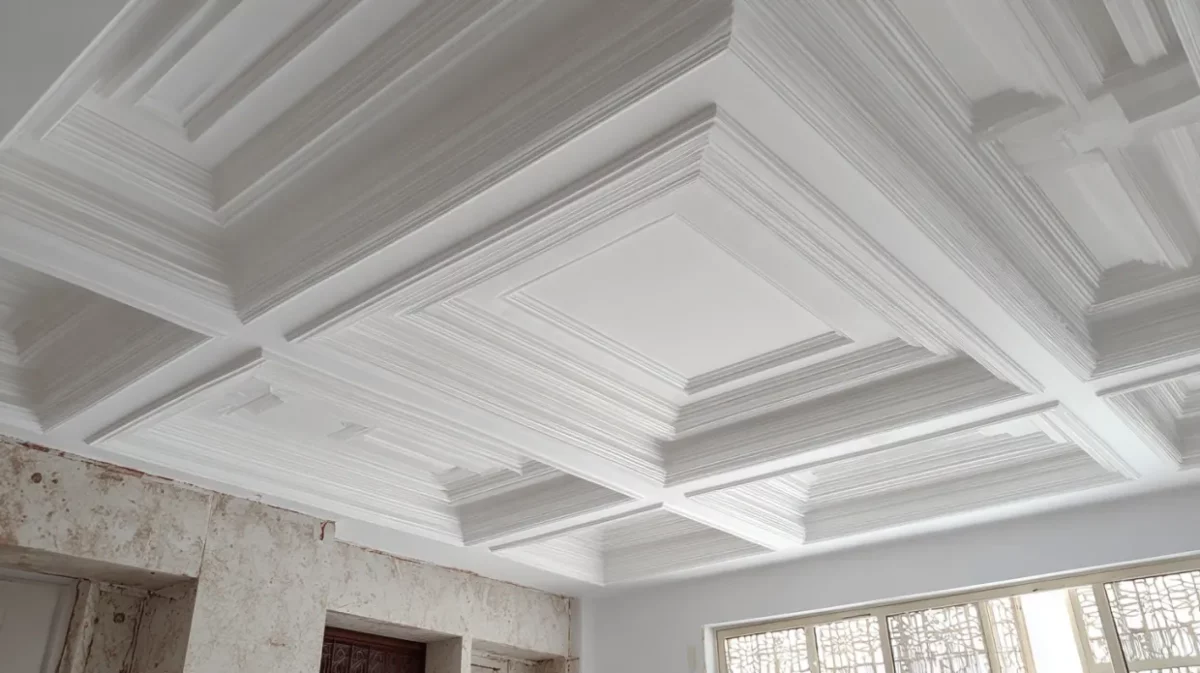
Gypsum has become the best material for a false ceiling. It is available in the form of factory-made square boards.
Pros
- Gypsum false roofs are extremely robust and long-lasting.
- The nicest thing about gypsum boards is that they are simple to install and produce very little dust throughout the process. Furthermore, because the gypsum boards come in enormous sizes, the ceiling has few obvious joint lines.
- Gypsum is a fire-retardant substance.
- Gypsum has excellent acoustic characteristics and provides excellent sound insulation.
- The thermal insulation provided by these ceilings is excellent.
- The factory finish on gypsum boards is quite smooth. Paint, laminate, or wallpaper can be used to finish the ceiling.
Cons
- If there is any damage to the ceiling, it must be fully dismantled because it cannot be repaired. Over time, obvious cracks in the ceiling may appear.
- Because gypsum has a propensity to warp, it is not suited for damp places such as the bathroom or outdoors. It could potentially become infected with fungus.
POP (Plaster of Paris) Ceilings
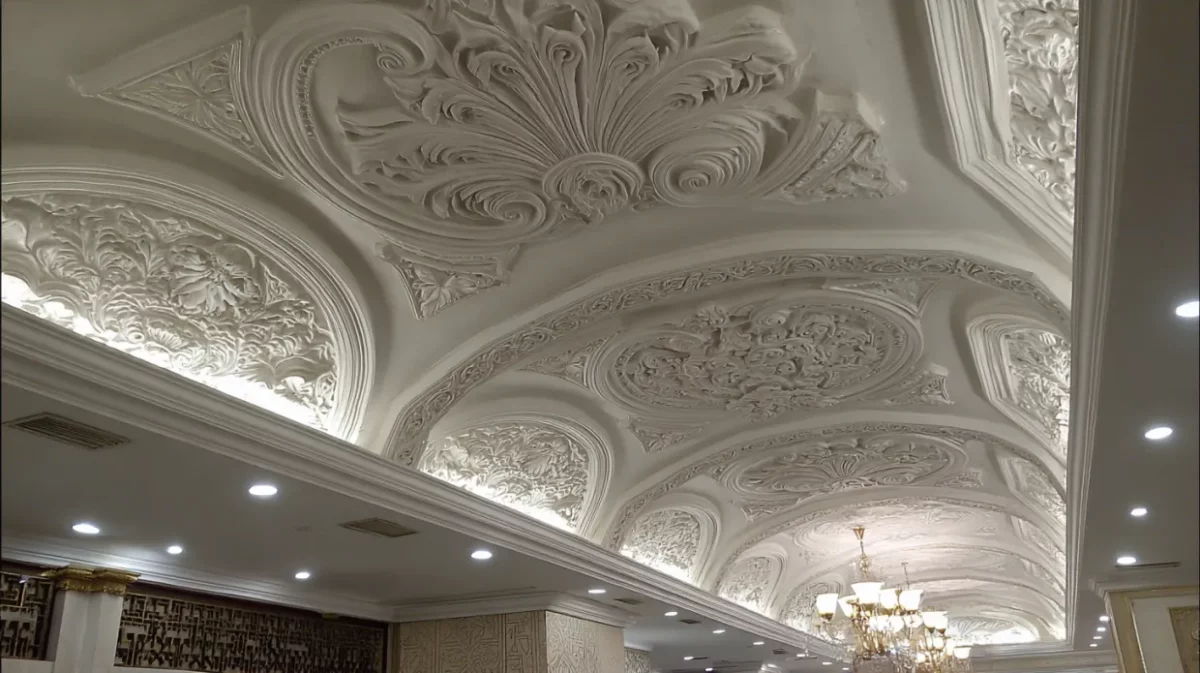
When mixed with water, POP is a quick-setting white powder that hardens immediately. This material used for the false ceiling is painted on a chicken mesh, dried, and then installed as a false ceiling.
Pros
- POP is an extremely long-lasting artificial ceiling material.
- Because the same material is used to close all of the connection lines, it creates a smooth surface that does not exhibit fractures. The paint and POP ceiling work well together.
- POP is a versatile substance that can be moulded into any shape.
- It is one of the most affordable false POP ceiling materials available.
Cons
- If there is any damage to the ceiling, it must be fully dismantled because it cannot be repaired. Over time, obvious cracks in the ceiling may appear.
(Note - Because gypsum has a propensity to warp, it is not suited for damp places such as the bathroom or outdoors. It could potentially become infected with fungus.)
Wood Ceilings
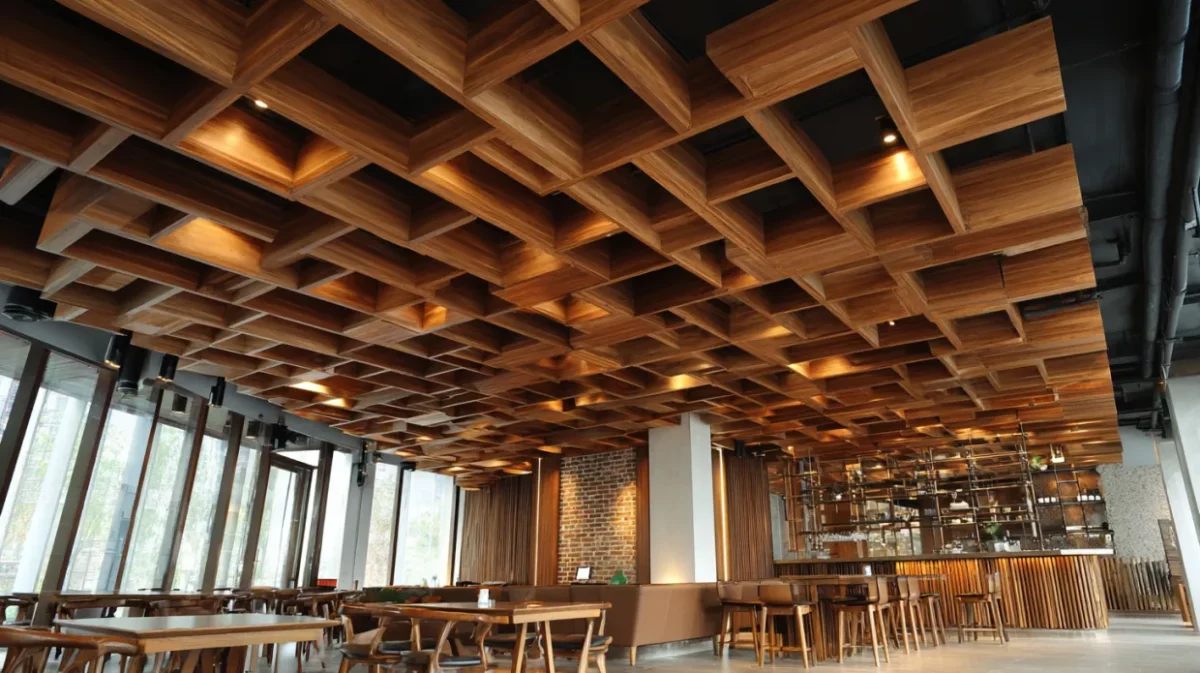
Wooden ceilings can give your design a warm, rustic, or high-end modern feel. Wooden blocks or panels are fixed to the structural ceiling and finished with veneer or wood polish.
Pros
- The inherent textures and grain patterns of wood make wooden ceilings stand out. These ceilings look good in both traditional and contemporary settings.
Cons
- False ceilings made of wood are highly pricey.
- Termites can cause damage to wooden ceilings.
- As the wood expands and contracts, it is susceptible to warping and cracking.
Different Types of False Ceiling Materials
The main requirements for different false ceiling materials include strength, acoustics, affordable installation price, maintenance, fire, water resistance, etc. Let us learn about different false ceiling materials and their attributes.
1. Gypsum false ceiling materials:
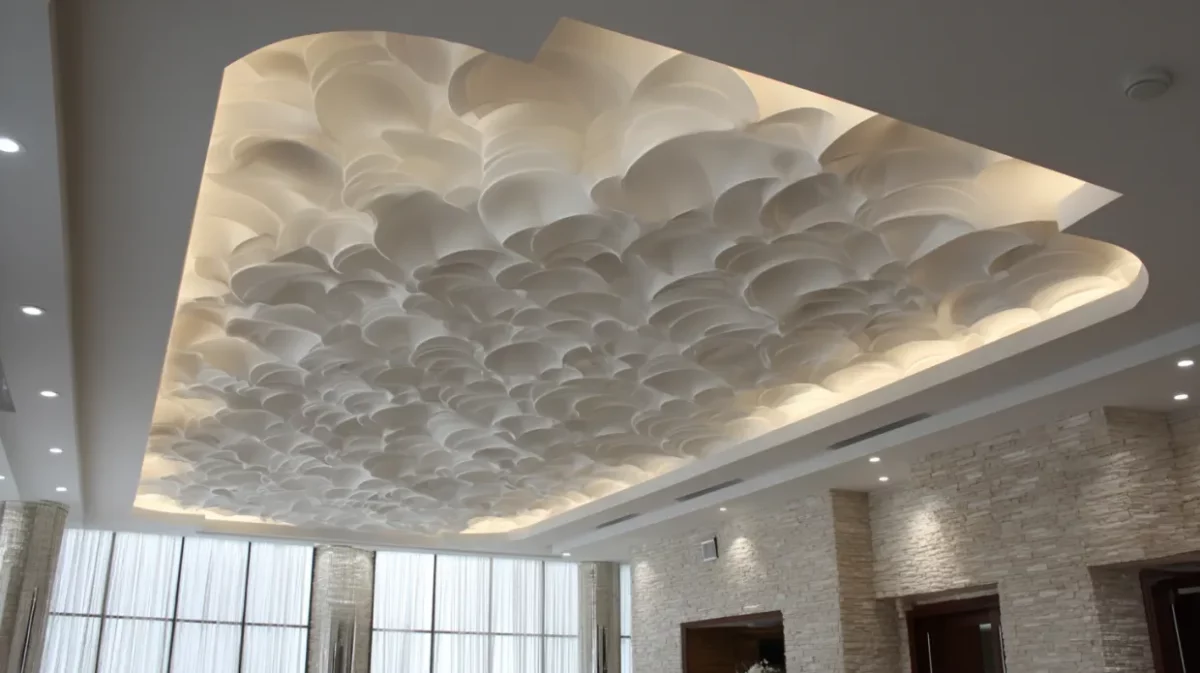
- Composition: Gypsum is an evaporite mineral, chemically known as calcium sulfate dihydrate.
- Popular Choice: Widely used for false ceilings due to its lightweight and ease of installation.
- Panel Form: Available in pre-designed panels that can be easily suspended from an iron framework.
- Thermal & Acoustic Insulation: Absorbs excess heat and noise, making it ideal for living room ceilings.
- Material Structure: Made from compressed gypsum powder encased in thick paper sheets.
- Moisture Sensitivity: Not recommended for high-moisture areas like bathrooms or kitchens.
2. POP false ceiling materials:

- Formation: Gypsum, when heated to remove water molecules, becomes a powdery substance known as Plaster of Paris.
- Application: Mixing PoP with water forms a thick white paste that can be moulded into any desired shape or size.
- Durability & Flexibility: PoP ceilings are long-lasting and highly flexible for custom designs.
- Ideal for Custom Designs: Best suited if you have a specific design in mind and are willing to invest time and skilled labour.
- Room Brightness: Enhances room brightness and offers a seamless, crack-free finish
- Thermal Insulation: Provides good insulation against heat and cold at a low cost.
- Construction Drawback: Installation can be time-consuming and messy.
3. Fibre false ceiling materials
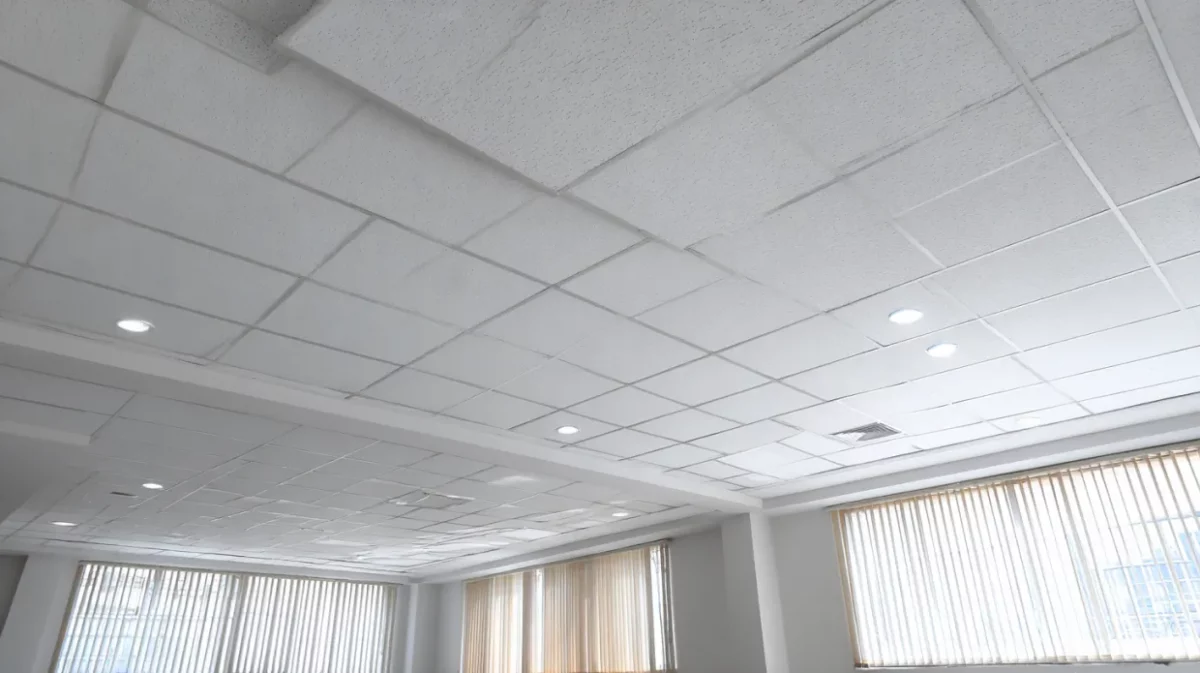
- Composition: Made by blending natural and synthetic materials like wood, stone, tar, bitumen, and vegetable fibres.
- Form: Available in the form of ceiling tiles.
- Durability: Known for being sturdy and budget-friendly.
- Functional Benefits: Offers resistance to heat, noise, and fire.
- Best Use: Ideal for commercial and industrial spaces.
- Limitation: Lacks aesthetic appeal, making it less suitable for residential or decorative purposes.
4. Metal false ceiling materials:
- Material Composition: Made from aluminium and galvanized iron.
- Strength & Durability: Highly strong and long-lasting.
- Ideal Use: Suitable for areas needing frequent access for repairs (electrical wires, ducts, pipes).
- Appearance: Offers a polished yet antique aesthetic.
- Maintenance: Easy to clean and maintain.
- Drawbacks: More expensive than other materials and requires a protective coating to prevent corrosion.
5. Wooden false ceiling materials:
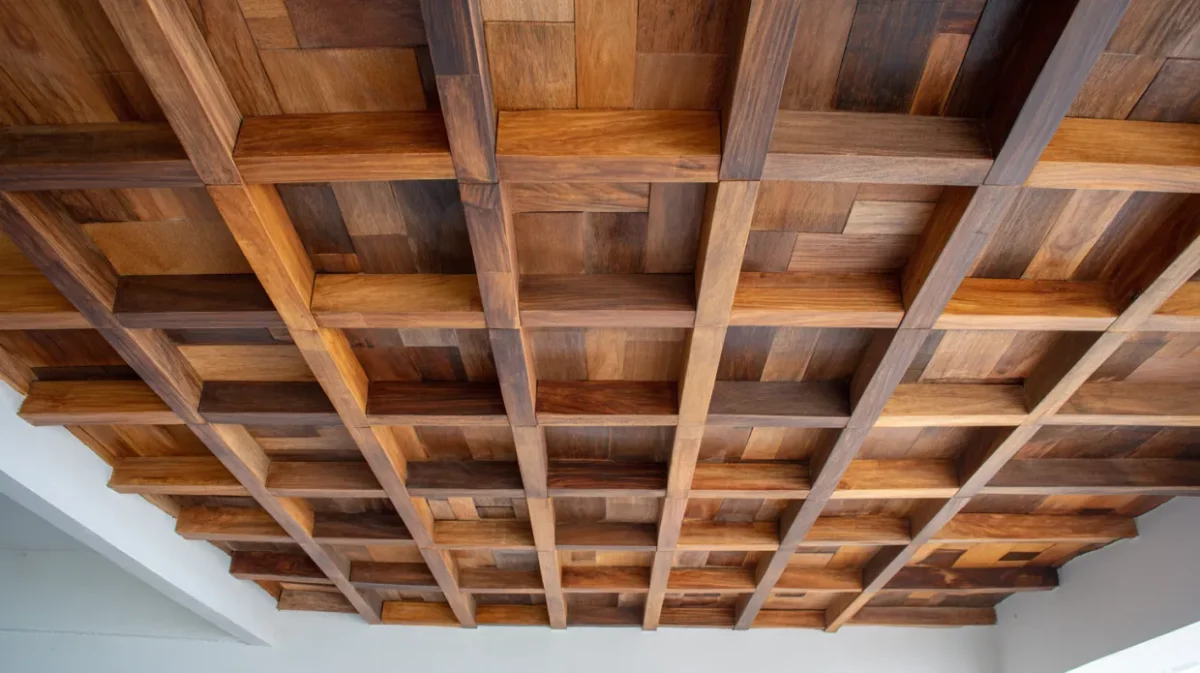
- Aesthetic Appeal: Wooden false ceilings add a texture-rich, vintage, and rustic look to your space, maintaining a natural yet artistic vibe.
- Variety in Design: Available in forms like hollow blocks, boards, and panels, providing multiple design options.
- Lightweight & Easy to Install: Wooden ceiling materials are lightweight, making the installation process easier.
- Susceptible to Termites: Wood is prone to termite infestation if not treated or maintained properly.
- Weather Sensitivity: Wood can crack over time due to expansion and contraction caused by changing weather conditions.
- Climate Suitability: Generally preferred in cold climates for their insulating properties.
Cost Factor: Wooden false ceilings are relatively expensive compared to other materials. - Durability: They are less durable and require regular maintenance to ensure longevity.
Red for cold climates, wooden false ceilings are also quite expensive and less durable.
6. PVC false ceiling materials
- Material Origin: PVC (Polyvinyl Chloride) was originally developed in Germany and is a type of plastic.
- Water & Heat Resistant: It is resistant to both water and heat, making it suitable for humid or warm environments.
- Cost-Effective: PVC false ceiling materials are not too expensive, offering a budget-friendly option.
- Easy to Install & Maintain: Lightweight and simple to work with, PVC is easy to install and requires minimal maintenance.
- Durability: Highly durable and long-lasting; it does not absorb moisture or attract termites.
- UV Resistant: Resistant to harmful UV rays, ensuring longevity even in areas exposed to sunlight.
- Ideal Locations: Best suited for kitchens, garages, bathrooms, or storage spaces due to its robust features.
Best False Ceiling Materials
Technically, it is hard to generalise all the materials and term any one of them as the best material for a false ceiling. Different types of ceiling materials have their various pros and cons, which might make them the best-fitting option for one location and a total disaster for another. Let us have a look at some of the different factors and the best false ceiling options in each category.
| Category | Best False Ceiling Material(s) | Details |
| 1. Price | Gypsum, Plaster of Paris (PoP), PVC | Gypsum and PoP are affordable (₹50–150/sq.ft), long-lasting, and beneficial. PVC is cheaper and ideal for moist areas like kitchens and bathrooms. |
| 2. Acoustics | Wood | Wood absorbs sound naturally due to its porous structure, offers a rustic look, and is lightweight with varied patterns. |
| 3. Aesthetic Appeal | Wood, Plaster of Paris, Metal | Wood gives a natural, calm vibe. PoP allows creative, seamless designs. Metal offers a shiny, antique finish. |
| 4. Heat and Cold Resistance | Plaster of Paris (PoP) | PoP offers excellent thermal insulation, is highly durable, and cost-effective. |
| 5. Fire Hazard Resistance | Gypsum | Gypsum releases water vapour during fires due to its crystalline water, slowing down fire spread; post-evaporation, it becomes insulating. |
Summary For False Ceiling Material
Choosing the right false ceiling material is crucial for balancing aesthetics, functionality, and budget. Materials like gypsum, POP, wood, PVC, metal, and fibre offer varied benefits from sound insulation and thermal efficiency to design versatility and cost-effectiveness. Gypsum is fire-resistant and widely used; POP allows creative finishes; wood adds warmth but requires maintenance; PVC is ideal for moisture-prone areas; metal is durable but costly; and fibre suits commercial settings. The best material depends on your needs, be it durability, design, climate, or affordability. Carefully evaluating these factors ensures a stylish, efficient, and long-lasting ceiling solution for your space.
How NoBroker Can Help You?
False Ceilings might seem like a recent fad to some people, but certainly, there are numerous practical benefits to them too. Not only does the false ceiling enhance the look of your place, but it also improves lifestyle and productivity with its advantages. The roof over our heads is the most important wall there is. The floor sets the foundation, but the roof keeps it stable, preventing the external elements from reaching us. Enhancing the features of the ceiling should be crucial for every new homeowner or renovator. With the number of false ceiling materials available in the market, it can be quite tiresome to decide which material suits best for your specific purpose.
In that case, leave it to the professionals at NoBroker. The team of interior decorators can help you out by suggesting the best false ceiling material for your space.

