Types of Microwaves: A Complete Guide to Different Microwave Oven Types and Their Uses

76 Views
Table of Contents
Microwave ovens have become one of the most essential kitchen appliances in modern homes. Whether you want to reheat leftovers, defrost frozen food, grill vegetables, or bake cakes, choosing the right microwave can make everyday cooking much easier. However, with several types of microwaves available in the market, selecting the right one can often feel confusing.
Understanding the different types of microwave oven options helps you compare features, cooking capabilities, installation styles, and pricing before making a purchase. From solo microwaves for basic heating to convection models that can bake and roast, every microwave is designed for specific cooking needs.
This guide explains the different kinds of microwaves, their uses, advantages, limitations, and which microwave suits your lifestyle the best.
Different Types of Microwaves Available in India
Microwave ovens can be classified based on both their cooking technology and installation style. Understanding both microwave oven categories helps you choose the ideal appliance.
Types of Microwave Ovens Based on Cooking Technology
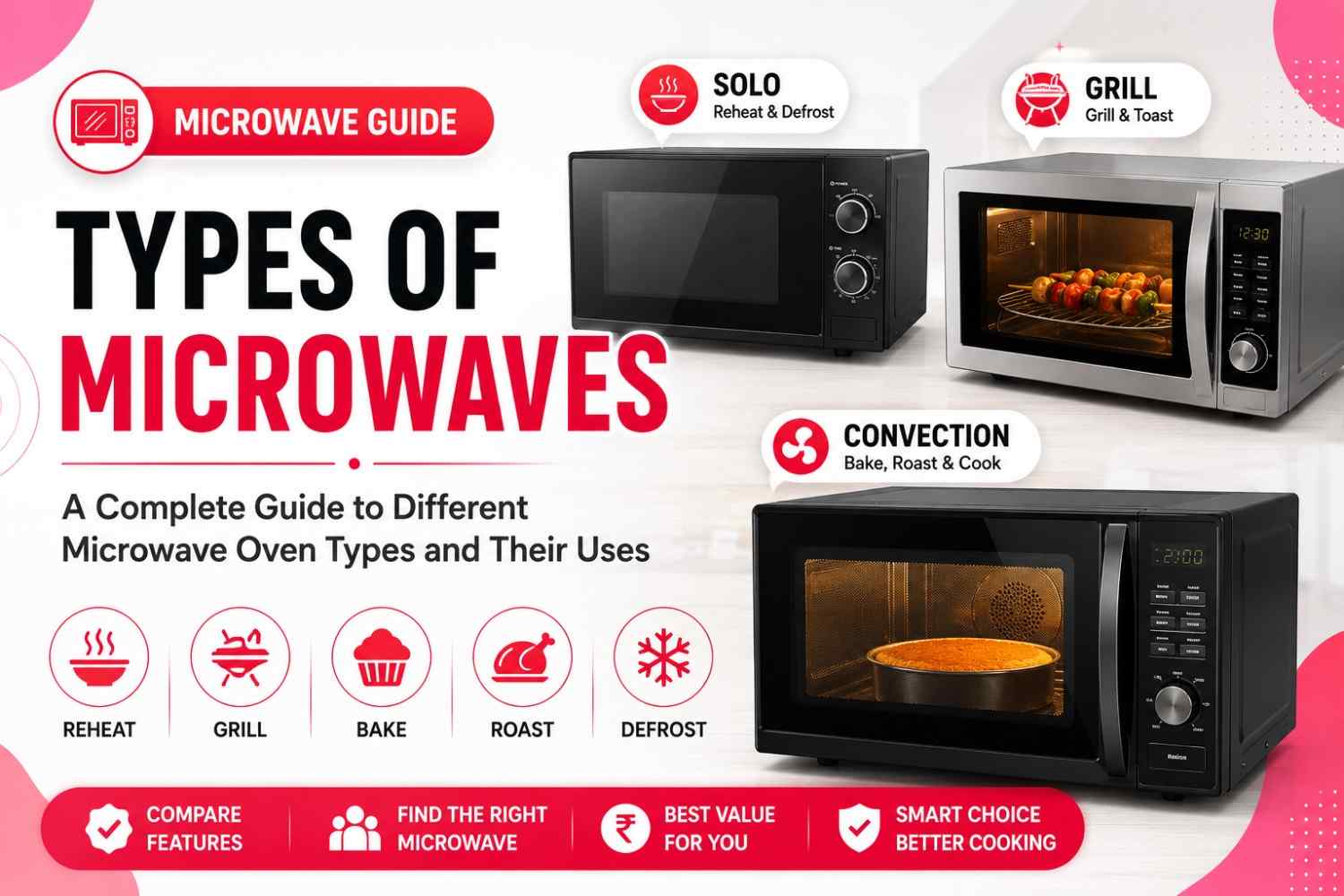
The three most popular types of microwave oven include:
- Solo Microwave Oven
- Grill Microwave Oven
- Convection Microwave Oven
Each serves different cooking purposes and comes with its own benefits.
Solo Microwave Oven
A solo microwave is the simplest and most affordable option among the different types of microwaves. It mainly uses microwave radiation to heat food quickly.
Best Uses of Solo Microwave Ovens
- Reheating cooked food
- Defrosting frozen meat and vegetables
- Boiling water
- Cooking instant noodles
- Making popcorn
Advantages
- Budget-friendly
- Easy to operate
- Consumes less electricity
- Compact design
Limitations
- Cannot bake cakes
- No grilling function
- Limited cooking options
Grill Microwave Oven
Grill microwave ovens include heating coils in addition to microwave technology, making them suitable for grilling and browning food.
Best Uses of Grill Microwave Ovens
- Grilling paneer
- Toasting sandwiches
- Roasting vegetables
- Crispy pizzas
- Kebabs
Advantages
- Better cooking versatility
- Crispy food texture
- Affordable compared to convection models
Limitations
- Cannot perform advanced baking
- Slightly more expensive than solo microwaves
Convection Microwave Oven
Among all convection microwave oven types, these are the most versatile. They combine microwave cooking, grilling, and convection heating using a fan that circulates hot air.
Best Uses of Convection Microwave Ovens
- Baking cakes
- Cookies
- Pizza
- Roasting chicken
- Grilling vegetables
- Full meal preparation
Advantages
- Supports baking and roasting
- Even cooking
- Multiple cooking modes
- Ideal for families
Limitations
- Higher initial cost
- Slightly higher electricity consumption
Types of Microwave Ovens Based on Installation
Microwave ovens are also classified according to how they are installed in the kitchen.
Countertop Microwave Oven
These are the most common types of microovens used in Indian homes.
Benefits include:
- Easy installation
- Portable
- Budget-friendly
- Available in multiple capacities
Ideal for renters and most households.
Built-In Microwave Oven
Built-in microwave ovens are permanently installed inside kitchen cabinets for a premium look.
Benefits include:
- Saves counter space
- Modern appearance
- Seamless kitchen design
- Often paired with modular kitchens
Best suited for newly designed kitchens.
Above the Range Microwaves
Above the range microwaves are installed directly above the cooking range or stove. They combine microwave cooking with an exhaust ventilation system.
Benefits include:
- Saves kitchen counter space
- Built-in exhaust fan
- Stylish appearance
- Suitable for compact kitchens
Limitations:
- Professional installation required
- More expensive
- Repairs may be complicated
Microwave Oven Types and Uses
Understanding the types of microwave ovens and their uses makes choosing easier. The table below compares the most common microwave oven types based on their primary cooking capabilities and suitable household needs.
| Microwave Type | Best For | Can Bake | Can Grill | Price Range |
| Solo | Reheating & Defrosting | ❌ | ❌ | Low |
| Grill | Grilling & Toasting | Limited | ✅ | Medium |
| Convection | Baking, Roasting & Cooking | ✅ | ✅ | High |
Comparison Between Solo, Grill and Convection Microwave Ovens
Choosing among different types of microwave ovens depends on your cooking habits, budget, and family size. Here's a detailed comparison.
| Feature | Solo | Grill | Convection |
| Reheating | Excellent | Excellent | Excellent |
| Defrosting | Excellent | Excellent | Excellent |
| Baking | No | Limited | Yes |
| Grilling | No | Yes | Yes |
| Roasting | No | Limited | Yes |
| Auto Cook Menus | Basic | Moderate | Advanced |
| Best For | Singles | Small Families | Large Families |
| Cost | Lowest | Medium | Highest |
Comparison Between Countertop, Built-In and Above-the-Range Microwaves
Installation style is just as important as cooking features. Compare the three major microwave oven categories below.
| Feature | Countertop | Built-In | Above the Range |
| Installation | Plug & Use | Permanent | Permanent Above Stove |
| Saves Counter Space | No | Yes | Yes |
| Exhaust Ventilation | No | No | Yes |
| Easy to Relocate | Yes | No | No |
| Cost | Affordable | Premium | Premium |
| Best For | Most Homes | Modular Kitchens | Compact Kitchens |
Comparison Between Manual, Digital and Smart Microwaves
Apart from cooking technology, microwaves also differ in controls and smart features. The table below helps you compare them easily.
| Feature | Manual Microwave | Digital Microwave | Smart Microwave |
| Controls | Knobs | Touch Panel | App & Voice Control |
| Ease of Use | Simple | Easy | Advanced |
| Auto Menus | Few | Many | Extensive |
| Connectivity | No | No | Yes |
| Price | Budget | Mid-Range | Premium |
| Best For | Basic Users | Families | Tech Enthusiasts |
Semi-Automatic Comparison: Basic vs Advanced Microwave Features
Just like washing machines are compared by automation level, microwaves can also be compared based on cooking convenience. The table below explains how basic and advanced microwave models differ in everyday use.
| Feature | Basic Microwave (Solo) | Advanced Microwave (Grill & Convection) |
| Cooking Modes | Reheat & Defrost | Bake, Grill, Roast, Reheat |
| Auto Cook Menus | Limited | Extensive |
| Baking | No | Yes |
| Multi-Stage Cooking | No | Yes |
| Cooking Flexibility | Basic | High |
| Ideal User | Students & Singles | Families & Cooking Enthusiasts |
Capacity Guide: Which Microwave Size Should You Buy?
Microwave capacity should match your family size and cooking requirements. The following table helps you select the right microwave size based on household usage.
| Capacity | Suitable For |
| 17–20 Litres | 1–2 People |
| 21–25 Litres | 2–4 People |
| 26–30 Litres | 4–6 People |
| 30 Litres & Above | Large Families & Baking |
Which Microwave Oven Should You Choose?
The ideal microwave depends on how frequently you cook and what you usually prepare.
- Buy a Solo Microwave if you mainly reheat food.
- Buy a Grill Microwave if you enjoy grilled snacks.
- Buy a Convection Microwave if you bake, roast, or cook complete meals.
- Choose Above the Range Microwaves if kitchen space is limited.
- Select Built-In models for modular kitchens.
- Countertop models remain the most economical option.
Tips for Choosing the Right Microwave Oven
Buying a microwave becomes easier when you evaluate your daily cooking habits instead of focusing only on price.
- Choose capacity according to family size.
- Decide whether you need baking or only reheating.
- Check available kitchen space.
- Compare electricity consumption.
- Look for child lock and auto cook menus.
- Consider warranty and after-sales service.
- Select inverter technology if available for even cooking.
Common Mistakes to Avoid When Buying a Microwave
Many buyers purchase the wrong microwave because they only compare prices.
Avoid these mistakes:
- Buying a solo microwave when you need baking means you may miss out on convection features required for cakes, bread, and roasting.
- Choosing a very small capacity for large families can make cooking inconvenient because the microwave may not fit bigger dishes or larger portions.
- Ignoring kitchen installation space may lead to a model that does not fit properly or blocks movement in your kitchen.
- Not checking power consumption can increase electricity bills and make the appliance less efficient for regular use.
- Overlooking warranty coverage may leave you paying extra for repairs or service issues later.
- Purchasing unnecessary smart features can increase the price without adding real value to your daily cooking needs.
How Can NoBroker Help with Home Appliance Services?
Buying the right microwave is only part of maintaining an efficient kitchen. Regular servicing and timely repairs help extend appliance life and ensure consistent performance. NoBroker Home Services connects you with verified technicians for appliance repair, maintenance, installation, uninstallation and inspection. Whether your microwave is not heating properly, making unusual noises, or facing electrical issues, trained professionals provide doorstep service with transparent pricing, genuine spare parts, and service warranty, helping you keep your kitchen appliances running smoothly.
Final Verdict
Choosing among the different types of microwaves ultimately depends on your cooking style, available kitchen space, and budget. Solo microwaves are perfect for everyday reheating, grill models add versatility for snacks and grilling, while convection microwave ovens are ideal for baking and complete meal preparation. If you're redesigning your kitchen, built-in or above the range microwaves can also enhance space efficiency. Comparing microwave oven categories before buying ensures you invest in a model that offers long-term convenience and value.
1. Which type of microwave is best for home use?
A convection microwave is usually the best option for families because it supports reheating, grilling, baking, roasting, and everyday cooking.
2. What are the three main types of microwave ovens?
The three main types of microwave oven are Solo, Grill, and Convection microwave ovens, each designed for different cooking needs.
3. Can a solo microwave bake cakes?
No, a solo microwave cannot bake cakes because it lacks convection heating required for baking.
4. What is the difference between grill and convection microwave ovens?
A grill microwave grills and browns food, while a convection microwave can grill, bake, roast, and cook using hot air circulation.
5. Are the range microwaves suitable for Indian kitchens?
Yes, above-the-range microwaves are suitable for modular and compact kitchens as they save counter space and include exhaust ventilation.
6. Which microwave is best for baking?
A convection microwave oven is the best choice for baking cakes, cookies, pizzas, and bread at home.
7. How do I choose the right microwave capacity?
Choose 17–20 litres for one or two people, 21–25 litres for small families, and 26 litres or more for larger households.
8. Is a convection microwave worth the extra cost?
Yes, if you regularly bake, grill, or prepare complete meals, the additional features make it a worthwhile investment.
9. Which microwave consumes less electricity?
Solo microwaves generally consume less electricity because they perform fewer cooking functions than grill or convection models.
10. Should I buy a countertop or a built-in microwave?
Choose a countertop microwave for affordability and flexibility, while a built-in microwave is better for modular kitchens and a seamless appearance.

Login / Sign up
Zero Brokerage.
Thousands of new listings daily.
100 Cr+ Brokerage saved monthly.
About the Author

avneen kaur
Senior Editor


Recent Blogs

Subscribe to our Newsletter
Get latest news delivered straight to your inbox