What Is TDS in a Water Purifier? Ideal Range, How to Check, Increase, and Reduce TDS

100 Views
Table of Contents
Water quality plays an important part in ensuring overall health, and TDS is the primary parameter used to measure the level of impurity in water through water purifiers. TDS allows determining the concentration of dissolved elements in the water that you consume. Irrespective of the type of water purifier that you have installed, such as an RO purifier, understanding the meaning of RO water TDS, the TDS range of water purifier, and ways to control it is vital for your well-being.
What Does TDS Mean in Water?
The meaning of TDS is Total Dissolved Solids. The total dissolved solids in water refer to the total amount of dissolved salts, minerals, metals, and other organic matter in water. The water purification process is crucial since it is responsible for measuring the quality, taste, and safety of water for consumption. RO TDS is usually measured in ppm (parts per million).
Why Is TDS Important in a Water Purifier?
The TDS level in water purifier systems influences the taste, mineral content, and safety of drinking water. It is important to have proper TDS water filtration that will remove all harmful particles but leave minerals in the water.
- Improves drinking water quality
- Filters excess salt and impurities
- Improves taste and smell
- Protects from hazardous contamination
- Ensures mineral balance
What Are the Common Substances Included in TDS?
TDS is made up of minerals that are both advantageous and contaminants dissolved in water. This varies according to the water source, treatment, and storage process involved.
| Substance Type | Examples |
| Minerals | Calcium, Magnesium, Potassium |
| Salts | Sodium Chloride, Sulfates |
| Metals | Iron, Copper, Lead |
| Organic Matter | Decayed plant material |
| Chemicals | Pesticides, Fluoride, Nitrates |
What is the Ideal TDS for Drinking Water?
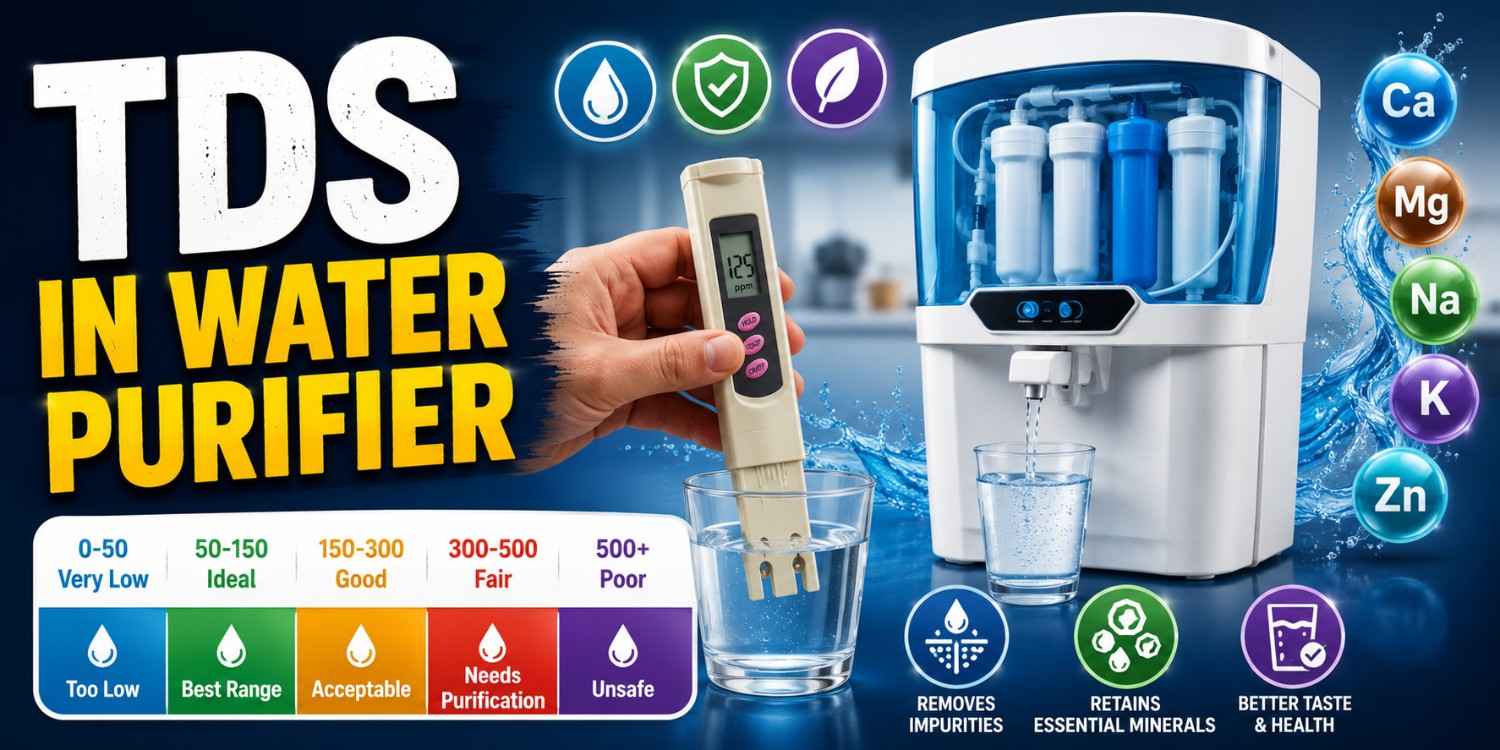
The RO Water TDS for drinking should normally range between 50 ppm and 150 ppm according to water quality professionals. This is a good balance of both taste and minerals while at the same time being safe for consumption. Of course, this will depend on the type of water and location.
| TDS Level (ppm) | Water Quality | Taste | Recommendation |
| 0 – 50 | Very Low | Flat | Not ideal for regular drinking |
| 50 – 150 | Excellent | Pleasant | Ideal RO water TDS |
| 150 – 300 | Good | Normal | Safe for drinking |
| 300 – 500 | Fair | Slightly salty | Acceptable if treated |
| Above 500 | Poor | Unpleasant | Requires purification |
What Is the Ideal TDS Level in Different States of India?
This is because the TDS level of a RO water purifier recommended in India will depend on the state, as not all water sources are the same in contamination level.
| State | Water Source Type | Recommended TDS Level (ppm) | Recommended Purifier | Reason |
| Delhi | Groundwater | 150 – 300 | RO + UV | High dissolved salts |
| Maharashtra | Mixed Supply | 100 – 250 | RO + UV + UF | Varying water quality |
| Karnataka | Borewell Water | 150 – 350 | RO Purifier | Hard water presence |
| Tamil Nadu | Municipal Water | 80 – 200 | UV + UF | Moderate TDS levels |
| Rajasthan | Groundwater | 250 – 500 | High Recovery RO | High salinity in water |
| Uttar Pradesh | Groundwater | 200 – 400 | RO + UV | Hard water in many areas |
| Punjab | Groundwater | 250 – 500 | RO Purifier | High TDS due to mineral-rich soil |
| West Bengal | Surface + Municipal | 80 – 200 | UV + UF | Lower TDS in many urban areas |
| Telangana | Borewell Water | 150 – 350 | RO Purifier | Hard water in many regions |
How Can You Check Your Water’s TDS Level?
The measurement of the TDS value in water purifiers is simple when done using a digital TDS meter. The instrument will provide an accurate measurement of the dissolved solids in the water. From this, you can tell whether there is a need to filter the water further.
Step-by-Step Method to Measure TDS
- Switch the digital TDS meter on.
- Fill a clean glass with drinking water.
- Place the meter in the water sample.
- Allow some time for the meter to take a steady reading.
- Note the TDS reading of the water in ppm.
- Compare the TDS reading with the optimum RO water TDS limit.
How Water Purifiers Increase and Reduce TDS Levels?
Modern water purifiers can reduce as well as balance TDS depending on their filter mechanisms. There are water purifiers that reduce the number of excess impurities, and there are others that bring back essential minerals into purified water.
How Water Purifiers Increase TDS
There are some RO water purifiers that add essential minerals to water through a process of using a mineral cartridge or TDS controller in order to get back the ideal RO water TDS level.
How Can You Increase TDS?
- Install a purifier with a TDS controller
- Attach mineral cartridges to the purifier
- Blend RO water with regular filtered water
- Use mineral drops if necessary
- Maintain your water purifier regularly
How Water Purifiers Reduce TDS
The RO membranes are able to decrease salt levels, metals, and other contaminants from the water. The TDS water purification procedure will assist in making high TDS water fit for consumption.
How Can You Reduce TDS?
- Use an RO water purifier
- Change RO membranes at proper intervals
- Make use of proper pre-filters
- Do not mix raw water
- Maintain your water purifier regularly.
What Is the Difference Between High TDS and Low TDS Water?
High TDS water and low TDS water are different in terms of taste, mineral content, and suitability for drinking purposes. Having the distinction is helpful in choosing an appropriate water purifier.
| Factor | High TDS Water | Low TDS Water |
| Taste | Salty or bitter | Flat or light |
| Mineral Content | High | Very low |
| Health Impact | May contain harmful salts | May lack essential minerals |
| Appliance Damage | Causes scaling | Less scaling |
| Purification Need | Usually requires RO | May not require RO |
When Should You Use an RO Water Purifier and When Should You Not?
The RO water purifier works very well when there is high TDS water, but it does not require the use of all the water. This is based on the RO TDS and the contamination level of the water.
When to Use an RO Water Purifier
- Water TDS is higher than 300 ppm
- Water comes from a borewell or a tanker
- A salty taste is felt in the water
- There is a presence of heavy metals in the water
- There is a problem of hard water
When Not to Use an RO Water Purifier
- Water TDS is lower than 100 ppm
- The municipal water is already filtered
- There are good minerals in the water
- There is only one requirement for sediment filters
Tips to Maintain Proper TDS Levels in Drinking Water
The ideal TDS level for the water purification system ensures a clean, healthy, and tasty water supply. It is crucial to maintain the purifier through regular inspection.
- Test TDS levels in water
- Service the purifier timely
- Change filters and membranes
- Do not store water for prolonged periods
- Install the right purifier for your water source
- Notice any changes in smell and taste
Conclusion
Knowing TDS levels in water purifiers is very important in ensuring that you have healthy water to drink at home. The right management of TDS, whether to lower or increase, is important for water quality. With the use of a RO water purifier TDS check, you can easily determine how to manage your water filtration processes for better health outcomes.
Cities We Serve for Water Purifier Repair & Services
If you’re looking for reliable water purifier repair services, NoBroker provides quick and professional support across major cities, including Bangalore, Chennai, Hyderabad, Delhi, Mumbai, Pune, Gurgaon, Noida, Ghaziabad, Greater Noida, and Faridabad. Enjoy quick 15-minute technician assistance, 180-day warranty, and 100% genuine spare parts for safe and hassle-free service.
Brands We Serve for Water Purifier Repair Services
Whether it’s Kent RO, Aquaguard, Pureit, Livpure, or Whirlpool, NoBroker provides reliable water purifier repair services for all major brands. Enjoy expert technicians at your doorstep, quick issue resolution, and genuine spare parts to ensure safe and healthy drinking water every day.
Frequently Asked Questions
1. What is the ideal TDS for RO drinking water?
2. Is low TDS water bad?
3. How to check the TDS level of water?
4. What is the ideal TDS level for drinking water?
5. Does RO remove TDS totally?
6. Is high TDS water harmful to appliances?
7. Do we need RO for municipal water?
8. Why does RO water have a different taste?
9. Can I improve my RO water’s TDS level?
10. How often should I check my water TDS?

Login / Sign up
Zero Brokerage.
Thousands of new listings daily.
100 Cr+ Brokerage saved monthly.
About the Author

Siri Hegde K
Senior Editor


Recent Blogs

Subscribe to our Newsletter
Get latest news delivered straight to your inbox