RO vs UV vs UF Water Purifier: Differences, Benefits, Working & Which One to Choose

13 Views
Table of Contents
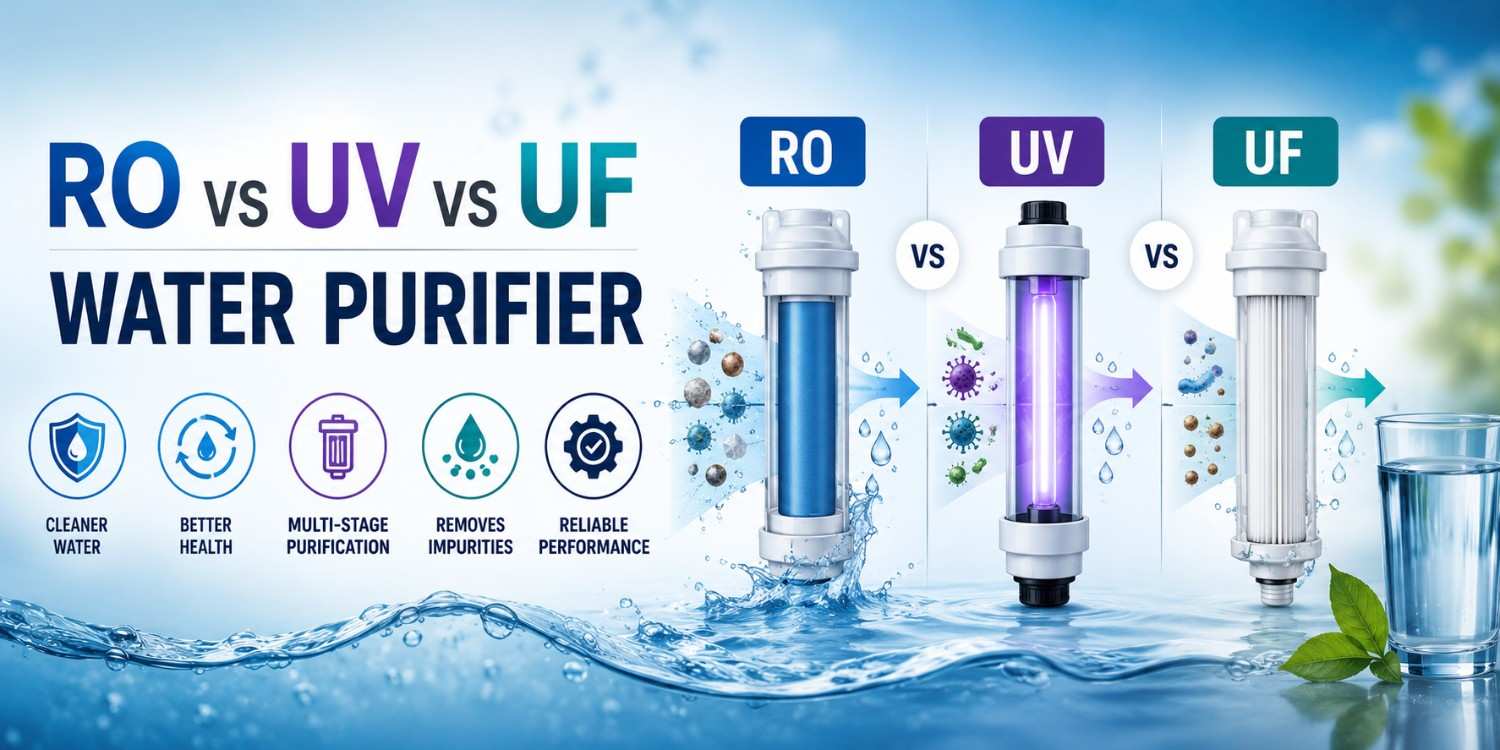
Water purification technology has evolved significantly, making it easier for households to access safe and clean drinking water. However, many people often get confused between RO, UV, and UF purification technologies and wonder about the meaning of RO, UV, and UF and which system suits their needs. Understanding RO, UV, UF means knowing how each technology works individually and together. This guide explains what RO UV UF is, its benefits, differences, and how to choose the right water purifier.
What Is RO (Reverse Osmosis) Water Purification?
RO stands for Reverse Osmosis. This is a water filtration method that uses a semipermeable membrane filter to remove salts, heavy metals, chemicals, and other impurities present in the water. The RO process can be used effectively to reduce the TDS content and is ideal for water with TDS more than 300 ppm, particularly for underground water sources. In the discussion of RO UV TDS, RO is the key process involved in lowering TDS content.
What Is UV (Ultraviolet) Water Purification?
The process of UV (Ultraviolet) filtration involves the use of ultraviolet light to kill off the pathogens that are in the water, which may include bacteria, viruses, and other harmful organisms. In contrast with RO systems, UV filtering processes do not remove dissolved contaminants and minerals and thus have no effect on the total dissolved solids content. They are usually effective for treating municipal water whose total dissolved solids content is less than 300 parts per million.
What Is UF (Ultrafiltration) Water Purification?
Ultrafiltration (UF) is an electricity-free process that uses membranes to filter out suspended particles, dirt, cysts, and bacteria present in water. UF is effective in filtering contaminants that are visible to the naked eye. As UF does not eliminate salt particles, its inability to reduce TDS concentration makes it suitable only for treating water with a TDS concentration of less than 200–300 parts per million.
What Is the Difference Between RO, UV, and UF?
Although all three technologies purify water, they target different contaminants and serve different purposes. Understanding RO vs UV vs UF helps in selecting the most suitable purification system.
| Feature | RO | UV | UF |
| Removes Dissolved Salts | Yes | No | No |
| Reduces TDS | Yes | No | No |
| Kills Bacteria & Viruses | No | Yes | Partially |
| Removes Suspended Particles | Yes | No | Yes |
| Requires Electricity | Yes | Yes | No |
| Suitable for Hard Water | Yes | No | No |
Each technology addresses specific water quality concerns, and combining them often provides better purification results.
What Are the Advantages and Disadvantages of RO, UV, and UF Water Purifiers?
Every purification technology offers unique benefits and limitations. Knowing these helps users understand the meaning of ro uv uf and make informed purchasing decisions.
| Feature | RO (Reverse Osmosis) | UV (Ultraviolet) | UF (Ultrafiltration) |
| Advantages | • Removes dissolved salts• Reduces TDS• Eliminates heavy metals• Improves taste | • Kills bacteria and viruses• Fast disinfection process• Maintains mineral content | • Removes suspended particles• Works without electricity• Low maintenance |
| Disadvantages | • Wastes some water• Requires electricity• Periodic membrane replacement | • Does not remove dissolved salts• Requires electricity• Ineffective against chemical contaminants | • Does not reduce TDS• Cannot remove dissolved impurities |
The best option depends on your water source, contamination levels, and purification requirements.
How RO, UV, and UF Work Together in Water Purifiers
Modern purifiers often combine multiple technologies to deliver comprehensive purification. This combination improves water safety by targeting dissolved impurities, microorganisms, and suspended particles simultaneously.
| Stage | Technology | What It Removes | Purpose |
| Stage 1 | UF | Dust, sediments, suspended particles | Pre-filtration |
| Stage 2 | RO | Dissolved salts, heavy metals, chemicals | TDS reduction |
| Stage 3 | UV | Bacteria, viruses, pathogens | Disinfection |
| Stage 4 | Post Filter | Odour and taste impurities | Taste enhancement |
Using multiple technologies ensures better water quality and broader contaminant removal.
Common RO, UV, and UF Water Purifier Combinations
1. RO + UV
- Removes dissolved impurities and harmful microorganisms
- Suitable for high TDS water
- Common in urban households
- Provides comprehensive purification
2. RO + UF
- Removes dissolved salts and suspended particles
- Effective for hard water conditions
- Offers additional filtration support
- Suitable for mixed contamination sources
3. UV + UF
- Removes microorganisms and physical impurities
- Suitable for low TDS municipal water
- Maintains natural minerals
- Consumes less energy than RO systems
4. RO + UV + UF
- Provides multi-stage purification
- Removes dissolved, biological, and physical contaminants
- Suitable for uncertain water quality conditions
- Commonly used in advanced water purifiers
5. RO + UV + UF + TDS Controller
- Controls mineral retention after purification
- Improves water taste
- Balances essential minerals
- Suitable for areas with extremely high TDS levels
Common Myths About RO, UV, and UF Water Purifiers
Several misconceptions exist regarding water purification technologies. Understanding the facts helps consumers make better decisions when evaluating RO UV UF systems.
| Myth | Reality |
| RO removes all useful minerals permanently | Many modern RO systems use mineral retention technology |
| UV removes dissolved salts | UV only disinfects microorganisms |
| UF can reduce TDS | UF cannot remove dissolved salts |
| RO is necessary everywhere | Choice depends on water quality |
| UV works without electricity | UV systems require power to operate |
Knowing the actual capabilities of each technology prevents unnecessary expenses and confusion.
RO vs UV vs UF: Which Water Purifier Should You Choose?
The ideal purifier depends on the water source, contamination type, and TDS level. Understanding what is involved in water purifier systems can help identify the most suitable technology.
Choose RO Water Purifier If:
- Water has high TDS levels
- Groundwater is the primary source
- Water contains heavy metals
- Taste and odour issues are present
- Hard water is common in your area
Choose UV Water Purifier If:
- Water has low TDS levels
- Microbial contamination is a concern
- Municipal water supply is available
- Mineral retention is preferred
- Water appears chemically safe
Choose UF Water Purifier If:
- Water contains visible impurities
- Electricity availability is limited
- Water TDS is already acceptable
- Basic filtration is required
- Low-maintenance purification is preferred
Choose Combination Systems If:
- Water quality varies frequently
- Multiple contaminants are present
- Complete purification is required
- Family health protection is a priority
- Water source reliability is uncertain
How to Maintain RO, UV, and UF Water Purifiers for Best Performance
Regular maintenance ensures consistent purification efficiency and extends purifier lifespan. Proper servicing also helps maintain water quality and system reliability.
- Replace RO membranes as recommended.
- Change UV lamps periodically.
- Clean or replace UF membranes when needed
- Schedule regular professional servicing
- Monitor water flow and taste changes
- Replace pre-filters on time
- Check TDS levels regularly
- Follow manufacturer maintenance guidelines
Conclusion
Understanding RO UV UF technologies is essential for choosing the right water purifier. RO removes dissolved impurities and reduces TDS, UV destroys harmful microorganisms, and UF filters suspended particles. When comparing RO vs UV vs UF, each technology serves a specific purpose. Modern combination systems offer comprehensive purification by integrating multiple technologies. By evaluating your water quality, TDS levels, and contamination concerns, you can select the most effective water purifier for safe and healthy drinking water.
NoBroker Water Purifier Repair & Services Across Major Cities in India
NoBroker provides reliable water purifier repair services across major cities, including Bangalore, Chennai, Hyderabad, Delhi, Mumbai, Pune, Gurgaon, Noida, Ghaziabad, Greater Noida, and Faridabad. Get expert technician assistance within 15 minutes of booking, along with hassle-free doorstep service and transparent pricing.
What Brands Do We Cover For Water Purifier Repair Services?
NoBroker offers professional water purifier repair services for leading brands like Kent RO, Aquaguard, Pureit, Livpure, AO Smith, Whirlpool, Blue Star, and more. Our skilled technicians handle different water purifier models with expert support and reliable repair solutions.
Frequently Asked Questions
What is RO UV UF in a water purifier?
What is the meaning of RO UV UF?
What is RO UV TDS?
Which is better: RO, UV, or UF?
Does UV reduce TDS in water?
Can UF remove bacteria from water?
Is RO necessary for municipal water?
Why do modern purifiers combine RO, UV, and UF?
How often should RO membranes be replaced?
Which purifier is best for high TDS water?

Login / Sign up
Zero Brokerage.
Thousands of new listings daily.
100 Cr+ Brokerage saved monthly.
About the Author

Siri Hegde K
Senior Editor


Recent Blogs

Subscribe to our Newsletter
Get latest news delivered straight to your inbox