How to Replace a Refrigerator Water Filter: When to Change, How to Find Yours & Maintenance Tips

17 Views
Table of Contents
One of the primary benefits of using a modern refrigerator with a built-in dispenser is access to clean and safe drinking water. Unfortunately, many people fail to change their refrigerator water filters in a timely manner, which might negatively impact the water taste, smell, and its filtration process. Timely changes in refrigerator water filters will not only improve water quality but also help protect the interior components of the device and ensure its efficient operation.
What Is a Refrigerator Water Filter?
The refrigerator water filter is a small filter that gets fitted either inside the refrigerator or in front of it. It filters out the dirt particles, chlorine, and other impurities found in the water meant for drinking and making ice cubes. The importance of regularly replacing a refrigerator filter cannot be overlooked.
What Does a Refrigerator Water Filter Do?
The water from your refrigerator passes through a water filter to purify it before it is delivered through either your water dispenser or your ice maker.
- Reduces chlorine content and sediment
- Tastes better when drunk
- Eliminates odors in the water
- Removes contaminants and other particles
- Protects the ice maker machine
How to Know When to Replace Your Refrigerator Water Filter
The manufacturer suggests changing the filter once every six months. Failure to change the filter may lead to poor-quality water as well as decreased efficiency of the appliance.
- Water dispensing slowly
- Taste or odor problems in water
- Cloudy ice cubes
- The warning light comes on
- Abnormal noise from the dispenser
How to Find Your Refrigerator Water Filter Location
It should be noted that various fridge brands install their filters at various locations to ensure convenient filter access. In order to perform fridge filter installation, it is necessary to correctly locate your filter in accordance with the fridge model and instruction manual guidelines.
Common Refrigerator Water Filter Locations
- In the upper corner of the fridge interior
- Behind the bottom grill
- On the fridge ceiling
- On the back part of the fridge
- In proximity to the vegetable drawers
How to Identify the Filter in Your Refrigerator
- Check your refrigerator manual for the filter type and location.
- Look for the filter inside the fridge or behind the base grille.
- Find the part number printed on the filter.
- Use your refrigerator model number to verify compatibility.
- Match the existing filter before buying a replacement.
What Tools and Supplies Do You Need to Replace a Refrigerator Water Filter?
Most water filters in the refrigerator are easy to replace and don’t need complex equipment. It is important to have the necessary supplies to make the job easier.
| Item | Purpose |
| New water filter | Replaces the old filter |
| Soft cloth | Cleans the surrounding area |
| User manual | Helps identify filter type |
| Bowl or towel | Collects water drips |
| Gloves | Improves grip and cleanliness |
How to Replace a Refrigerator Water Filter: Step-by-Step Process
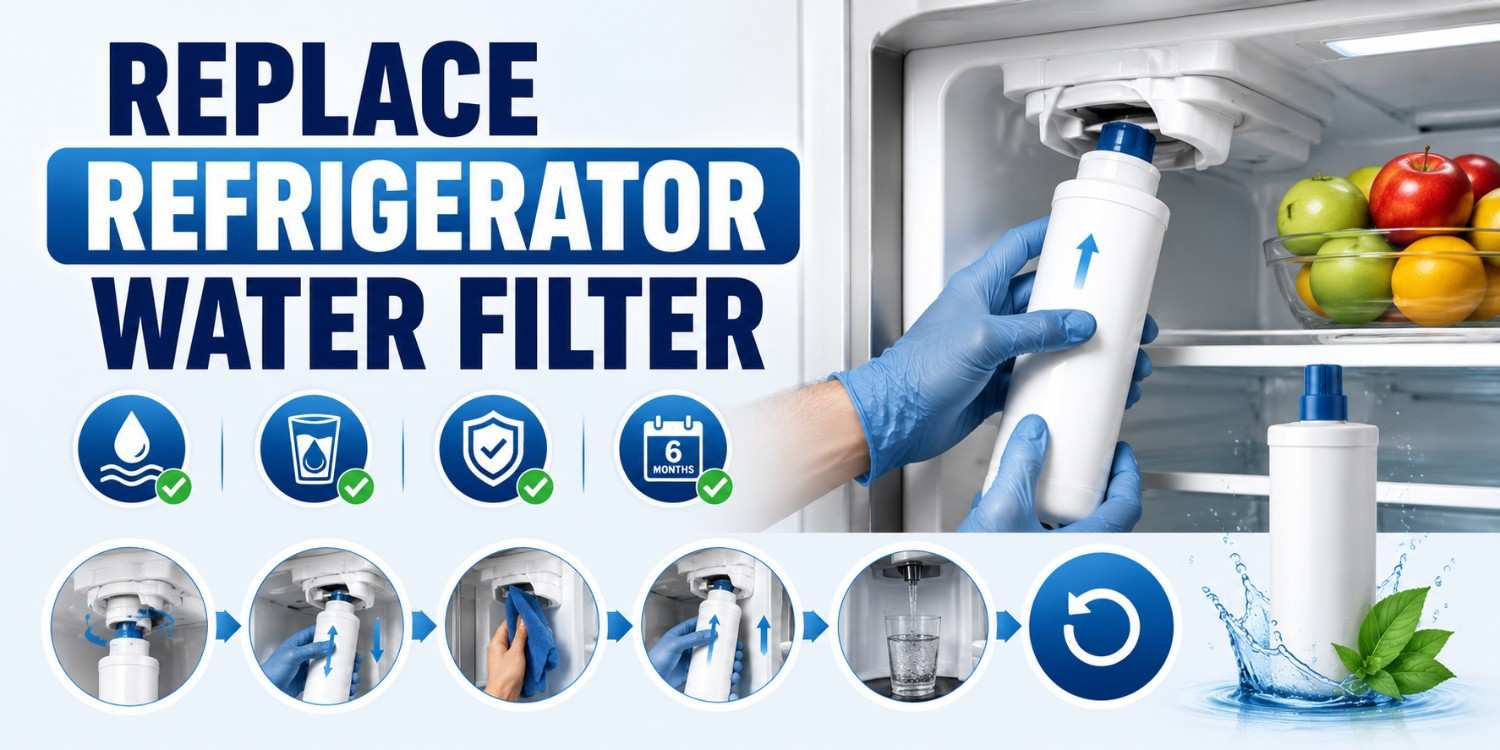
Replacement of the refrigerator water filters is often an easy task that may be completed within a couple of minutes by taking appropriate measures. These steps will ensure the successful process of the refrigerator filter change without leakage, wrong installation, or water supply issues.
Step 1: Turn off Refrigerator Water Supply
It is important to turn off the refrigerator water supply in case of your specific refrigerator model. Some models enable users to change filters without turning off the water, but this step can help prevent any leakages.
Step 2: Remove Old Water Filter
Twist, pull, or push the release button according to your model and remove the filter carefully to prevent any water spillage into the refrigerator or floor.
Step 3: Cleaning the Filter Housing Section
Clean the filter housing area by using a cloth to clean any dust, moisture, or other particles that might interfere with the fitting of the filter.
Step 4: Installing a New Water Filter
Fit the new filter according to the arrow directions or by using its locking mechanism, making sure that it fits perfectly and no force is used when placing the filter.
Step 5: Flushing the Water System
Run the water for several minutes after inserting the new filter by pouring several glasses of water. It aids in eliminating any air or carbon particles caught within the filter.
Step 6: Reset the Filter Reminder Button
Press and hold the filter reset button if your refrigerator includes a filter indicator system. Resetting helps track the next replacement schedule accurately.
How to Find the Correct Refrigerator Water Filter for Your Model
It is necessary to use the right kind of filter in order to perform filtration and get a working refrigerator. Filters vary by size and fitting based on the make and model of each refrigerator.
- Check the refrigerator model number
- Compare filter serial number
- Consult the manufacturer's guidelines
- Buy genuine compatible filters
- Ensure installation compatibility
Signs You Are Using the Wrong Refrigerator Water Filter
- The filter is not correctly installed
- Water leakage around the filter zone
- Decreased water flow
- Strange taste of water persists
- The refrigerator indicates a filter error
Brand-Wise Refrigerator Water Filter Compatibility
Various brands have their own series of filters and cartridges. The right selection of a filter will result in effective purification of water as well as compatibility with the refrigerator.
| Brand | Common Filter Series |
| Whirlpool | EveryDrop series |
| Samsung | HAF series |
| LG | LT series |
| Kenmore | 9690 series |
| Bosch | UltraClarity series |
| GE Appliances | XWF and MWF series |
| Frigidaire | PureSource series |
| KitchenAid | EveryDrop series |
| Maytag | UKF and EveryDrop series |
| JennAir | EveryDrop series |
| Electrolux | PureAdvantage series |
| Haier | HAF-compatible series |
| Panasonic | Internal cartridge series |
| Hitachi | Nano Titanium filter series |
| Siemens | UltraClarity Pro series |
| Viking | RWFFR series |
| Sub-Zero | 7007067 filter series |
| Fisher & Paykel | 847200 series |
| Daewoo | External inline filter series |
| Midea | Universal cartridge series |
What Are the Benefits of Replacing Your Refrigerator Water Filter?
Replacing filters in refrigerators is essential for maintaining good water quality, increasing the efficiency of your appliances, and improving your drinking water.
- Purer drinking water
- Fresh ice cubes
- Efficient water dispenser function
- Less contaminants
- Increased refrigerator system lifespan
What Problems Can Happen If You Don’t Replace the Refrigerator Water Filter Correctly?
A wrong installation procedure or late replacement could cause water flow problems and decrease filter efficiency. In rare situations, it might even cause damage to other refrigerator parts.
- Water leakage problems
- Bad-tasting water
- Obstruction in water flow
- Ice maker failure
- Filtration inefficiency
How to Maintain Your Refrigerator Water Filter for Long-Lasting Performance
Maintenance plays a key role in enhancing the efficiency of your filter and providing you with clean drinking water. Even simple acts of maintenance can help avoid issues with your fridge water system.
- Change the filter every six months
- Properly flush new filters
- Use compatible replacement filters
- Regularly clean the filter housing
- Check filter warning signals
Conclusion
Changing the water filter in your refrigerator is an easy maintenance job that will enhance water quality as well as the working efficiency of both the water dispenser and the ice maker in your fridge. If you are looking for whirlpool refrigerator water filter change, samsung refrigerator water filter change, kenmore refrigerator water filter change, or even bosch fridge water filter change, performing the proper procedure will help to keep out leakage or any other filtration problem.
NoBroker Refrigerator Repair Services Across Major Cities in India
NoBroker serves major Indian cities, including Bangalore, Chennai, Hyderabad, Delhi, Mumbai, Pune, Gurgaon, Noida, Ghaziabad, Greater Noida, and Faridabad, with professional refrigerator repair services at your doorstep.
Brands We Serve for Refrigerator Repair Services
NoBroker provides reliable refrigerator repair services across all major brands like Samsung, LG, Whirlpool, IFB, Godrej, Bosch, Haier, Panasonic, and many more with transparent pricing and skilled professionals.
Frequently Asked Questions
1. Can I use my refrigerator without a water filter?
2. At what frequency do I need to change refrigerator water filters?
3. What are the consequences of not changing my water filter regularly?
4. Do I still have to replace the refrigerator filter even if I have an RO system installed at home?
5. Can I wash and reuse the filter?
6. Why does the water from my refrigerator become cloudy after installing a new filter?
7. What steps should I take to reset my refrigerator's water filter indicator?
8. Is it safe to install generic water filters in refrigerators?
9. Does using the wrong water filter for my refrigerator cause any damage?
10. Will changing a water filter for my refrigerator make ice better?

Login / Sign up
Zero Brokerage.
Thousands of new listings daily.
100 Cr+ Brokerage saved monthly.
About the Author

Siri Hegde K
Senior Editor


Recent Blogs

Subscribe to our Newsletter
Get latest news delivered straight to your inbox