Direct Drive vs Belt Drive Washing Machine: Key Differences, Pros & Cons, and Which One to Buy?


Appliance Tips & Guides

120 Views
Table of Contents
If you are trying to decide between direct drive and belt drive washing machine systems, learning about the working mechanisms behind each can prove to be quite useful. There are certain differences when it comes to sound generation, durability, maintenance needs, power requirements, and washing effectiveness of each type of washer. If you are asking yourself whether the direct drive washer or the belt drive washer is better, here is some information for you.
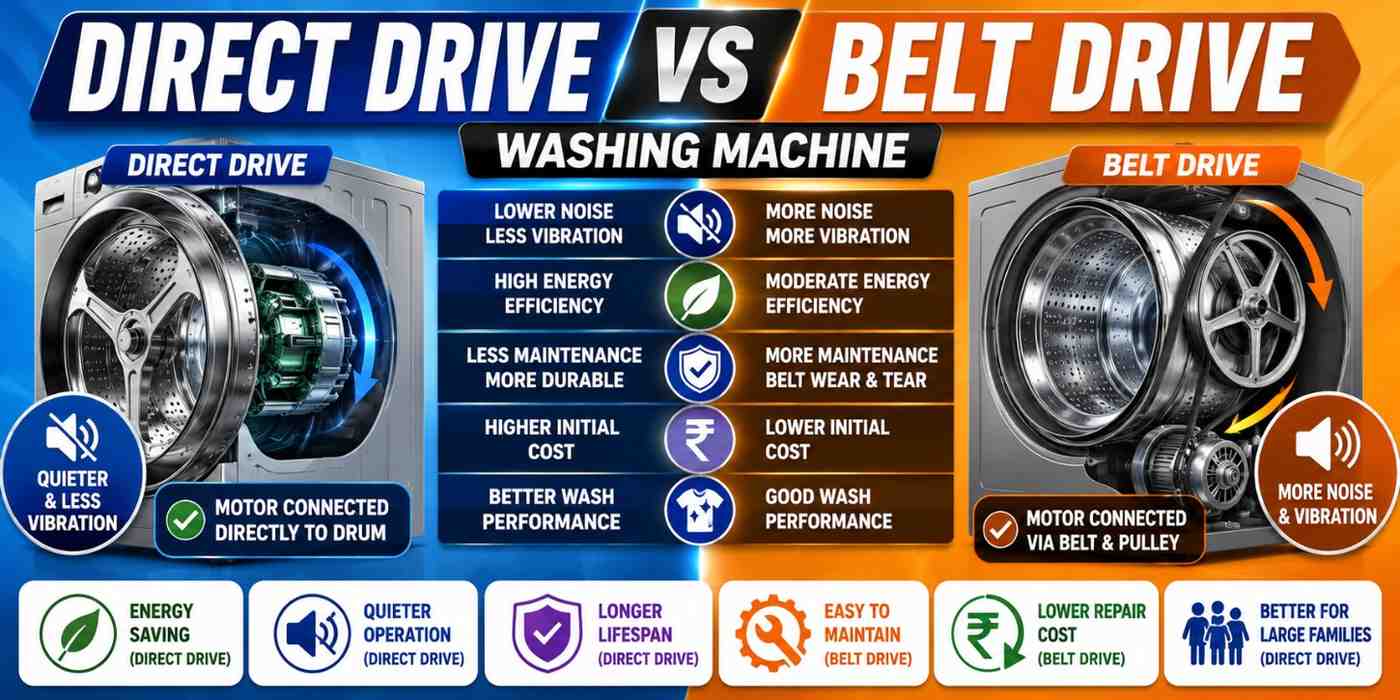
Direct Drive vs Belt Drive Washing Machine - Quick Comparison Table
The direct drive washing machine, compared to a belt washing machine, can be explained easily through some basic information about its features, performance, and maintenance.
| Feature | Direct Drive Washing Machine | Belt Drive Washing Machine |
| Motor Position | Attached directly to the drum | Connected through a belt and pulley |
| Noise Level | Lower | Higher |
| Vibration | Minimal | Comparatively higher |
| Energy Efficiency | Better | Moderate |
| Maintenance | Less frequent | More frequent |
| Durability | High | Good |
| Repair Cost | Higher | Lower |
| Washing Performance | Efficient and precise | Effective but less precise |
| Initial Cost | Higher | More affordable |
| Common Usage | Premium models | Budget and mid-range models |
Direct Drive Washing Machine: Working, Components, Advantages, and Disadvantages
A direct drive washing machine features a motor that is connected directly to the drum of the washing machine. As there are no belts or pulleys used, the efficiency of energy usage improves. The direct drive washers are usually preferred by those who study the effectiveness of such appliances due to their lower noise level and vibrations.
How Direct Drive Technology Works
In a direct drive system, a motor is located behind the drum and is connected to it directly, thus facilitating smoother performance and increased energy efficiency.
- Motor is attached directly to the drum
- No belt/pulley system used
- Less number of parts
- Torque control improvement
- Decreased energy waste
Key Components of Direct Drive Washing Machines
- Direct drive motor
- Rotor & stator mechanism
- Tub/drum of the washer
- Electronics control circuit
- Load balancing sensors
- Suspension mechanism
- Bearings and shafts
Advantages of Direct Drive Washing Machines
- Silent wash cycle operation
- Less vibration during spin cycle
- Energy-efficient operation
- Fewer moving parts prone to wear
- Greater longevity
- Higher accuracy in washing
- Can handle more laundry load
- Smart home technology compatible
Disadvantages of Direct Drive Washing Machines
- More expensive to buy
- Costly to fix motor problems
- Difficult servicing procedure
- Electronic problems lead to high expenses
- Fewer home-repair options
Belt Drive Washing Machine: Working, Components, Advantages, and Disadvantages
The principle behind a belt drive washer relies on the usage of belts and pulleys to transfer power between the electric motor and the drum. It’s an old-school solution that continues to be favored because of its lower cost and easier maintenance. Comparing a direct drive and a belt drive washing machine, the belt drive washing machine becomes preferable among consumers with tighter budgets.
How Belt Drive Technology Works
Power produced by the electric motor is passed along a belt and pulleys to reach the drum. The rotation of the drum helps carry out washing and spinning actions.
- Belt and pulley system is used
- Motor is not directly connected to the drum
- Indirect power transmission occurs
- Common technology
- Easier maintenance
Key Components of Belt Drive Washing Machines
- Electric motor
- Drive belt
- Pulley mechanism
- Drum construction
- Transmission system
- Suspension system
- Control panel
Advantages of Belt Drive Washing Machines
- Less expensive to buy initially
- Easier to maintain
- Inexpensive replacement parts
- Availability of repair services
- Proven technology that works well
- A good choice for low-budget customers
- Simple repair process
Disadvantages of Belt Drive Washing Machines
- Wear and tear of belts over time
- Greater noise production
- Vibration while spinning
- Slightly less efficient due to friction
- Require more maintenance than some other models
- Lower efficiency than other washing machines
Electricity Consumption: Direct Drive vs Belt Drive Washing Machines
Energy consumption is one of the most important considerations in comparing the advantages and disadvantages of direct drive and belt-driven washers. The direct drive washing machine typically uses less energy because it delivers the energy straight to the drum.
| Factor | Direct Drive Washing Machine | Belt Drive Washing Machine |
| Power Transfer Efficiency | Higher | Lower |
| Energy Loss | Minimal | Moderate |
| Motor Performance | Optimized | Dependent on belt condition |
| Electricity Consumption | Lower | Slightly higher |
| Long-Term Savings | Better | Moderate |
Common Problems in Direct Drive and Belt Drive Washing Machines
While both systems are effective and durable, they may have problems during operation. Identifying the problems will help users determine when maintenance should be performed to extend their lifespan.
Common Problems in Direct Drive Washing Machines
- Motor sensor malfunctions
- Faults in the rotor or stator
- Worn bearings
- Problems with the electronic control board
- Drum imbalance problems
- High-cost replacement parts
Common Problems in Belt Drive Washing Machines
- Worn/broken belt
- Damage to the pulley
- Slippage of the belt when the machine is in use
- Vibration
- Noisy operation
- Wear and tear of the transmission
Which Washing Machine Should You Buy: Direct Drive or Belt Drive?
The right choice will depend on how much money you are willing to spend, what your washing routine is like, and what you expect from your appliance in the long run.
Choose Direct Drive Washing Machine If:
- You want a quieter operation
- Energy consumption is of the essence
- Modern technology appeals to you
- Durability and longevity are essential
- Frequent washing is done
- Money can be spent on quality equipment
Choose Belt Drive Washing Machine If:
- Money is an issue
- Easier maintenance is needed
- Lower expenses for repairs are desirable
- Reliable basic machine is desired
- Access to spare parts is convenient
- Infrequent machine usage is planned
Tips to Choose the Right Washing Machine: Direct Drive vs Belt Drive
When you have to make the choice between a direct drive vs belt washing machine, assess your home’s needs, preferences regarding maintenance, and budget in order to determine which type of washing machine is the best for your needs.
- Look into energy efficiency
- Think about noise concerns
- Take warranties into account
- Assess ease of repairs
- Consider your family’s laundry needs
- Weigh lifetime costs
- Assess technology features
Conclusion
The main distinction between the two technologies, direct drive vs. belt drive washing machines, is the mechanism of power transfer from the motor to the drum. While direct drive washing machines are more efficient, quieter, and require minimal maintenance, belt-driven washing machines remain relatively inexpensive and easy to fix. So, when you ask whether direct drive is better than belt drive washing machines, you should focus on the key criteria.
Cities We Cover for Washing Machine Repair & Services
NoBroker provides reliable washing machine repair and services across Bangalore, Chennai, Hyderabad, Delhi, Mumbai, Pune, Gurgaon, Noida, Ghaziabad, Greater Noida, and Faridabad with quick 15-minute doorstep assistance.
Brands We Serve for Washing Machine Repair Services
From Samsung, LG, Whirlpool, IFB, Bosch, and Haier to other popular brands, NoBroker offers trusted washing machine repair services with skilled technicians, fast diagnosis, and hassle-free doorstep repairs.
Frequently Asked Questions
1. What is the main difference between a direct drive and a belt drive washing machine?
2. Which is better: direct drive or belt drive washing machine?
3. Are direct drive washers better for energy savings?
4. Is direct drive better than belt drive washing machine in terms of noise reduction?
5. Do direct drive washing machines need less maintenance?
6. Why are belt drive washing machines cheaper?
7. Can a belt drive washing machine work as many years as a direct drive one?
8. What are the common problems with direct drive washing machines?
9. What are the common problems with belt drive washing machines?
10. What washing machine is ideal for large families?

Login / Sign up
Zero Brokerage.
Thousands of new listings daily.
100 Cr+ Brokerage saved monthly.
About the Author

Siri Hegde K
Senior Editor


Recent Blogs
Subscribe to our Newsletter
Get latest news delivered straight to your inbox