5 Star Fridge Power Consumption in India (2026): Units, Monthly Cost & Savings Explained

273 Views
Table of Contents
Power consumption of 5 Star refrigerator is categorized under Bureau of Energy Efficiency (BEE) standards & labeling scheme, which classifies refrigerators on the basis of annual energy consumption in kWh, and the more stars a refrigerator gets, the higher its efficiency and the less electricity it uses to perform in the same cooling performance. For a 5 Star fridge it usually lies between 120 to 250 kWh per year. Considering that the current rise in temperature is taking place worldwide and that the global warming rate is still at an “unprecedented level,” 2026 is expected to rank among the four hottest years in history after 2024 and 2025, which have already set new records for global temperature, further highlighting the importance of energy-efficient appliances like 5 Star refrigerators in reducing electricity demand and managing household cooling costs. In this blog you will understand in detail about 5 Star Refrigerator Power Consumption.
5 Star Fridge Power Consumption (Quick Answer)
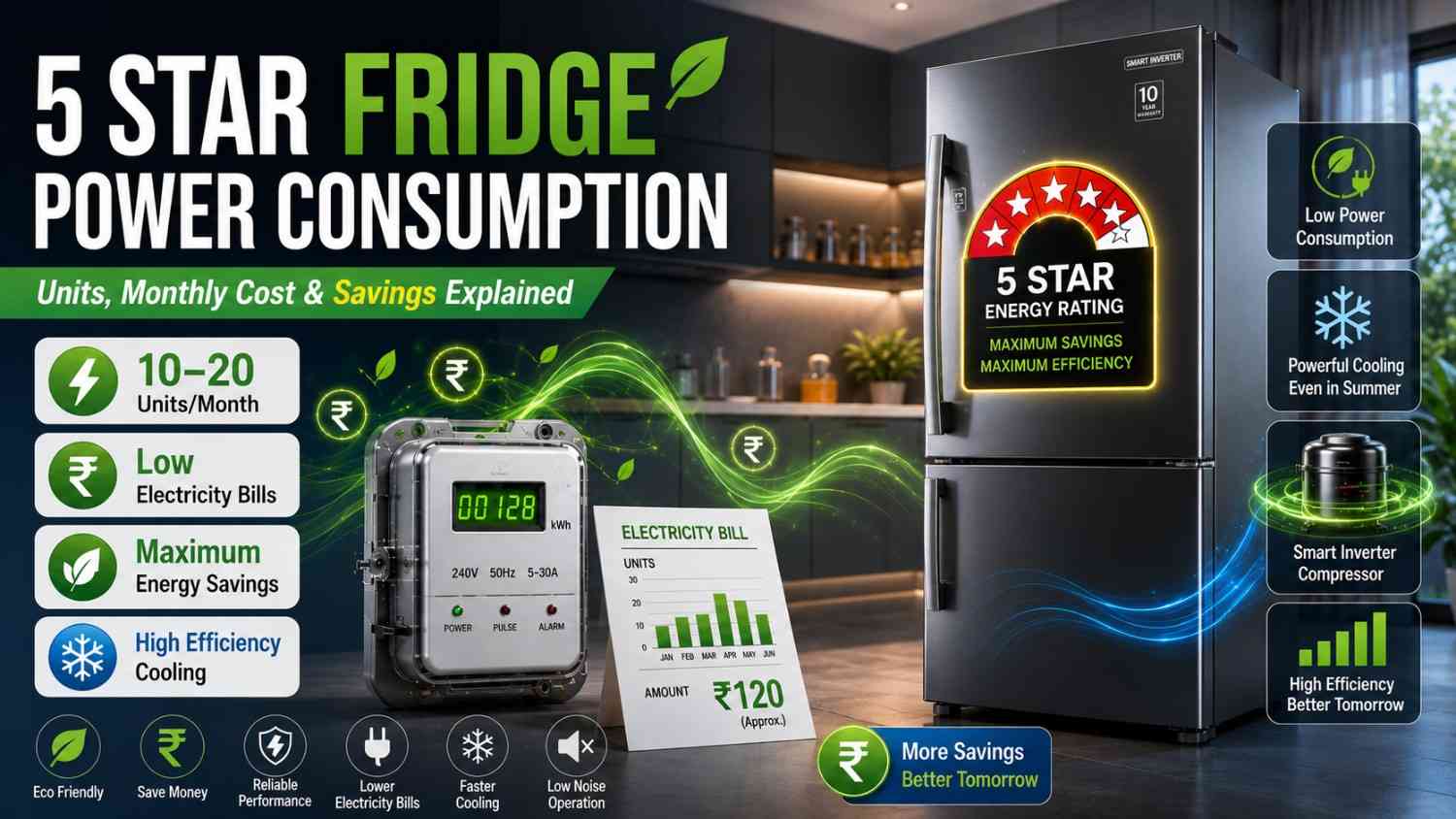
The annual consumption of power by a 5 Star refrigerator normally falls within the range of 120 to 250 kWh per year. It implies that a 5 Star refrigerator normally consumes electricity within the range of 10 to 20 units per month. This appliance is considerably cheaper in comparison with other fridges due to its low energy consumption.
What Does a 5 Star Rating Mean?
A 5 Star rating suggests that it is the most energy-efficient appliance in terms of consumption, as rated by BEE. Power usage in a fridge with a 5 Star rating is much less since it employs sophisticated compressors and high-quality insulation systems. This kind of refrigerator is designed to retain its cooling capacity with very little energy input.
Nonetheless, it is necessary to state that BEE revised its standards by 2026, thereby tightening the requirements for efficiency. It implies that new models of 5-star refrigerators consume less energy compared to old models with similar ratings.
5 Star Fridge Power Consumption by Capacity (Quick Table)
5 Star fridge power consumption per month varies based on size and usage patterns. Below is a quick breakdown for better understanding:
| Fridge Capacity | Annual Units (kWh) | Monthly Units | Annual Cost (₹) | Monthly Cost (₹) |
| 190–250 L | 120–150 | 10–12 | 960–1200 | 80–100 |
| 250–350 L | 150–200 | 12–17 | 1200–1600 | 100–135 |
| 350–500 L | 200–250 | 17–21 | 1600–2000 | 135–170 |
(Calculated at ₹8/unit average electricity rate)
How to Calculate 5 Star Fridge Power Consumption and Electricity Cost
Knowledge about how much electricity your 5 Star refrigerator uses will make it easy for you to calculate your monthly electricity bill because it is determined by the number of units used and the price of each unit of electricity.
Power Consumption Formula (Units)
Units (kWh) = (Wattage x Hours per day x Days)/1000
Units (kWh) = Annual Energy Consumption (kWh) ÷ 12
Example:
If a 5 Star fridge uses 180 kWh per year → 180 ÷ 12 = 15 kWh/month
Conclusion: 5 Star fridge power consumption per month stays low due to efficient compressor cycling and reduced energy loss.
Cost (₹) = Units × Electricity Rate (₹/unit)
Cost = Units × Electricity Rate
Example:
If monthly usage = 15 units and electricity rate = ₹8/unit → 15 × 8 = ₹120/month
Units = 15 per month
Electricity rate = ₹8 per unit
Cost = 15 × 8 = ₹120 per month
Conclusion: Even with daily usage, a 5 Star refrigerator keeps monthly electricity cost minimal, making it highly budget-friendly for long-term use.
Does Refrigerator Type Affect 5 Star Power Consumption?
Certainly, the kind of refrigerators are important in determining the power requirement for 5 Star fridge models. The frost free ones use little more power compared to the direct cool type since of the fan and defrosting processes.
| Refrigerator Type | Monthly Units (kWh) | Monthly Cost (₹) | Why It Consumes This Much |
| Direct Cool | 10–14 | 80–110 | Natural cooling, no fan |
| Frost Free | 12–18 | 100–145 | Auto defrost system |
| Side-by-Side | 18–25 | 145–200 | Larger space & dual cooling |
Conclusion: Direct cool models consume less, but frost-free offers convenience.
Factors That Affect 5 Star Fridge Electricity Consumption
5 Star fridge power consumption depends on usage habits, ambient temperature, door opening frequency, storage load, and maintenance condition, all of which directly influence compressor workload and overall electricity consumption efficiency.
- Setting of Temperature- If temperature is set low, then it will cause longer working hours for the compressor resulting in higher power consumption.
- AI-powered inverter technology- Modern refrigerators use AI algorithms to adjust cooling based on usage patterns, outside temperature, and door openings, which helps optimize compressor activity and reduce unnecessary power consumption.
- Opening of Door- Repeatedly opened doors can cause loss of cold air from the refrigerator causing extra effort for the compressor and ultimately leading to increased electricity consumption.
- Amount of Storage- Overload inside the refrigerator causes poor circulation of air resulting in longer working hours of the compressor and hence increases the power consumption.
- Maintenance Condition- If dust accumulates on the coils, it lowers efficiency, causing a long cooling process and thus increased power consumption.
5 Star vs 4 Star Fridge: Is Upgrading to 5 Star Worth It?
Moving to the 5 Star rating for refrigerator electricity consumption results in lower electrical expenses in the long run. Although 4 Star rating fridges may be more affordable, 5 Star fridges are more efficient and cost-effective.
| Feature | 4 Star | 5 Star |
| Energy Efficiency | Good | Excellent |
| Monthly Units | 15–25 | 10–18 |
| Electricity Savings | Moderate | High |
Using a 5 Star rated fridge will make more sense in the long run because of their better efficiency rates. It is the most efficient appliance that should be used by families with high use of refrigerators.
How to Reduce 5 Star Fridge Electricity Consumption
A 5 Star refrigerator electricity use can be improved through basic practices such as ensuring that temperatures remain optimal, not opening doors too frequently, storing food properly, and ensuring cleanliness to enable efficient compressor functioning and lower energy consumption.
- Keep Refrigerator Temperature Optimal- The temperature should be maintained in the range of 3-5 degrees Celsius for the compressor to function optimally by running its cycles without being overworked.
- Minimize Door Openings- Each time the refrigerator door is opened, cold air escapes and warm air enters the fridge. This causes more cooling cycles to be initiated by the compressor and hence uses up more electricity.
- Maintain Condenser Coils Clean- Dirty condenser coils cannot dissipate heat effectively; hence, they lead to higher electricity usage because they require more operation from the compressor.
- Avoid Overfilling the Fridge- Overfilling the fridge hinders proper airflow in the fridge and causes improper cooling of its contents. This results in increased compressor work hence higher power usage.
Conclusion
Power consumption by 5 Star fridge in India still continues to be among the most economical choices in 2026. Given their monthly power consumption that lies within the range of 10-20 units, they enable individuals to save on their electricity bills. Examples of such brands include LG 5 Star refrigerator power consumption, Samsung 5 Star refrigerator power consumption, and Whirlpool 5 Star refrigerator power consumption. Although the upfront price may be higher, in the long run, they will prove to be cost-effective and efficient.
Our Refrigerator Repair Services Across Major Cities
NoBroker offers dependable refrigerator repair services across major cities such as Bangalore, Mumbai, Chennai, Delhi, Pune, Hyderabad, Gurgaon, Noida, Ghaziabad, Greater Noida, and Faridabad. Get quick technician support within 15 minutes of booking, a 180-day service warranty, and assurance of 100% genuine spare parts for smooth and hassle-free doorstep repairs.
Brands We Serve for Refrigerator Repair Services
NoBroker provides trusted refrigerator repair services for all major brands, including Samsung, LG, Whirlpool, Godrej, Bosch, IFB, Haier, Panasonic, Hitachi, Siemens, and more. The service ensures quick issue resolution, expert technicians, and 100% genuine spare parts for reliable appliance performance.
Frequently Asked Questions
1. What is the 5 Star fridge power consumption per month?
2. What is the LG 5 Star refrigerator power consumption per month?
3. What is the Whirlpool 5 Star refrigerator power consumption per month?
4. How much electricity does a Samsung 5 Star refrigerator consume per month?
5. Does the 5 Star refrigerator really conserve electricity?
6. Do 5 Star refrigerators have inverter technology?
7. Between the 4 Star or 5 Star refrigerator, which one is better?
8. Is fridge size a factor in electricity usage?
9. Is voltage fluctuation a determining factor in electricity usage?
10. What is the proper temperature for 5 Star refrigerators?

Login / Sign up
Zero Brokerage.
Thousands of new listings daily.
100 Cr+ Brokerage saved monthly.
About the Author

Siri Hegde K
Senior Editor


Recent Blogs

Subscribe to our Newsletter
Get latest news delivered straight to your inbox