





- https://nsi.gov.in/storage/files/1/download/anti-ragging-affidavit.pdf
- https://www.iimv.ac.in/uploads/ugc-iec-guidlines-for-curbing-the-menace-of-ragging.pdf
- https://jsrohilla.in/difference-between-oath-commissioner-and-notary-in-india/
- https://mkins.edu.in/assets/doc/arg.pdf
- https://antiragging.in/affidavit_affiliated_form.php
- https://www.antiragging.in/assets/pdf/information/ugc-iec-guidlines-for-councils-universities-and-colleges-for-curbing-the-menace-of-ragging.pdf
- https://www.antiragging.in
Summary
An anti ragging affidavit can be attested by an Oath Commissioner, Notary Public or a First Class Judicial Magistrate. In most colleges and universities, a notarized affidavit is accepted, as a notary is legally authorized to administer oaths and verify identity. An Oath Commissioner is usually an advocate appointed by a court to take sworn statements and is commonly found near district courts and advocate chambers. Students can get the affidavit signed at court complexes, notary offices or authorized service centers. Always check your institution’s instructions, as some universities specifically mention oath commissioner or magistrate instead of a notary.
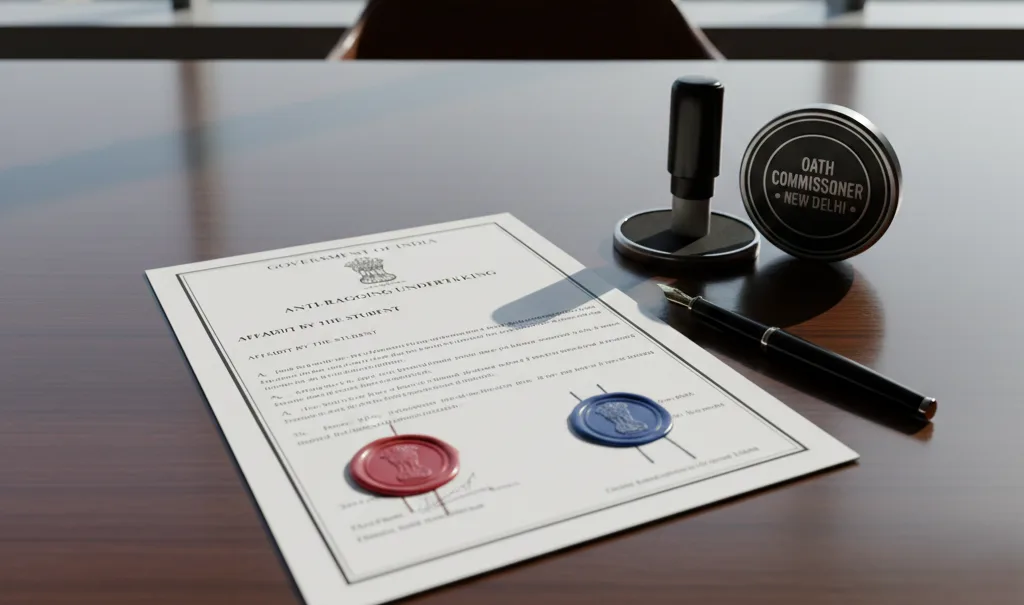
Every student seeking admission to an Indian college or university must submit an anti-ragging affidavit. This document is a mandatory legal commitment from both the student and the parent, stating that they understand the prohibition of ragging and the severe consequences of violating this rule. The affidavit must be legally sworn before an authorised official to make it enforceable. This key step raises the question: who is the oath commissioner for the anti-ragging affidavit, and who else is authorised to attest to this document? The authorised official commonly an oath commissioner, Notary Public, or Magistrate transforms the simple written statement into a legally binding declaration accepted by the institution.
Who Is an Oath Commissioner?
An Oath Commissioner in India is a legal professional appointed by the High Court or a subordinate judicial authority to administer oaths and affirmations and to verify signatures on affidavits and declarations. They are specifically authorised under the Oaths Act, 1969, to ensure that the individual (the affiant) making a written statement does so truthfully and voluntarily. Primarily found near court complexes, the oath commissioner confirms the identity of the person signing the document and affixes their official seal and signature, transforming a simple declaration into a legally enforceable, sworn statement widely used in courts, government offices, and administrative processes. [1]
Role of an Oath Commissioner in Anti-Ragging Affidavits
The role of the official in the anti-ragging affidavit attestation process is to confirm the identity of the person making the declaration and to give the statement legal sanctity. [2]
- The Commissioner ensures the person signing the document is the student or parent named on the affidavit.
- They confirm the affiant is signing willingly and understands the serious commitment they are undertaking.
- The Commissioner formally asks the affiant to swear that the contents of the affidavit are true, binding them under the penalty of perjury.
- By affixing their official seal, signature, and date, the Commissioner authenticates the affidavit, making it admissible as a legal commitment.
- In some cases, the Commissioner maintains a record in their official register, noting the details of the affidavit for future reference.
Who Can Issue an Anti-Ragging Affidavit?
The anti-ragging affidavit is issued by the student and the parent (the affiants), but it must be attested by one of several authorised legal officials.[3]
- Oath Commissioner: A highly suitable and commonly accepted official, especially for affidavits intended for court or government purposes.
- Notary Public: Often used interchangeably with the Oath Commissioner, a Notary Public has a broader authorization under the Notaries Act, 1952.
- First Class/Executive Magistrate: These officials also have the legal authority to administer oaths for affidavits and declarations.
- Judicial Magistrate: A higher judicial authority who can legally attest to the document.
- Sub-Registrar (occasionally): While their primary role is property registration, they may also be authorised to attest to affidavits in certain local jurisdictions.
Oath Commissioner vs Notary: Which One to Choose for Anti-Ragging Affidavit?
The important point is that both officials are legally authorised to administer the necessary oath in India, meaning the resulting affidavit is legally valid. However, always check the specific college or university guidelines, as some older institutions may express a preference. For general information, the table highlights key differences between the two roles: [4]
| Aspect | Oath Commissioner | Notary Public |
|---|---|---|
| Appointed By | High Court or subordinate courts (for specific local jurisdiction) | Central or State Government (under the Notaries Act, 1952, with broader authority) |
| Oath Administration | Primarily focused on administering oaths and affirmations for court-related affidavits. | Can notarize various documents for both domestic and international use (e.g., powers of attorney, deeds, affidavits). |
| Legal Validity | Accepted as legally valid evidence in administrative and court matters within India. | Widely accepted and often used interchangeably with an Oath Commissioner for domestic affidavits. |
| Availability | Primarily found within or near court complexes and magistrate offices. | Often found more broadly, including in private legal offices or authorised firms. |
| Ideal For | Documents strictly required for judicial or court-affiliated processes. | Most general administrative, financial, and educational affidavits. |
Documents Required for Anti-Ragging Affidavit
To ensure the smooth and successful attestation of your anti-ragging affidavit, the student and parent must carry several mandatory identification and factual documents.
- Student ID/admission letter (to verify enrolment status and course details)
- ID proof of student & parent (Aadhaar, PAN, Passport for identity verification by the Commissioner)
- Address proof (for verifying the permanent residence of the affiants)
- Affidavit form details (the downloaded, ready-to-print format from the UGC/college website)
How to Get an Anti-Ragging Affidavit Attested by an Oath Commissioner?
The process of obtaining a legally attested affidavit often involves a preliminary online step followed by a mandatory in-person verification with the legal official. This answers the question of how to get an anti-ragging affidavit attestation. The entire process begins with the mandatory online undertaking prescribed by the University Grants Commission (UGC) before the physical attestation. [5]
Step 1: Fill the Online Anti-Ragging Form (UGC Website)
The student and parent must first visit the National Anti-Ragging Helpline website (www.antiragging.in) or a similar official portal. They fill out separate undertakings with all personal and college details, confirming they have read the regulations. This is the mandatory first step before creating the physical document.
Step 2: Draft the Affidavit
After submitting online, the student receives a unique Reference ID. Using this ID, they download the Student Undertaking and Parent/Guardian Undertaking formats (Annexures). These formats must then be printed onto non-judicial stamp paper of a nominal value (e.g., ₹10 or ₹20), often replacing the need to print the document on plain paper.
Step 3: Visit an Oath Commissioner
The student and parent must visit the oath commissioner or Notary Public with the stamped document. It is important to bring original identity proofs (Aadhaar, PAN). For more information on who can perform this task, see who can notarize an affidavit.
Step 4: Sign in Front of the Oath Commissioner
The affidavits must be signed by the student and the parent in the physical presence of the legal official. The official verifies the ID and witnesses the signature, confirming the affiant's identity.
Step 5: Get the Affidavit Attested
The oath commissioner administers the oath, affirming that the statements made are true. They then affix their official seal, signature, and date, legally completing the anti-ragging affidavit attestation.
Is the Online Anti-Ragging Affidavit Accepted?
Yes, the online anti-ragging affidavit submission is the officially mandated procedure by the UGC and AICTE for initial commitment, aiming to simplify the process.
- The online submission through portals like Antiragging.in creates a legally binding commitment and generates a unique reference number.
- While the digital record is the official commitment, some colleges and universities, due to internal administrative requirements, may still demand that the student print the downloaded undertaking format, place it on stamp paper, and have it physically notarized.
- Always check the specific college's admission prospectus to confirm if a physical copy is required in addition to the digital submission. [6]
Anti-Ragging Affidavit Format in India 2026
AFFIDAVIT BY THE STUDENT
I, [Full Name of Student], son/daughter of [Parent’s Name], having been admitted to [College/Institute Name], do hereby solemnly affirm and state as follows:
- That I will not indulge in any behavior or act that may come under the definition of ragging.
- That I will not participate in or abet or propagate ragging in any form.
- That I will not hurt anyone physically, emotionally, or mentally.
- That if I am found guilty of any aspect of ragging, I may be punished as per the provisions of the UGC regulations and/or as per the law of the land.
- That I hereby affirm that I have read and understood the directives of the UGC on the anti-ragging and the disciplinary actions that may be taken against me if I am found guilty.
Signature of Student: ___________
Name: ___________________
Address: _________________
Date: ____________________
AFFIDAVIT BY THE PARENT/GUARDIAN
I, [Full Name of Parent/Guardian], father/mother/guardian of [Student’s Name], admitted to [College/Institute Name], do hereby solemnly affirm and state as follows:
- That my ward will not indulge in any behavior or act that may be considered as ragging.
- That my ward will not participate in or abet or propagate ragging in any form.
- That if he/she is found guilty of any aspect of ragging, he/she may be punished as per the provisions of the UGC regulations and/or as per the law of the land.
- That I hereby affirm that I have read and understood the directives of the UGC on anti-ragging and the possible disciplinary actions against my ward, in case he/she is found guilty.
Signature of Parent/Guardian: ___________
Name: ___________________
Address: _________________
Date: ____________________
Cost and Processing Time for Attestation
The cost of the anti-ragging affidavit attestation consists of the stamp paper fee(e.g., ₹10 or ₹20) plus the official fee charged by the oath commissioner or Notary Public, which generally ranges from ₹50 to ₹150 per affidavit. [7]
How NoBroker Can Help with the Anti-Ragging Affidavit
Navigating the dual requirements of online submission and physical attestation for the anti-ragging affidavit can be complex. NoBroker provides correct anti-ragging affidavit formats as per UGC guidelines, assists with stamp paper procurement, and verifies the legal language for compliance with the anti-ragging act india. We connect you with verified notaries, offer doorstep attestation services in many cities, ensure proper completion of both student and parent affidavits, and guide you through the entire process, including securing the required seal and signature from the authorised legal official.
Frequently Asked Questions
Who is an oath commissioner for an anti-ragging affidavit?
An oath commissioner for anti-ragging affidavits is a legal officer appointed by the High Court who is authorised to administer the oath and formally attest the truthfulness of the student's and parents' declarations.
What is an anti-ragging affidavit?
An anti-ragging affidavit is a mandatory legal declaration made by a student and their parent, swearing that they will not participate in ragging and that they are aware of the severe penalties for such behaviour.
Can a notary attest an anti-ragging affidavit instead of an oath commissioner?
Yes, a Notary Public is fully authorised to attest the anti-ragging affidavit and is often used interchangeably with an oath commissioner by colleges for official submission.
Where can I find an oath commissioner?
You can typically find an oath commissioner or Notary Public in or around District Court complexes, Sub-Divisional Magistrate (SDM) offices, or authorised legal firms in your city.
How much does anti-ragging affidavit attestation cost?
The attestation cost is nominal, usually including the price of the stamp paper (e.g., ₹10) plus an official fee charged by the oath commissioner or Notary Public, typically ranging from ₹50 to ₹150.