





- https://legaldesk.com/general/who-is-a-notary-public
- https://blog.ipleaders.in/types-of-stamps-and-documents-that-can-be-affixed-upon
- https://cdnbbsr.s3waas.gov.in/s36a4cbdaedcbda0fa8ddc7ea32073c475/uploads/2025/01/20250128189926435.pdf
- https://notary.gov.in/
Summary
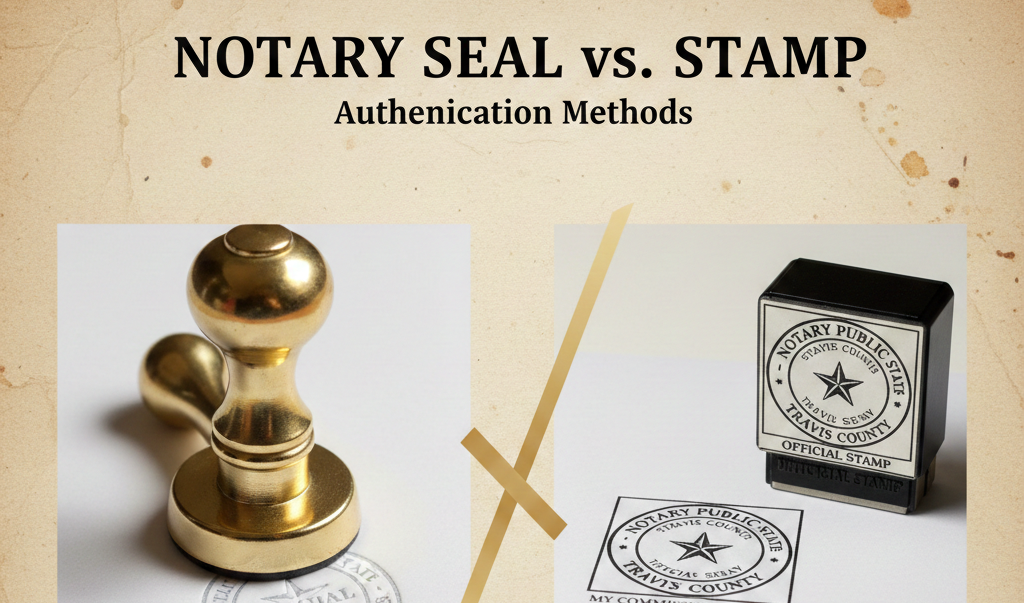
Notary seal vs stamp refers to two methods used by a notary public to authenticate documents. A notary seal is an embossed, raised impression that provides tamper-evident proof of notarization, while a notary stamp is an inked imprint showing the notary’s name, registration number, and validity. Both confirm the document’s authenticity and legal validity. Required items include the original document, signer’s ID proof, and the notary’s official authorization details.
What Is a Notary Stamp?
A notary stamp is a physical device, often made of rubber or designed as a self-inking unit, used by notaries to leave a flat, inked impression on a document. This mark contains vital information about the official, including their full name, commission or registration number, and the specific jurisdiction where they are authorized to practice. In many modern legal systems, the stamp is the primary method of authentication because it is highly legible and easily reproducible on photocopies and digital scans. [1]
What Is a Notary Seal?
A notary seal refers to the official authentication mark that certifies a notarial act. Historically and technically, the term "seal" often refers to an embosser a mechanical device that "crimps" the paper to create a raised, inkless impression. While a stamp provides readable text, the seal is a "classic" certification that adds a tactile layer of security to the document. Under many legal frameworks, the seal is the formal certification that validates the notarization, making it a mandatory requirement for certain high-level legal documents. [2]
Recommended Reading
Different Types of Notary Stamps in Indi...

3.3K Views

Oct 22, 2025
Passport Annexure Formats: Notary Attest...
2.3K Views
Aug 03, 2025
Apostille vs Notary in India: Meaning, P...
1.1K Views
Aug 03, 2025
Duties of a Notary Public in India: Role...
945 Views
Jul 30, 2025
Notary vs Lawyer: Differences, Duties, L...
621 Views
Sep 22, 2025
Notary Seal vs Stamp
While both tools are used for the same legal purpose, they differ in their physical delivery and how they appear on your official paperwork. [3]
| Feature | Notary Seal | Notary Stamp |
|---|---|---|
| Purpose | To provide a secure, raised authentication mark. | To provide legible, inked registration details. |
| Physical Form | Metal mechanical device (embosser). | Rubber or polymer device (inked). |
| Visibility | Raised texture; hard to see on copies. | Flat colored mark; easy to photocopy. |
| Legal Acceptance | Often required for international use. | Primary tool for daily legal tasks. |
| Typical Usage | High-security or formal legal deeds. | Affidavits, rental agreements, and loans. |
Notary Stamp and Seal: How They Work Together
In many jurisdictions, the notary stamp and seal are used in a complementary fashion rather than being a choice between one or the other. The inked stamp is preferred for its clarity, ensuring that government officials or bank clerks can easily read the notary's registration details. Meanwhile, the embossed seal serves as a fraud deterrent. Because a raised impression physically alters the paper's texture, it is significantly more difficult to forge or alter than a flat ink mark. This dual-layer approach ensures the document is both readable and tamper-evident.
When Is a Notary Seal or Stamp Required?
A notary's authentication is not required for every document, but it is mandatory for specific transactions where identity verification is a legal requirement. [4]
- Property or legal agreements: Ensures that all parties involved in a land or house deal have signed willingly.
- Affidavits and declarations: Validate sworn statements that may be used as evidence in a court of law.
- Power of attorney documents: Confirm the grantor has formally authorized another person to act on their behalf.
- International paperwork: Essential for documents like birth or marriage certificates that are moving across borders.
- Corporate filings: Used to authenticate board resolutions or partnership agreements for business registration.
Key Information Included in a Notary Stamp or Seal
For a mark to be legally valid, it must follow strict government guidelines. A standard notary seal or stamp typically displays specific information. [5]
- Notary’s full name: The official name as recorded in the government’s certificate of practice.
- Commission number: A unique identification number assigned by the appointing government authority.
- Jurisdiction/state: The specific area (district or state) where the official is legally allowed to work.
- Commission expiry date: The date when the official’s legal authority to practice ends.
- Official designation: Clearly featuring the word "NOTARY" in capital letters.
Documents That Commonly Require a Notary Seal and Stamp
Several documents require the notary stamp and seal for legal validity. [6]
- Affidavits: Sworn statements for name changes, address proof, or financial status.
- Power of Attorney: Documents giving another individual the right to manage your assets or legal affairs.
- Declarations: Formal statements made for government applications or visa processing.
- Indemnity bonds: Often required by banks to protect against potential financial losses.
- Consent letters: Frequently used when a minor is traveling abroad without both parents.
Common Mistakes to Avoid With Notary Stamps and Seals
Even a minor error in the authentication process can render a document "null and void." Awareness of these common pitfalls can save you from administrative delays. [7]
- Using expired stamps or seals: Notaries must renew their licenses; using an outdated mark makes the document invalid.
- Missing required information: If the registration number or expiry date is missing, the document will likely be rejected.
- Improper placement on documents: Placing a stamp over a signature or text makes the document unreadable and suspicious.
- Assuming stamp alone replaces seal: In some formal or international contexts, the embossed seal is specifically required.
- Using non-compliant formats: Using a rectangular stamp where the law requires a circular one can lead to legal rejection.
How NoBroker Can Help With Notarized Documents?
Navigating the complexities of notary seal vs stamp requirements can be stressful, especially during property transitions. NoBroker simplifies the rental and property documentation process for users. We connect you with verified legal services that understand the specific duties of a notary public and ensure your types of notary stamps are correct for your needs. Whether you need help with how to notarize a document in Bangalore or any other city, NoBroker provides end-to-end support to complete your paperwork faster without the burden of traditional brokerage.
Frequently Asked Questions
What is a notary stamp?
It is a rubber or self-inking tool used by a notary to imprint their official registration details on a document in a legible ink format.
Is a notary seal mandatory?
Yes, in most jurisdictions, the official seal is a mandatory requirement to authenticate the notary’s signature and validate the document for legal use.
What’s the difference between seal and stamp?
A difference between a seal and a stamp lies in their form; a stamp uses ink for legibility, while a seal (embosser) crimps the paper for security.
Can I notarize without a seal?
Generally, no. A notarization is considered incomplete and legally unenforceable if it lacks the official stamp or seal required by local law.
Do all countries require both?
Requirements vary by country and document type. Many modern systems use a single inked stamp, while international and high-security documents often require both.