





- https://www.nationalnotary.org/notary-bulletin/blog/2015/04/when-use-loose-certificate?
- https://notary.gov.in/docs/The%20Notaries%20Rules1956.pdf
- https://thc.nic.in/Central%20Governmental%20Rules/Notaries%20Rules,1956.pdf
Summary
A loose notary certificate is a separate authentication sheet attached to a legal document when there is no space for a notary’s seal or when prescribed notarial wording is missing. Instead of stamping the original paper, the notary prepares a stand-alone certificate containing acknowledgment or jurat language and securely links it to the main document with seal and signature overlap. Commonly used for property deeds, annexures, and court filings, it is legally valid under the Notaries Act, 1952, provided it is properly cross-referenced, sealed, and recorded in the notarial register to prevent misuse or rejection.
What Is a Loose Notary Certificate?
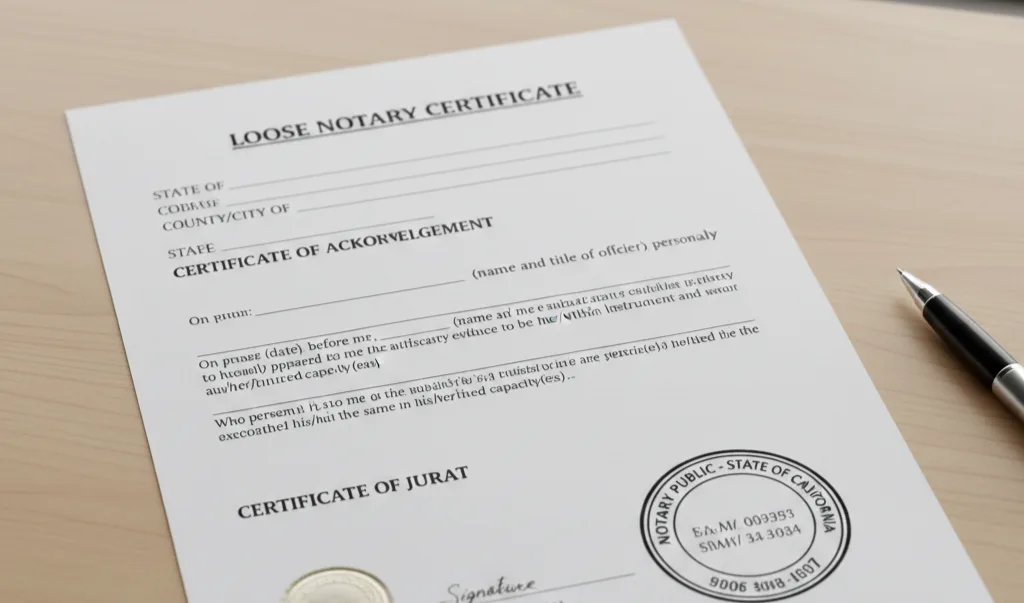
A loose notary certificate (also frequently referred to as a notary loose certificate) is a separate, stand-alone authentication sheet used by a notary public to perform a notarial act. Instead of applying the seal and signature directly to the main document, the notary prepares this separate page containing the necessary legal language such as an acknowledgment or a jurat. This sheet is then securely affixed to the main document to provide the required legal authentication when the original cannot accommodate the stamp or lacks the required prescribed wording.
When Is a Loose Notary Certificate Required?
While notaries generally prefer to stamp the original document, a loose notary certificate becomes necessary in several specific legal and physical circumstances. [1]
Recommended Reading
Different Types of Notary Stamps in Indi...

3.3K Views

Oct 22, 2025
Passport Annexure Formats: Notary Attest...
2.3K Views
Aug 03, 2025
Apostille vs Notary in India: Meaning, P...
1.1K Views
Aug 03, 2025
Duties of a Notary Public in India: Role...
945 Views
Jul 30, 2025
Notary vs Lawyer: Differences, Duties, L...
621 Views
Sep 22, 2025
- Document has detachable exhibits: When a filing includes separate maps, photos, or evidence that need individual authentication.
- Multiple attachments require separate authentication: In complex cases where annexures are added after the main text is finalized.
- Legal filings with attachments: When court-bound documents require specific verification for every included schedule or list.
- Property or contract paperwork with annexures: When a sale deed or lease has multiple schedules that lack space for stamps.
Key Features of a Loose Notary Certificate
A loose notary certificate must contain specific elements to be considered a valid legal instrument under the Notaries Rules, 1956. [2]
- Stand-alone sheet with exhibits: It exists as an independent page but remains legally tied to the attached exhibits.
- Contains notary information and jurisdiction: It clearly lists the notary's name, registration number, and the specific area they are authorized to serve.
- Identifies the related document(s): The certificate must describe the "master" document by its title, date, and total page count.
- Signed and sealed by the notary: It must bear a fresh handwritten signature and the official 5 cm circular seal.
- Used for separate acknowledgments: Essential when different signers appear at different times or locations for the same document.
Loose Notary Certificate vs Standard Notary Certificate
The choice between a standard stamp and a loose sheet depends on the physical constraints and the legal requirements of the receiving authority. [3]
| Feature | Loose Notary Certificate | Standard Notary Certificate |
|---|---|---|
| Purpose | Used as a last resort for crowded or improperly worded documents. | Used when the document has pre-printed wording and ample space. |
| Attachment Method | Secured with staples and a "corner stamp" across pages. | Printed or stamped directly on the main document pages. |
| Reference to Exhibits | Contains detailed cross-references to annexures or schedules. | Integrated directly into the body of the main document. |
| Use Case | Ideal for foreign documents or complex property annexures. | Best for standard affidavits and simple two-page contracts. |
| Integration | Requires manual linkage via notation and embossing. | Naturally, part of the document unit from the start. |
| Typical Scenarios | Lack of space, multiple signers, or correcting errors. | Standard rental agreements or basic identity proofs. |
How to Use a Loose Notary Certificate?
Using a loose notary certificate requires a strict protocol to prevent the document from being viewed as tampered with or fraudulent. [4]
- Identify attached exhibits needing authentication: Pinpoint exactly which schedules or annexures cannot accommodate a standard stamp.
- Prepare certificate referencing attachments clearly: Ensure the certificate explicitly names the document (e.g., "Acknowledgment for Power of Attorney dated 12 October 2023").
- Notary administers oath or acknowledgment: The signer must appear in person before the notary to affirm the truth of the contents.
- Attach certificate with exhibits: The sheet is typically stapled to the back of the signature page of the main document.
- Seal and sign the certificate: The notary must affix their seal at the junction of the two pages to create a "legal lock."
Is a Loose Notary Certificate Legally Valid?
A loose notary certificate is fully valid in India as long as it adheres to the Notaries Act, 1952. Its acceptance generally depends on the specific authority or institution receiving it. For instance, courts and banks usually accept them if there is a clear link to the main document, such as a "corner stamp" or embossing that appears on both pages. Most importantly, the act must be recorded in the Notarial Register with a unique serial number; otherwise, the notarization can be declared null and void during a legal challenge.
Loose Notary Certificate Format
State of: ____________
County of: ____________
On this ____ day of ______, 20, before me personally appeared ________________________________, who proved to me on the basis of satisfactory evidence to be the person whose name is subscribed to this document.
Witness my hand and official seal.
Notary Public Signature: ____________________
Printed Name: _____________________________
Commission No.: __________________________
Commission Expiry: _______________________
(Notary Seal)
Risks Associated with Loose Notary Certificates
Despite their legal standing, these certificates carry specific risks because they are physically separate from the primary text.
- Detachment or misuse: Since it is a separate sheet, staples can be removed, and the certificate could potentially be moved to a fraudulent document.
- Rejection by courts or authorities: Embassies, passport offices, or specific banks may view loose attachments with suspicion and request a fresh notarization on the original.
- Authenticity concerns: If the notary fails to cross-reference the page count or date of the main document, the certificate’s connection becomes hard to prove.
How NoBroker Can Help With Notarized Property Documents?
Navigating the complexities of property documentation requires precision, especially when dealing with notary attestation. NoBroker assists users by providing a seamless platform to prepare rental agreements and property documents that comply with all duties of a notary public. We connect you with verified legal experts who ensure that if a loose notary certificate is required, it is executed with the correct cross-referencing and registry entries. This helps you complete your documentation smoothly, ensuring that your notarized agreement is valid in court without the burden of heavy brokerage costs. Whether you need to verify a notary or draft a complex deed, NoBroker is your trusted partner.
Frequently Asked Questions
What is a loose notary certificate?
It is a separate authentication sheet attached to a document by a notary when the original lacks space for stamps or proper legal wording.
How does it differ from a standard notary certificate?
A standard certificate is stamped directly on the main document, while a loose certificate is a separate page that must be securely cross-referenced.
Do loose certificates require a notary seal?
Yes. A loose certificate is invalid without the notary’s official 5 cm circular seal and their handwritten signature.
Can a loose notary certificate be used for all attachments?
Yes, but it is best used only when there is no physical space on the original document to avoid suspicion of fraud.
Is there a template for loose notary certificates?
While formats vary, a loose notary certificate template must include the document title, date, page count, venue, and the prescribed notarial wording.