





Summary
When dealing with legal documents in India, ensuring their validity is a critical step to protect your rights and interests. Two of the most common methods for this are notarization and registration. While both processes are often mentioned together, the differences between notarization and registration are vast and significant. Many people confuse these terms, which can lead to serious legal complications, especially in property-related matters. This guide will clearly explain the purpose, legal standing, and appropriate use for each.
What is Notarization?
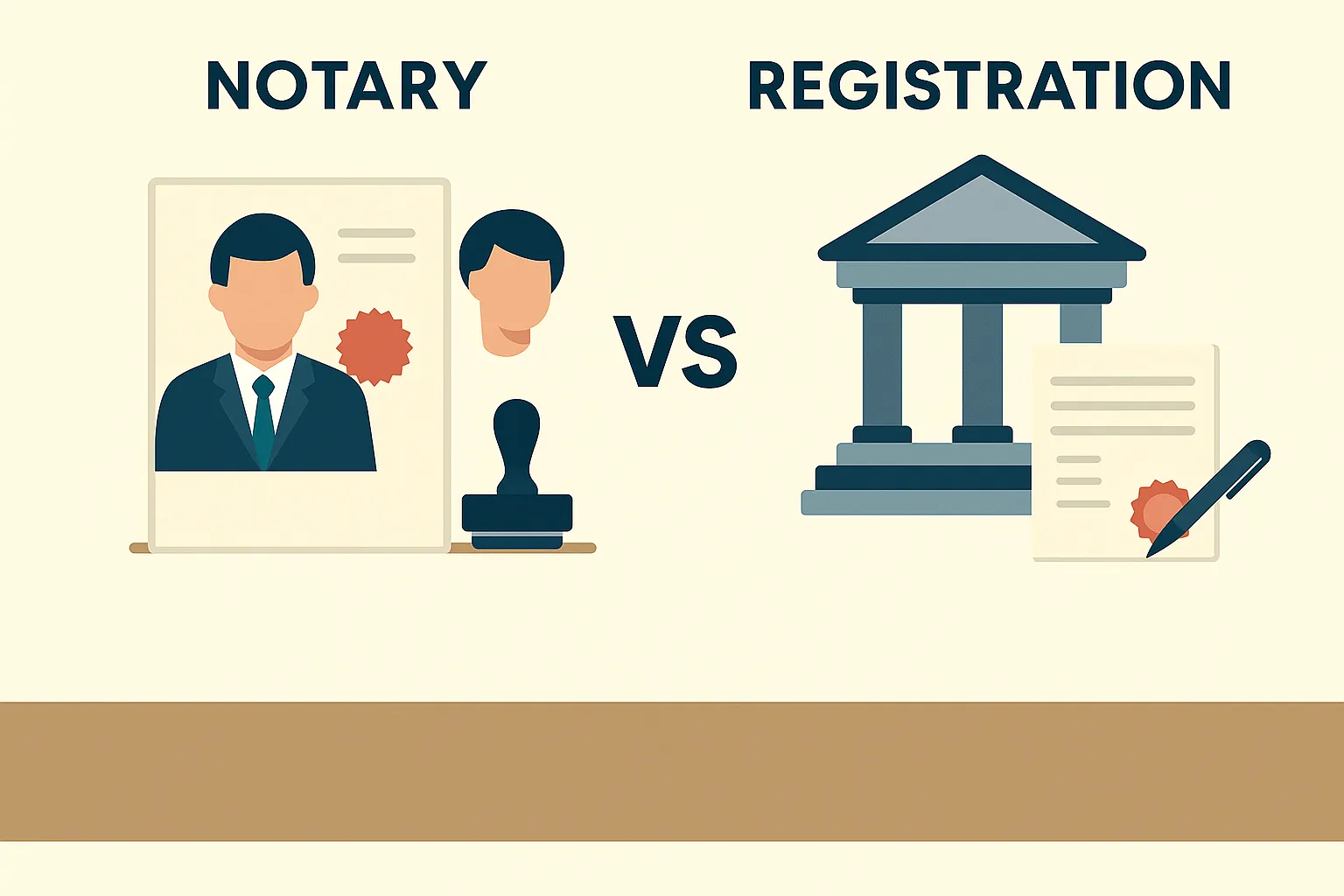
Notarization is the process of having a document authenticated by a Notary Public, who is a government-appointed lawyer. The primary purpose of this act is to verify the identity of the individuals signing the document and to witness their signatures. A notary does not verify the content of the document but confirms its proper execution. This process is commonly used for documents like affidavits, declarations, and certain types of powers of attorney to prevent fraud and ensure authenticity.
What is Registration?
Registration is the official process of recording a document with the Sub-Registrar’s Office. This creates a permanent and public record of the transaction for legal validity. The registration helps with transfer rights and ownership, particularly for immovable property formally. By law, documents such as property sale deeds, long-term lease agreements, and gift deeds must be registered to be legally enforceable.
Key Differences Between Notary and Registration
| Aspect | Notary | Registration |
|---|---|---|
| Authority | The document is certified by a Notary Public, a government-appointed legal professional. | The document is recorded and certified by the Sub-Registrar's Office, a dedicated government department. |
| Purpose | To authenticate the identity of the signers and certify that the signatures on the document are genuine. | To create a legally binding public record of the transaction and to formally transfer ownership and legal rights. |
| Legal Effect | A notarised document serves as proof of its execution, but it has limited evidentiary value in court and does not grant legal title. | A registered document is considered legally valid and is fully admissible as primary evidence in a court of law. It creates and transfers legal rights. |
| Scope of Use | Commonly used for affidavits, declarations, powers of attorney, and short-term rental agreements (11 months or less). | Mandatory for all transactions involving immovable property, such as sale deeds, gift deeds, and lease agreements for a term exceeding one year. |
| Cost | The cost is nominal and involves a small fixed fee for the Notary's services, typically ranging from ₹200 to ₹500. | The cost is significantly higher, as it includes stamp duty (a percentage of the property's value) and a separate registration fee. |
| When Required | Required when a document needs to be presented as a sworn statement or when its signing needs to be officially witnessed to deter fraud. | Mandated by law (under the Registration Act, 1908) for all high-value transactions, especially those related to real estate, to ensure legality. |
When to Use a Notary vs Registration?
Here are some practical examples of when to use each:
- Situations Where Notarization is Sufficient:
- Short-Term Rental Agreements: For rental or lease agreements with a duration of 11 months or less, notarization is a common practice to authenticate the document.
- Affidavits: Any formal sworn statement made for official purposes, such as affidavit for name change, passport application, or as evidence in a legal matter, must be notarised.
- General Powers of Attorney: Powers of Attorney that do not grant the authority to sell property are often notarised to verify the signature of the person granting the power.
- Declarations and Consent Forms: Various personal or business declarations are notarised to add a layer of authenticity to the signing process.
- Situations Where Registration is Mandatory:
- Property Sale Deeds: The transfer of ownership of any immovable property (land, house, apartment) is legally incomplete and invalid without the registration of the sale deed.
- Long-Term Lease Agreements: Any rental agreement for a property with a term of 12 months or more must be registered to be legally enforceable. This is a critical difference between a notarised and registered agreement.
- Gift Deeds: The legal transfer of a property as a gift is only completed once the gift deed is registered with the Sub-Registrar.
- Mortgage Deeds: When a property is used as security for a loan, the mortgage deed must be registered to give the lender a legal right over the property.
- Certain Powers of Attorney: A Power of Attorney that specifically grants the right to sell an immovable property must be compulsorily registered.
Legal Consequences of Skipping Notary or Registration
Failing to complete the legally required validation for your documents can have serious repercussions, ranging from the document being questioned to the entire transaction being declared void.
- Consequences of Not Completing Notarization:
- Questionable Authenticity: The document may be challenged because the signatures have not been verified.
- Rejection by Authorities: Government agencies or other institutions may refuse to accept the document if it lacks the required notarization.
- Weakened Legal Position: The lack of notarization weakens the document's standing as a properly executed instrument, even if the underlying agreement is valid.
- Consequences of Not Completing Registration:
- Invalid Transaction: This is the most severe consequence. For property deals, the transaction is considered legally non-existent. No ownership rights are transferred to the buyer.
- Inadmissible as Evidence: An unregistered document that is mandatorily registrable cannot be presented as evidence in a court of law to prove a right or title.
- No Legal Title: The buyer does not get a legal title to the property, which makes them highly vulnerable to fraud and future ownership claims from third parties.
- Inability to Resell: You cannot legally sell a property that was not correctly registered in your name when you purchased it.
- Risk of Financial Loss: You could lose the entire amount paid for the property if the transaction is not registered and the seller decides to dispute the sale or sell the property to someone else.
How can NoBroker’s Notary Services Help?
Navigating the nuances of legal documentation can often be confusing. NoBroker simplifies this process by offering professional online notary services for drafting and notarizing various legal documents. Whether you need a rental agreement for your home or an affidavit for official use, NoBroker provides a convenient and reliable solution, ensuring your paperwork is legally accurate and handled by experts without hassle.
