





- https://nerdmine.in/coach/12/138/Notary-Public-3408
- https://lawsarathi.com/affidavit-before-first-class-magistrate/
- https://cdnbbsr.s3waas.gov.in/s3ec03333cb763facc6ce398ff83845f22/uploads/2025/10/2025100752.pdf
- https://legalaffairs.gov.in/sites/default/files/AU1476.pdf#:~:text=(a):Rule%203%20of%20the%20Notary%20Rules%201956,of%20experience%20as%20Legal%20Practitioner%20is%20required.
Summary
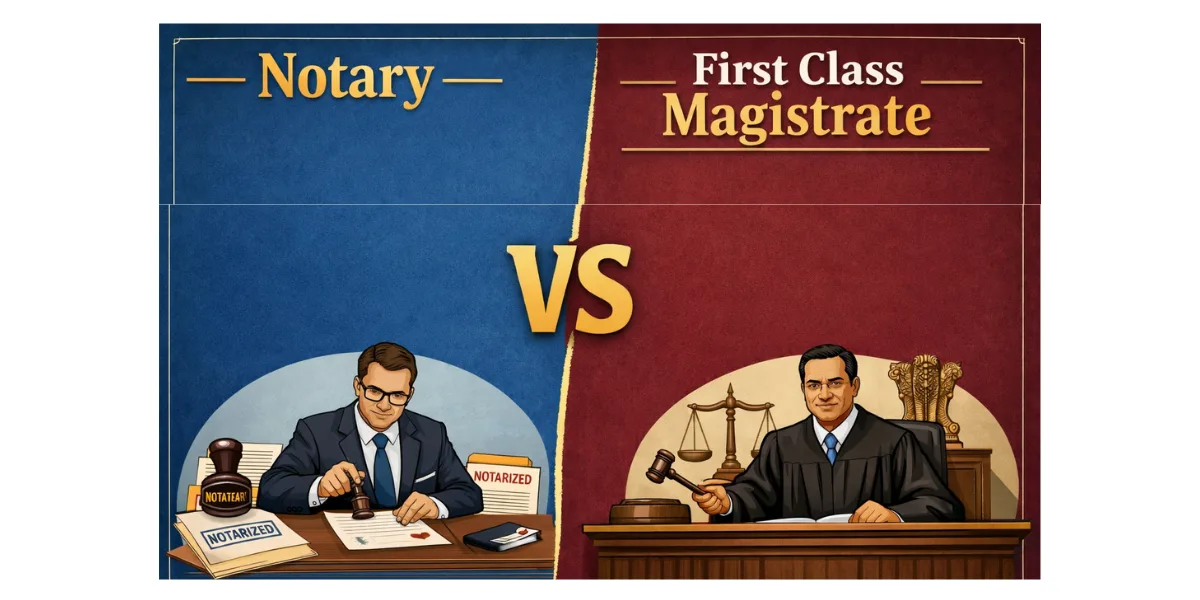
The Difference Between Notary And First Class Magistrate lies in their roles and legal powers. A notary public mainly performs administrative functions such as verifying identity, witnessing signatures, and notarizing affidavits. In contrast, a first-class magistrate is a judicial officer authorised to hear cases, record statements, and issue legally binding orders. Understanding this distinction helps avoid document rejection or delays. Platforms like NoBroker help users select compliant attestation services effortlessly.
Many people search for the difference between a notary and first class magistrate because both appear to perform similar tasks on documents. In reality, their roles are very different. A notary mainly helps with document authentication, identity verification, and sworn declarations for day-to-day legal needs. A first-class magistrate, however, is a judicial officer with court powers who handles criminal matters and passes legal orders. Knowing this difference helps you approach the right authority and avoid rejection of important documents.
What Does a Notary Public Do?
A notary public is an official witness to the signing of documents, confirming the identities and willingness of the parties involved. Their primary roles include attesting to affidavits, verifying identity with government-issued IDs, and certifying documents as true copies. They are authorized to administer oaths and affirmations. It is important to note what a notary public does in a non-judicial capacity to better understand their role. [1]
Who Is a First Class Magistrate?
A first-class magistrate, or Judicial Magistrate of First Class (JMFC), is a judicial officer who presides over criminal trials and is part of the lower judiciary. Their role is defined under the Code of Criminal Procedure, which grants them the authority to conduct trials for offenses punishable by imprisonment for a term not exceeding three years. They are senior officers who can take cognizance of offenses, record statements under oath for court use, and pass legally binding judicial orders. They hold the power to issue warrants, grant bail, and impose fines. [2]
Key Powers and Functions of a Notary
The authority of a notary is governed by the Notaries Act, 1952. Their functions are designed to facilitate smooth civil and commercial transactions by providing a layer of official trust. [3]
- Notarizing affidavits and declarations: Ensuring that the deponent is making a statement under a formal oath.
- Certifying copies: Confirming that a photocopy is a true and accurate reproduction of the original document.
- Attesting signatures: Serving as a witness to ensure that signatures on deeds or wills are genuine.
- Administering oaths: Formally swearing in individuals for legal or statutory declarations to ensure truthfulness.
- Verifying documents: Checking the validity of identity papers before a transaction is executed or finalized.
Key Powers and Functions of a Magistrate
A first-class magistrate possesses judicial authority that extends far beyond the administrative verification of paperwork. Their powers are focused on enforcing criminal law. [4]
- Conducting criminal trials: Presiding over cases and evaluating evidence presented by the prosecution and defense.
- Passing sentences: Having the power to award imprisonment up to three years or impose specific fines.
- Issuing summons and warrants: Ordering the appearance of individuals or the search of premises during investigations.
- Recording judicial statements: Taking formal statements from witnesses or accused persons that can be used as evidence.
- Attesting serious legal documents: Swearing in affidavits that are specifically required by high-level government or judicial authorities.
Notary Public vs First Class Magistrate: Key Differences
The difference between a notary and first class magistrate becomes clear when examining their daily tasks.
| Aspect | Notary Public | First Class Magistrate |
|---|---|---|
| Appointment | Appointed under the Notaries Act, 1952. | Appointed via Judicial Service examinations. |
| Nature of Role | Administrative and witness-based. | Judicial and adjudicatory. |
| Authority Level | Limited to document verification. | High; possesses sentencing powers. |
| Types of Documents | Affidavits, deeds, and true copies. | Court orders, warrants, and trials. |
| Legal Power | Impartial witness to signatures. | Ability to pass binding judicial sentences. |
| Accessibility | Highly accessible in public law offices. | Accessible primarily through court proceedings. |
When to Approach a Notary or a First Class Magistrate?
Deciding which authority to visit depends entirely on the nature of the document and the requirements of the receiving institution.
- Affidavits and declarations: For general purposes like name changes or address proof, a notary is appropriate.
- Document certification: Use a notary to certify educational or birth certificates for general use.
- Judicial proceedings: If a court specifically asks for a statement, a magistrate’s attestation is often required.
- Criminal or procedural matters: For bail bonds or surrender certificates, a first-class magistrate is the authority.
If you are dealing with a standard property deed or a simple rental affidavit, a mobile notary or a local notary office is sufficient. However, if the law mandates a higher level of scrutiny, such as for an indemnity bond for a high-value government tender, you might need to visit a magistrate.
How NoBroker Can Help With Notary Services?
NoBroker assists users with notarized documents, affidavits, and declarations by connecting them with verified notaries, guiding document preparation, and providing quick, convenient notary support. Whether you are curious about what states allow online notary or simply need a local professional to attest to your rental agreement, our platform simplifies the process. We ensure your paperwork is handled by authorized officials, helping you understand the difference between a notary and a first-class magistrate so you can choose the correct service for your specific legal needs without unnecessary delays.
Frequently Asked Questions
Is a notary the same as a magistrate?
No, a notary is a witness for document verification, while a magistrate is a judge who handles criminal trials and possesses judicial power to pass sentences.
Who has more authority: a notary or a first-class magistrate?
A first-class magistrate has more authority because they belong to the judiciary and can pass legal judgments, whereas a notary's power is limited to attestation.
Can a magistrate notarize documents?
While a magistrate can attest to affidavits and oaths, they do not function as a "notary" in the commercial sense. They usually handle documents required for court use.
What documents require attestation by a first-class magistrate?
Documents like bail bonds, certain high-value indemnity bonds, or statements specifically mandated by a court order often require a magistrate's attestation rather than a notary's.
Is notarization enough for court use?
For basic affidavits and identity proofs, notarization is usually enough. However, for evidence or formal trial statements, the court may require an attestation from a judicial magistrate.