Form D for Marriage Registration: Meaning & Process
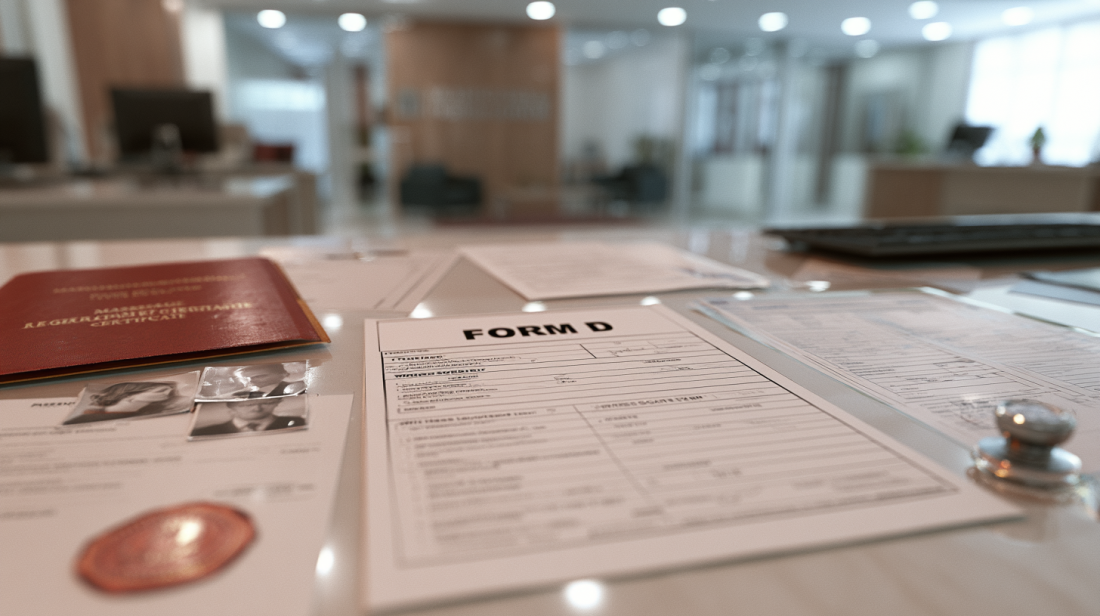

Marriage certificate

116 Views
Table of Contents
Marriage registration Form D often confuses couples who are only trying to formalise a wedding that has already taken place, rather than those who are yet to marry. Certain state and municipal registration authorities specifically require this form before issuing a marriage certificate, while other states use a completely different format and numbering system for the same purpose. Knowing what Form D marriage registration involves, when it applies, who is eligible to use it, and what paperwork to prepare in advance can save you an avoidable trip to the registrar's office. This guide walks through the form's purpose, its full process, and every document you are likely to need.
What Is Marriage Registration?
Marriage registration is the legal process of recording a marriage with the competent government authority after it has been solemnised. Once the marriage is recorded in official government registers, the couple receives a marriage certificate, which serves as legally recognised proof that the marriage took place and remains valid.
What Is Form D for Marriage Registration?
Form D marriage registration is the prescribed memorandum or application form that certain state registration authorities use to formally record the details of the bride, groom, the marriage itself, and the witnesses present. It is typically used to register a marriage that has already been solemnised through a religious or civil ceremony, rather than one that is yet to take place. The exact format, title, and applicability of Form D for marriage registration vary considerably from one state or municipal authority to another.
When Is Form D Used for Marriage Registration?
Form D marriage registration is not something every couple will encounter, since its use depends heavily on where the marriage was solemnised and which authority handles registration in that area. The following situations are the most common circumstances in which this specific form comes into play.
- Registration of an already solemnised marriage: used when the wedding ceremony has already taken place, and the couple now needs the marriage recorded in official government records.
- Submission before the Marriage Registrar: the completed form is formally submitted to the designated Marriage Registrar with jurisdiction over the couple's residence or place of marriage.
- Issuance of a marriage certificate: the registrar relies on the details in this form to prepare and issue the official marriage certificate.
- Registration under applicable state rules: some states have adopted this specific form under their own local marriage registration rules and regulations.
- Cases where the prescribed authority requires Form D: certain municipal corporations or district registrars specifically mandate this form over any other format.
Who Can Apply Using Form D?
Not everyone is eligible to apply using this form, as eligibility depends on the couple's marital status and whether their marriage already meets the applicable legal requirements. Broadly, the following categories of applicants can use it.
- Couples eligible for marriage registration: both partners must meet the age, consent, and legal capacity requirements set out under the applicable marriage law.
- Married couples seeking legal registration: couples whose marriage ceremony has already been performed and who now wish to have it formally recorded.
- Applicants fulfilling the applicable marriage law: the marriage must comply with the relevant personal law, or with the court marriage procedure in India under the Special Marriage Act, depending on how it was solemnised. It helps to know the difference between a court marriage and a registered marriage before deciding which route applies.
- Couples meeting the prescribed documentation requirements: applicants must be able to produce the identity, address, and marriage-related documents the registrar requires.
Information Required in Form D
Before you sit down to fill out this form, it helps to know exactly what information the registrar will expect from you. Gathering these details beforehand makes the actual filling-out process considerably faster.
- Bride and groom details: full names, parentage, and occupation of both spouses.
- Date and place of marriage: the exact date on which the marriage was solemnised and the venue where the ceremony took place.
- Residential addresses: current and permanent addresses of both spouses at the time of registration.
- Age and date of birth: confirming that both parties meet the minimum legal age for marriage.
- Religion and marital status: recorded where applicable, along with any prior marital status such as divorced or widowed.
- Witness details: names, addresses, and relationship of the witnesses who were present at the marriage.
- Details of the marriage solemnisation: the manner in which the marriage was performed, including any religious rites followed.
- Signatures of the parties and witnesses: both spouses and the witnesses must sign the form to validate the declaration.
Form D Marriage Registration Process
Filing this form is a fairly linear process once you know the sequence of steps involved. Each stage builds on the previous one, so it helps to complete them in order rather than skipping ahead.
Obtain Form D
Applicants should first obtain the prescribed Form D from the appropriate marriage registration authority, whether that means visiting the registrar's office in person or downloading it from an online portal, where such a facility is available.
Fill in the Required Details
Next, enter the bride's, groom's, marriage's, and witnesses' details accurately and legibly, making sure every entry matches the supporting documents you plan to submit alongside the form.
Attach Supporting Documents
Attach the prescribed identity, address, age, and marriage-related documents to the completed form, since an incomplete document set is one of the most common reasons applications are sent back for correction.
Submit the Application
Submit the completed Form D, along with all attachments, before the competent Marriage Registrar who has jurisdiction over your place of residence or the location where the marriage was solemnised.
Verification by the Registrar
The Registrar then verifies the information you have entered against the supporting documents and, where necessary, may ask for clarification or additional proof before proceeding further.
Issuance of Marriage Certificate
Once verification is complete and the registration itself is finalised, the marriage certificate is issued to the couple as official, legally recognised proof of the marriage.
Documents Required Along With Form D
Along with the completed form, registrars typically expect a standard set of supporting documents to establish both identity and that the marriage actually took place.
- Identity proof of both spouses: such as Aadhaar, PAN, or passport.
- Address proof: a recent utility bill, bank statement, or similar residence document.
- Age proof: a birth certificate or school-leaving certificate confirming date of birth.
- Passport-size photographs: recent photographs of both spouses, usually two copies each.
- Marriage photographs: photographs taken during the actual ceremony, showing both parties together.
- Marriage invitation card: if available, this can help corroborate the date and venue of the ceremony.
- Witness identity proofs: identity documents of the witnesses who signed the form.
- Other prescribed documents: any additional paperwork the specific registration authority requires, which can vary by state.
Common Mistakes to Avoid While Filling Form D
A single clerical error can be enough to get your application returned, forcing you to correct it and resubmit, so it helps to watch out for these common pitfalls before you file.
- Incorrect personal details: even minor typos in names or dates can cause the registrar to reject the form.
- Mismatch with supporting documents: entries on the form must match your identity and address proof exactly.
- Incomplete witness information: missing addresses or contact details for witnesses can delay processing.
- Missing signatures: forgetting to have both spouses or witnesses sign the form is a frequent oversight.
- Attaching incomplete documentation: submitting only some of the required documents often means a second visit to the registrar.
- Errors in the date or place of marriage: inconsistencies here can raise questions during verification and slow down approval.
Is Form D the Same Across All States?
Form D is not a single, universally prescribed marriage registration form used uniformly across India. Different states and municipal registration authorities frame their own forms, formats, and procedures under their respective marriage registration rules, and the applicable law can differ depending on whether the marriage falls under a specific personal law or the Special Marriage Act. Some states label this document Form D, while others use an entirely different form number or name. This matters if you wish to register a marriage in two different states; confirm the correct form and procedure with your local registrar before applying.
How NoBroker Can Help With Marriage Registration
Marriage registration paperwork can feel unnecessarily confusing when state rules, form names, and required documents all vary so widely depending on where you live. NoBroker helps couples figure out exactly which form applies to their state, assists with preparing the required documentation correctly the first time, and guides applicants through submission and verification, so the registration process moves forward smoothly rather than stalling over avoidable errors or missing paperwork.
Frequently Asked Questions
What is Form D for marriage registration?
Is Form D mandatory for every marriage registration?
Where can I obtain Form D for marriage registration?
What documents are required with Form D?
Can Form D be submitted online?
About the Author

Arthi A
Senior Editor


Recent Blogs

Subscribe to our Newsletter
Get latest news delivered straight to your inbox