Wasp Nest - Quick Information
Getting rid of a wasp nest requires the right timing, safety precautions, and removal method. If you're wondering how do you get rid of a wasp nest, the table below provides quick, easy-to-follow information on the safest and most effective options.
| Aspect | Quick Information |
|---|
| Best Time to Remove | Dusk or dawn, when wasps are less active and more likely to be inside the nest |
| Safety First | Wear long sleeves, gloves, closed shoes, and protective eyewear before approaching the nest |
| Fastest Method | Spray a commercial wasp killer at the nest entrance, wait 24–48 hours, then remove the nest. |
| Home Remedy | Soapy water can be effective for small nests by coating and immobilising the wasps |
| Vinegar Solution | A vinegar-and-water mixture may help deter wasps, but it is less effective against active nests. |
| Wait Time | 24-48 hours before removing the nest |
| What to Avoid | Do not knock down, burn, or spray a nest during the daytime when wasps are active. |
| Paper wasp nest | Smaller, open-comb structure and easy to treat |
How to Get Rid of a Wasp Nest Step by Step
Getting rid of a wasp nest safely requires patience, the right timing, and proper protection. Follow these simple steps to remove a nest effectively while reducing the risk of stings and future infestations. Check the steps below for detailed information:
- Identify the Type and Size of the Nest: Check whether it is a small paper wasp nest, a mud nest, or a larger hornet nest. Large nests are best handled by professionals.
- Choose the Right Time: Plan the removal at dusk or dawn when most wasps are inside the nest and less active.
- Wear Protective Clothing: Put on long sleeves, full-length pants, gloves, closed-toe shoes, and eye protection before approaching the nest.
- Keep Children and Pets Away: Clear the surrounding area to prevent accidental stings if the wasps become disturbed during removal.
- Prepare Your Removal Method: Have your wasp spray, soapy water solution, or other approved treatment ready before approaching the nest.
- Treat the Nest Carefully: Apply the spray or solution directly to the nest entrance from a safe distance and follow product instructions.
- Wait for Wasp Activity to Stop: Leave the nest undisturbed for 24–48 hours and check for any remaining wasp activity before touching it.
- Remove and Clean the Area: Once the nest is inactive, carefully remove it, place it in a sealed bag, and clean the surface thoroughly.
- Seal Entry Points: Close cracks, gaps, and openings around walls, roofs, windows, and vents to prevent new nests from forming.
- Monitor the Area Regularly: Inspect the location every few weeks, especially during warmer months, and remove early nest formations immediately.
Important Note: Wasps leave pheromone markers at nesting sites. Skipping Step 8 is one of the most common reasons a new nest forms in the same location the following year, so always clean the area thoroughly after removal.
Safety Precautions Before You Remove a Wasp Nest
Before learning how can you get rid of a wasp nest safely, take proper precautions to reduce sting risks and avoid disturbing the colony.
What to Wear Before Removing a Wasp Nest
- Wear a long-sleeved shirt and full-length pants to cover exposed skin and reduce the risk of painful wasp stings.
- Use thick leather or similar gloves to protect your hands when handling equipment near the nest.
- Wear closed-toe shoes or boots with socks to prevent wasps from reaching your feet and ankles.
- Put on safety goggles or protective eyewear to shield your eyes if wasps become agitated and start flying.
- Choose light-coloured clothing without loose openings, as dark colours and gaps may attract wasps or let them inside.
What Not to Do When Removing a Wasp Nest
- Do not approach the nest during the daytime, as wasps are more active, increasing the chances of being stung.
- Do not hit, shake, or knock down the nest, as this can trigger an aggressive swarm response.
- Avoid wearing perfumes, scented lotions, or strong fragrances that may attract or irritate nearby wasps.
- Do not use fire, smoke, or petrol to destroy a nest, as it can cause injuries and property damage.
- Never attempt to remove a large or hard-to-reach nest alone; contact a pest control professional instead.
Types of Wasp Nests Found in Indian Homes
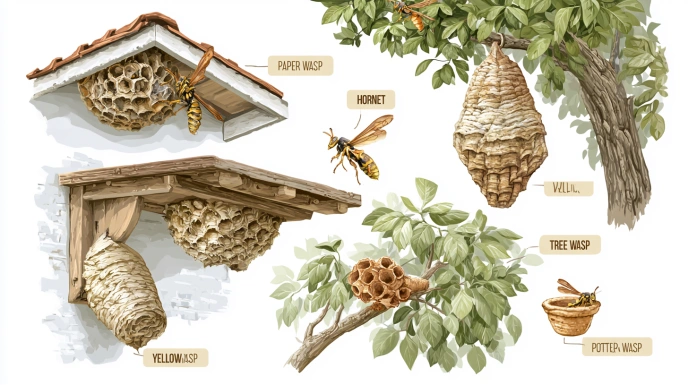 Different wasp nests found in homes
Wasp nests in Indian homes can vary in size, shape, and location depending on the species. Knowing the type of wasp nest helps you choose the safest removal method and avoid unnecessary stings.
- Potter Wasp (Eumenes): Constructs small pot-shaped mud nests on walls, plants, and outdoor structures. Solitary by nature and usually harmless.
- Paper Wasp (Polistes): Most common in Indian homes; builds small, open-comb nests that hang from eaves, balcony ceilings, window grilles, and AC unit covers. Usually less aggressive unless disturbed.
- Hornet (Vespa): Builds large, enclosed paper nests on trees, rooftops, attics, and wall cavities. More aggressive than paper wasps and can sting multiple times.
- Yellow Wasp (Ropalidia): Creates small paper-like nests under roofs, verandas, and sheds. Common in urban and suburban areas and may defend nests when threatened.
- Mud Dauber Wasp (Sceliphron): Makes tube-shaped mud nests on walls, ceilings, garages, and corners of buildings. Generally non-aggressive and rarely stings people.
- Tree Wasp: Often builds larger nests on tree branches, garden structures, and boundary walls. Colonies can grow quickly during warm months.
Home Remedies to Get Rid of a Wasp Nest
 Home remedies for wasp nests
Home remedies can help manage small wasp nests using common household ingredients. Knowing how to clean wasp nest areas afterwards also helps prevent future nesting.
Dish Soap and Water Spray
- What: Mix 2 tablespoons of dish soap in a spray bottle filled with water.
- How: Spray directly on the nest and entrance. The soap blocks the wasps' breathing pores, killing them.
- Best for: Small paper wasp nests and newly forming nests around homes.
- Caution: Requires close contact with the nest; wear full protective clothing and use only during dusk or dawn.
Apple Cider Vinegar Trap
- What: A mixture of apple cider vinegar, sugar, and water placed inside a container or bottle trap.
- How: Place the trap near the nesting area to attract and capture foraging wasps.
- Best for: Reducing wasp activity around patios, balconies, gardens, and outdoor seating areas.
- Caution: Does not eliminate an active nest and should be used as a supplementary control method.
Peppermint Oil Spray
- What: Mix 10-15 drops of peppermint essential oil with water in a spray bottle.
- How: Spray around eaves, windows, balconies, and areas where wasps frequently appear.
- Best for: Preventing wasps from building new nests in common nesting locations.
- Caution: Works mainly as a repellent and may not remove established or large nests.
Neem Oil Spray (India-Specific Remedy)
- What: A solution made by mixing neem oil with water and a few drops of liquid soap.
- How: Spray around nests and potential nesting spots to discourage wasp activity.
- Best for: Natural pest control in Indian homes, gardens, terraces, and balconies.
- Caution: Reapply regularly, especially after rain, for consistent effectiveness.
Camphor (Kapoor) Fumigation
- What: Camphor tablets are burned in a safe container to release a strong-smelling smoke.
- How: Place near the nesting area during the evening to help drive wasps away.
- Best for: Small outdoor nests and areas where wasps repeatedly gather.
- Caution: Use only in well-ventilated spaces and keep away from children, pets, and flammable materials.
How to Get Rid of a Paper Wasp Nest
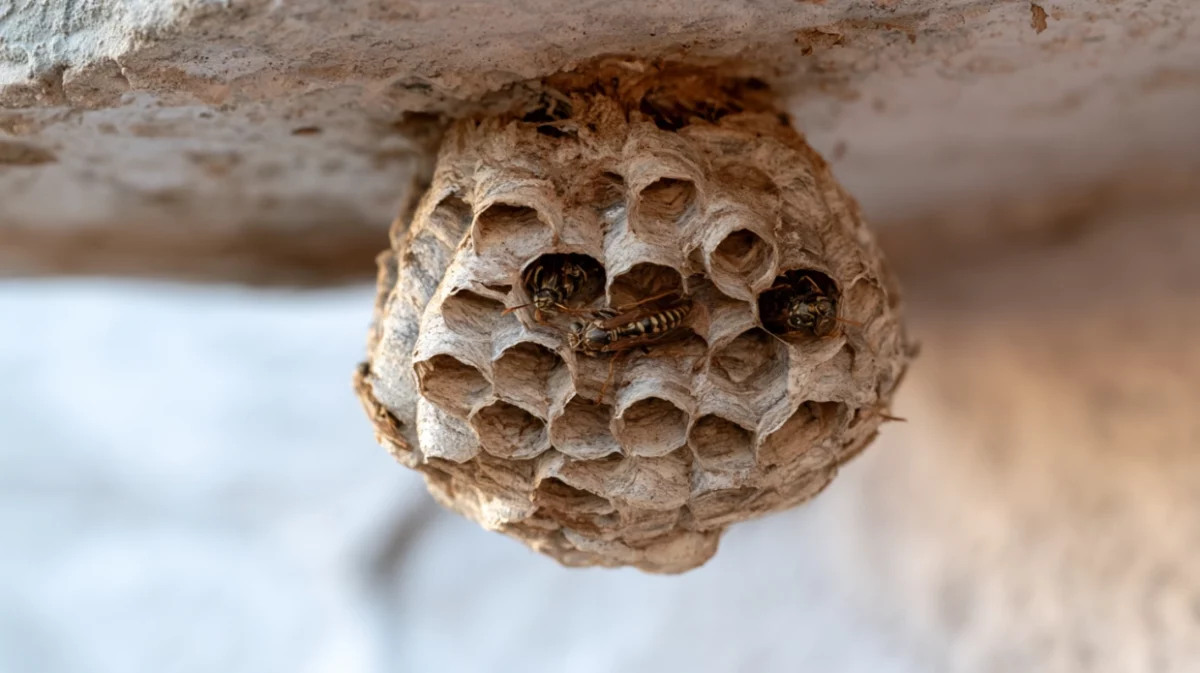 Removing a paper wasp nest safely
Paper wasps are the most common wasp found in Indian homes. Their nests are easy to recognise because they have an open, umbrella-like structure, making them simpler to identify and treat than many other wasp species.
- Identification: Paper Paper wasp nests have visible hexagonal cells without an outer covering and usually appear grey or brown in colour.
- Common Locations in Indian Homes: They are often found under roof eaves, on balcony ceilings, behind window grilles, on AC unit covers, on verandas, in garages, and on outdoor light fixtures.
- Why They Are Easier to Treat: Paper wasp colonies are usually smaller than hornet colonies, and their exposed nests allow treatments to reach the wasps directly.
- Best Time for Removal: Remove or treat the nest during dusk or dawn when most wasps are inside and less active.
- Removal Method: Use a commercial wasp spray, a dish soap and water spray, or a professional pest control treatment, depending on the nest size.
- After Treatment: Wait 24-48 hours, check for activity, then carefully remove the nest and dispose of it in a sealed bag.
- Prevent Future Nests: Clean the area thoroughly and inspect nearby surfaces regularly during warmer months.
Important Note: If the paper wasp nest is attached to or near an AC unit, switch the AC off and unplug it before spraying any liquid near the equipment.
How to Kill a Wasp in the House
A single wasp inside your house can be alarming, but staying calm and using the right method can help safely remove it.
- Trap It Near a Window: Open nearby windows and doors to create an exit path. Many wasps will naturally fly toward sunlight and leave.
- Use a Soapy Water Spray: Spray a mixture of dish soap and water directly on the wasp. The soap affects its breathing and quickly immobilizes it.
- Use an Insect Spray: If the wasp is resting on a surface, apply a household insect spray from a safe distance and leave the area briefly.
- Cover and Remove: Place a glass or container over the wasp, slide a piece of cardboard underneath, and take it outside.
- Check for More Wasps: Inspect windows, vents, curtains, and nearby rooms. A single wasp indoors can sometimes indicate a nearby nest.
Safety Tip: Avoid swatting at a flying wasp, as sudden movements can make it feel threatened and increase the chance of stings.
How to Prevent Wasp Nests from Coming Back
Preventing wasp nests is much easier than removing them later. The best time to act is early spring, before the queen begins building a new nest and establishing a colony.
Physical Prevention:
- Seal cracks, gaps, and holes around roofs, walls, windows, vents, and siding to block common nesting entry points.
- Remove small starter nests as soon as you spot them. Early removal can prevent a full colony from developing.
- Install fine-mesh screens on vents, attic openings, and windows to prevent wasps from entering hidden spaces.
- Keep outdoor bins tightly closed and clean up food scraps, sugary drinks, and fallen fruits that attract wasps.
- Regularly inspect balconies, roof eaves, garages, sheds, and AC units, as these are common nesting locations.
Natural and Chemical Detergents
- Spray peppermint oil around windows, balconies, and roof edges, as its strong scent can discourage nesting.
- Use neem oil spray around common nesting areas for a natural deterrent that is widely used in Indian homes.
- Hang decoy wasp nests in open areas, as some wasps avoid locations they believe are already occupied.
- Apply a residual wasp-control spray to high-risk areas before the nesting season for longer-lasting protection.
When to Call a Professional Pest Control Service
Professional pest control is the safest option when a wasp problem is difficult to access, unusually large, or poses health risks.
- If the nest is hidden inside a wall, ceiling, attic, crawl space, or underground, professional equipment is usually required.
- A nest larger than a football can contain a significant number of wasps and may become dangerous to handle.
- Call a professional immediately if anyone in your household has a known allergy to wasp stings.
- If DIY treatments show little or no reduction in wasp activity after 48-72 hours, expert intervention is recommended.
- Wasps repeatedly entering your home through an unknown opening may indicate a hidden nest that needs inspection.
- Finding multiple nests around the property often signals a larger infestation that requires a comprehensive treatment plan.
Book NoBroker Home Services
Removing a wasp nest safely starts with the right protective gear, proper timing (dusk or dawn), and using an attachment suited to the nest size. Always clean the area after removal, as leftover pheromone markers are a common reason nests return. Small or newly forming nests may respond to home remedies, while large, hidden, or indoor nests are best handled by professionals. NoBroker connects you with trained pest control technicians across Indian cities, offering transparent pricing with no hidden charges.
Book a NoBroker pest control service today for safe and effective wasp nest removal.
Frequently Asked Questions
Q1. What is the fastest way to get rid of a wasp nest? The fastest method is to use a commercial wasp spray, then wait 24-48 hours before safely removing the inactive nest.
Q2. Can I remove a wasp nest myself? Yes, small, easily accessible nests can be carefully removed with proper protective gear and appropriate treatment.
Q3.What home remedy kills wasps instantly? A strong dish soap and water spray can quickly immobilise wasps by blocking their breathing pores on contact.
Q4.What time of day should I approach a wasp nest? Approach a wasp nest at dusk or dawn when most wasps are inside and less likely to attack.
Q5. How long after spraying can I remove the nest? Wait at least 24-48 hours after treatment and confirm no wasp activity before attempting to remove the nest.
Q6. . Do wasps come back after the nest is removed? They can return if pheromone markers remain. Cleaning the area thoroughly helps prevent future nests in the same locations.
Q7. Is a paper wasp nest dangerous? Paper wasps are less aggressive than hornets, but they may sting if they feel their nest threatened.
Q8. When should I call a professional for wasp nest removal? Call professionals for large nests, hidden nests, recurring infestations, or when household members have sting allergies.
Q9. What should I do if a wasp stings me? Wash the area, apply a cold compress, and seek medical help immediately if severe allergic symptoms appear.
Most Viewed Articles
I'm Suju, an alchemist turned content writer from the enchanting land of Coorg. I love infusing my words with a touch of magic, creating engaging blogs, and informative articles And I have a deep passion for crafting beautiful poems.
Loved what you read? Share it with others!




 ✕



 Full RM + FRM support