Uttar Pradesh Rent Control Act: Provisions, Tenant Rights and Rental Laws Explained in 2026


38.2K Views
Table of Contents
Summary
The Uttar Pradesh Rent Control Act plays an important role in regulating rental relationships by defining the rights and responsibilities of both landlords and tenants. As cities across Uttar Pradesh continue to witness growing demand for rental housing, understanding these legal provisions has become essential for avoiding disputes related to rent, eviction, maintenance, and tenancy terms. Whether you are renting a house, apartment, or commercial property, knowing the key rules under the UP Rent Control Act 1972 Bare Act can help protect your legal interests, ensure compliance with applicable laws, and create a fair and transparent rental arrangement for both parties.
What Is Uttar Pradesh Rent Control Act?
The Uttar Pradesh Rent Control Act, officially known as the Uttar Pradesh Regulation of Urban Premises Tenancy Ordinance, 2021, came into effect on January 11, 2021, replacing the older rent control law. The Model Tenancy Act, 2019, governs urban residential and commercial properties across Uttar Pradesh, aiming to promote transparency, minimise disputes, and encourage landlords to rent out vacant premises.
What is Tenancy and How do Tenancy Laws work?
Tenancy is defined as the possession of land or property as a tenant. Tenancy Laws such as the UP Rent Control Act aim at defining, describing and delineating the rights, duties and obligations of tenants and landlords while they enter into a tenancy agreement contract. This law will make it easier for landlords and tenants to negotiate the rental agreement, and ensure fair play and transparency.
UP Tenancy Act: Need for UP Rent Control Act
For the last 50 years or so, landlords and tenants have been sceptical about each other. There is a lack of trust between the two parties. This results in a large number of properties remaining vacant. To address this problem, the Union Ministry of Housing and Urban Affairs (MoHUA)passed the Model Tenancy Act 2019.
The Model Tenancy Act 2019, also known as the Model Rent Act, as the name suggests, is a model or a set of guiding principles. The power to make laws in the matter of rent and tenancy belongs to the State Governments of India and not the Union Government. The UP Rent Control Act, which has come into force recently, is a formula-based one of the Model Tenancy Act.
So, the Model Tenancy Act is expected to be used as a framework while each state amends its existing tenancy laws or scraps old legislation and drafts new laws. The Uttar Pradesh Regulation of Urban Premises Tenancy Ordinance, 2021 will soon become a law when it is approved by the Governor of Uttar Pradesh. Tenancy-related disputes in UP, especially in the heavily residential areas of Noida, Greater Noida and Ghaziabad.
History of Rent Control Laws in Uttar Pradesh
The UP Urban Buildings (Regulation of Letting, Rent and Eviction) Act, 1972 governed rental properties in Uttar Pradesh for nearly five decades. However, its tenant-centric provisions made evictions difficult, leaving many properties vacant. To modernise the rental framework, the Uttar Pradesh Regulation of Urban Premises Tenancy Ordinance, 2021, based on the Model Tenancy Act, 2019, replaced the 1972 law with a more balanced approach.
UP Rent Control Act: What the UP-Rental Tenancy Act says about Rent
As per the new UP Rent Act, the Rent to be paid for the premises has to be agreed upon between the landlord and the tenant as per the terms in the tenancy agreement. The revision of the rent should also be agreed upon by both parties. Additionally, the landlord should give 3 months' notice before the revision of rent becomes overdue. However, if the tenant does not notify the landowner of the termination of the tenancy, it is deemed that the tenant has accepted the rent increase.
How much Rent can be increased per year in Uttar Pradesh? Cap on Rent Hike and Security Deposit
A popular question that arises when you are about to enter into a tenancy agreement, “is the rent fixed under the rent control act?” is answered clearly by the new law. The new Rent Control Act states that if the premises have been let for a fixed term, the rent cannot be increased during the tenancy period. The tenancy agreement has laid down a method of working out the rental agreement.
Cap on Rent Hike: Rent can be increased by 5% per annum
However, the Act mentions certain special conditions on which rent may be increased. For instance, if the landowner, in agreement with the tenant, has incurred expenditure on the improvement, addition or structural alteration of the premises occupied by the tenant, the landlord may increase the rent for one month effective from the completion of work.
Cap on Security Deposit: The law caps the maximum-security deposit the landlord is allowed to collect from the tenant. The security deposit should not exceed two months’ rent in the case of residential property, and it should not exceed six months' rent in the case of non-residential property. By encouraging the landlord and the tenant to act respectfully and fairly to each other, the regulations brought in by the new law will trust the tenant-landlord relationship.
Is Rent Agreement mandatory in UP?

To foster transparency and clarity in communication, the new UP Rent Control Act makes rental agreements mandatory in Uttar Pradesh. The Tenancy ordinance clearly states that “no person shall, after the commencement of this Act, let or take on rent any premises except by an agreement in writing”.
The natural question which arises is, what should be done in the case of tenancy without written rental agreements created before the commencement of the Act? In this case, the Act mandates both the landlord and the tenant to enter into a written agreement and have it presented to the Rent Authority, a body created and empowered by this Act, within three months from the date of commencement of this Act, ie by March 11, 2011.
If either party has difficulty convincing the other party to do the same within 3 months, each party has the right to separately file the particulars, within one month from the date of expiry. If the landlord submits the particulars and the tenant fails to do so in the stipulated time, the landlord may apply for the tenant's eviction. The Act also announces that the State Government will be setting up an online platform for the submission of such documents. The format for submitting the particulars is provided by the Government in the Tenancy Act as a Tenancy Form.
Can the Landlord increase Rent without Notice?
The new rental law also protects landlords' rights in India. Revision of rent is a concern that bothers both landlords and tenants alike. The new law ends these worries by demarcating clear grounds for the revision of rent. The rent can be revised only per the terms and conditions of the written tenancy agreement.
However, the new UP rent control act clearly states that if the landlord has incurred expenditure for improving, adding to, or altering the structure of the premises occupied by the tenant, the landlord may increase the rent as agreed to between the landlord and the tenant. This rent increase will become effective only one month after the completion of the work.
The Act allows landlords to increase the rent at a rate of 5 per cent per annum for residential premises and a rate of 7 per cent per annum for non-residential premises. However, the landlord should give notice in writing to the tenant.
Tenant Rights Under the UP Rent Control Act
Knowing your rights as a tenant can help you avoid disputes and ensure a fair rental experience. Here are the key tenant rights under the UP Rent Control Act:
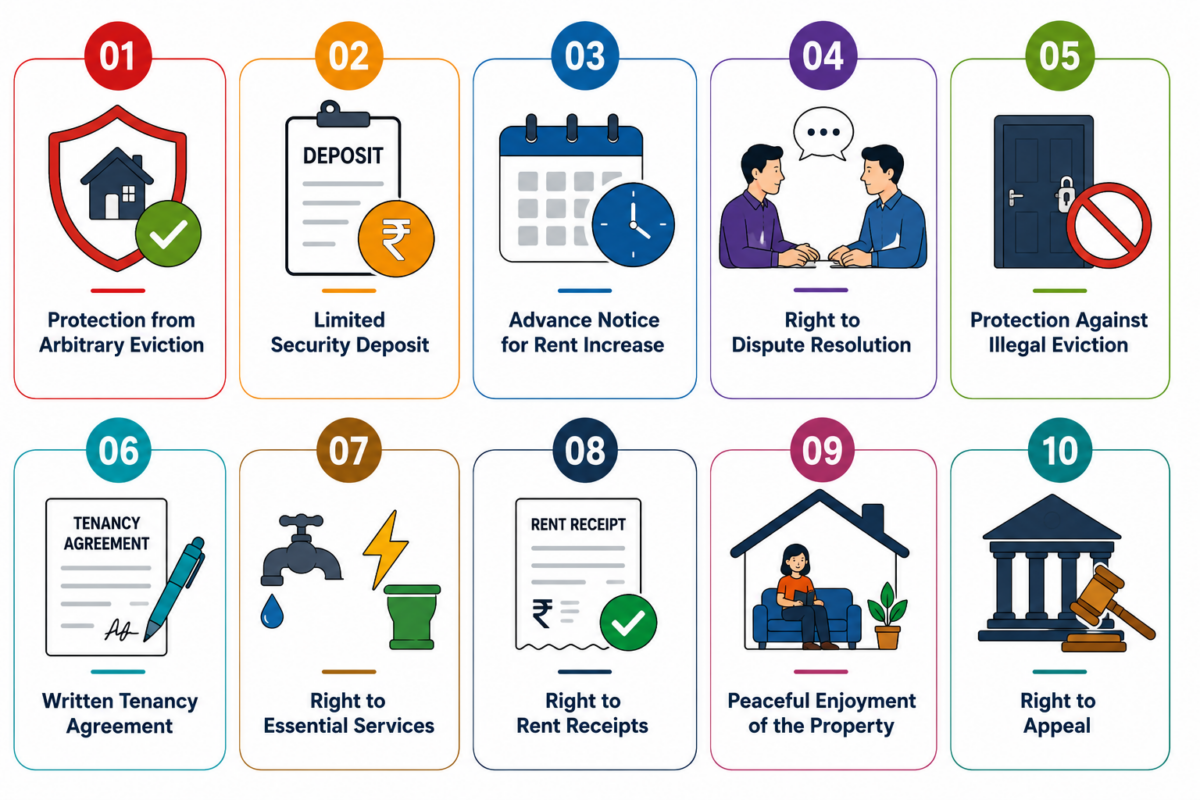
- Protection from arbitrary eviction: Tenants cannot be evicted as long as they pay rent on time and comply with the terms of the tenancy agreement, except on grounds specified under the law.
- Limit on security deposit: For residential properties, the security deposit cannot exceed 2 months' rent, while for non-residential properties, it is capped at 6 months' rent.
- Advance notice for rent revision: Landlords must provide at least three months' written notice before increasing the rent.
- Right to dispute resolution: Tenants can approach the Rent Authority for speedy resolution of disputes related to rent, maintenance, eviction, or tenancy agreements.
- Protection against illegal eviction: Landlords cannot forcibly evict tenants by changing locks, disconnecting electricity or water supply, or using intimidation or harassment.
- Right to a written tenancy agreement: Tenants are entitled to have the tenancy's terms and conditions clearly documented in a written agreement.
- Right to essential services: Landlords cannot unlawfully stop or restrict essential services such as water, electricity, or sanitation to force a tenant to vacate.
- Right to receive rent receipts: Tenants can request and receive proof of rent payment to avoid future disputes.
- Right to peaceful enjoyment of the property: Landlords should not interfere with a tenant's lawful possession or enter the premises without reasonable notice, except in emergencies.
- Right to appeal: If dissatisfied with an order passed by the Rent Authority, tenants may file an appeal before the Rent Tribunal within the prescribed time limit.
Evicting Tenants as Per UP Tenancy Act Provisions
When a landlord rents out a property to tenants, there are frequent times when the landlord needs the property for personal use or must evict the tenant for various reasons, many of which may be the tenant's fault. However, despite repeated requests from the owner, the tenants may frequently refuse to leave the property.
According to Section 105 of the Transfer of Property Act, 1882, a rental tenancy is merely a sort of lease in which the property is temporarily passed from the owner, who is referred to as the lessor, to the tenant, who is referred to as the lessee. However, all of the regulations pertaining to renters and landlords are covered by the Rent Control Act of 1948, which was passed by the Government of India to regulate the eviction of tenants in India and to calibrate the rentals of real estate. The most crucial need, however, is that you and your tenant have a formal rental agreement in place, which specifies information like the rent amount, the term of the contract, the security deposit, and the reason for the tenant's presence. While the Rent Control Act protects tenants from being arbitrarily evicted from their homes except for specific reasons and circumstances, the landlord nonetheless has the ability to do so if the tenant engages in certain specific behaviours or if the landlord needs the residence for his personal use.
Only when the lease expires or when the landlord terminates the lease by giving written notice in accordance with Section 106 of the Transfer of Property Act, 1882, is it permissible to evict a tenant; otherwise, the landlord must file a lawsuit and obtain a court order.
UP Tenancy Act: Grounds for Eviction
Any of the following reasons may be used to evict a renter from your property:
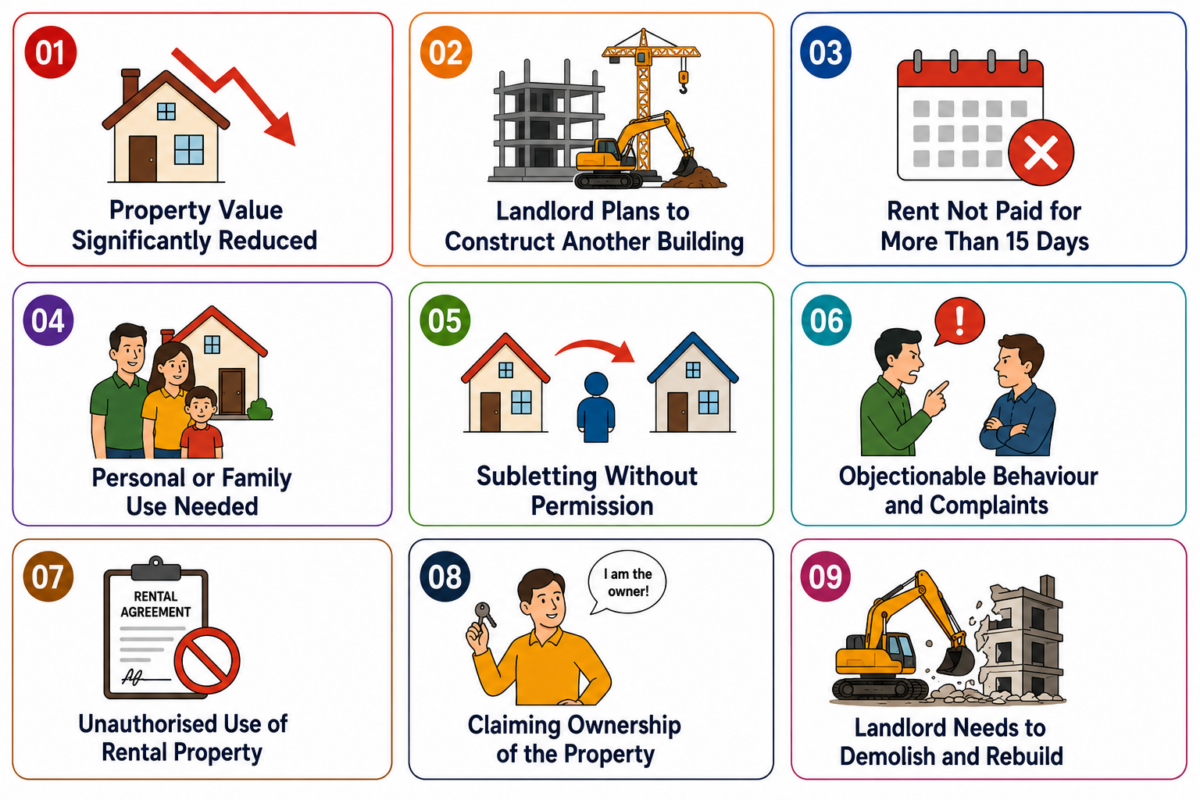
- If the tenant's behaviour has significantly reduced the property's worth or value
- If the landlord intends to construct another building that will require the destruction of the property.
- If the tenant does not pay the rent (as specified in the rental agreement) for more than 15 days after the due date, one may file an eviction lawsuit.
- If you or a member of your family needs the property for personal or family reasons.
- If a renter has rented a home, apartment, or other property to someone else before without your knowledge or consent.
- In the event that the neighbour deems the renter's behaviour objectionable and the landlord has been the subject of complaints regarding the tenant.
- If the tenant uses the rental property in an unauthorised manner or for a purpose not authorised by the rental agreement.
- If the renter intentionally tries to prove that they are the property's owner.
- In case the Landlord needs to destroy the current structure in order to build a new one.
Key Points to Remember as a Landlord while Evicting a Tenant
- Unless otherwise specified in the rental agreement, the landlord may not carry out the eviction by employing illegal tactics, such as turning off the water or electricity, changing the lock on the rental property, discarding the tenant's belongings, or imposing penalties on his own. These are crimes, and the tenant has the right to press charges against the landlord if he is found guilty.
- Only 11 months must elapse in the rental agreement, and a renewal clause is optional. It offers security from future eviction problems.
- According to the state's rental regulations, where the property is located, there must be cause for eviction.
- With the assistance of a real estate attorney, a rent agreement must be created that specifies the use of the property, how it will be terminated, how much rent will be due, and other details.
- If the rent is paid on time and the landlord does not intend to use the property for personal purposes, the landlord cannot evict the tenant for at least five years, according to the Supreme Court of India.
- A tenant cannot be evicted without first receiving an eviction notice from the landlord.
Process of Evicting a Tenant
Here are the three key steps involved in legally evicting a tenant under the UP Tenancy Act, from serving the initial notice to obtaining the final eviction order:
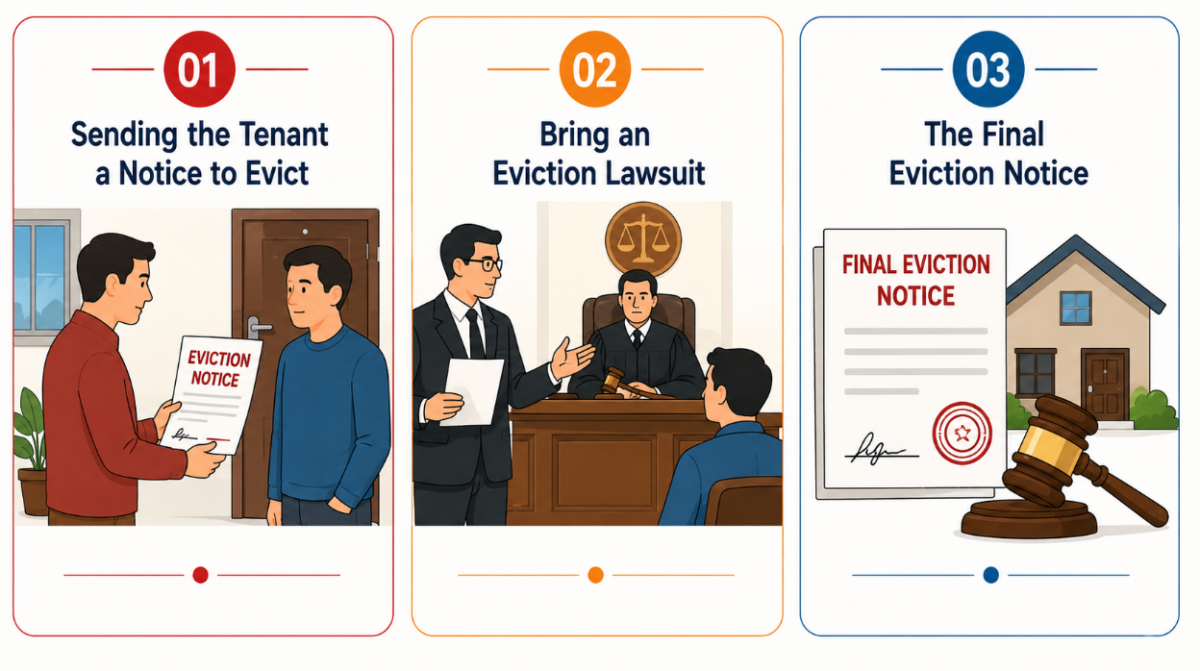
Step 1: Sending the Tenant a Notice to Evict
An eviction notice must be issued to the tenant, filed in a court with jurisdiction over the matter, and include the grounds for eviction as well as the time and date by which the tenant must vacate the property. The renter must be given a reasonable length of time to leave the rental property, according to the landlord.
Step 2: Bring an Eviction Lawsuit
The tenant has the choice to refuse to vacate the rental property and contest the eviction after receiving the court's eviction order. In this situation, the landlord may hire a rental property lawyer to bring eviction proceedings against the renter. The civil court that has jurisdiction over the rented property is where the tenant's eviction action is filed.
Step 3: The Final Eviction Notice
Following a hearing with both parties, the court issues a final legal notice of eviction for the tenant based on the arguments and evidence presented. The tenant is required to vacate the rental unit as soon as the court issues the final eviction order because they cannot ignore this notice.
How will the Uttar Pradesh Tenancy Act 2021 affect the Housing Market?
The tenancy act is arguably the best step the Government has taken in recent years toward improving transparency and information symmetry in the real estate market. The upper limits prescribed for security deposits in the UP Rent Control Act will make more rental houses accessible thereby helping in attending to the housing needs of Uttar Pradesh residents.
How Can NoBroker Help With UP Rent Control Act Legal Services?
Although Real estate laws of Uttar Pradesh, such as the UP Rent Control Act, are becoming more transparent and easier to understand owing to the increasing usage of e-governance mechanisms, navigating legal procedures of ownership and tenancy can be complicated and time-consuming. NoBroker’s Legal Services team is here to assist you in this regard. Our team of experts can guarantee a stress-free tenancy. NoBroker also provides relationship management and property management services, making it easy for both tenants and landlords. Download the NoBroker app or use the NoBroker website to reach out to us.
Frequently Asked Questions
1. Is rental agreement mandatory in UP?
2. Is the rent fixed under the rent control act?
3. Is there any restrictions on the security deposit for residential purposes in Uttar Pradesh?
4. What can the landlord do if the tenant is not responding to an eviction notice?
5. How will the Tenancy Act help in the long run?
6. What is the UP Rent Control Act 1972 and how does it differ from the 2021 ordinance?
7. What are the key provisions of the Uttar Pradesh Rent Control Act for tenants?
About the Author

Vinay Kulkarni
Senior Editor


Recent Blogs

Subscribe to our Newsletter
Get latest news delivered straight to your inbox