NRO to NRE Transfer in India: Process, Rules, Tax & Repatriation Guide (2026)

NRI Real Estate Guide & Property Tips

2.9K Views
Table of Contents
Summary
An NRO to NRE transfer allows NRIs to move funds from a Non-Resident Ordinary (NRO) account to a Non-Resident External (NRE) account. As per RBI guidelines, up to $1 million can be transferred per financial year after paying applicable taxes. The process requires submitting a request, FEMA declaration, and Forms 15CA and 15CB to ensure tax compliance and smooth fund transfer.
NRIs earning income in India, like rent or dividends, often find it confusing to transfer money abroad due to tax and regulatory requirements. An NRO account holds income earned in India, while an NRE account allows easy repatriation or transfer of funds abroad. Under FEMA, NRIs can transfer up to USD 1 million per financial year from NRO to NRE, provided taxes are paid. This involves submitting a request, a FEMA declaration, and Forms 15CA and 15CB to the bank. This blog covers the NRO to NRE transfer process, including the rules and documentation for easy transfers.
What is NRO to NRE Transfer?
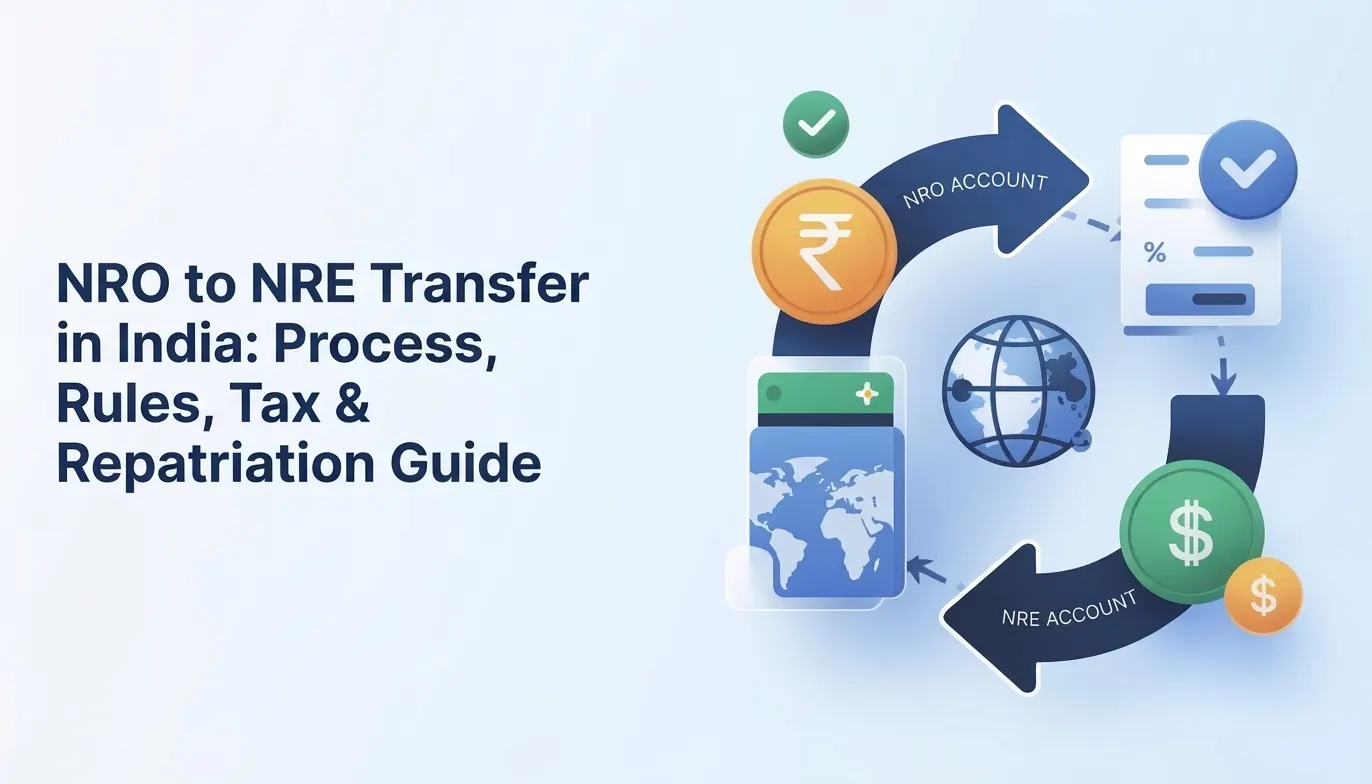
An NRO-to-NRE transfer is the movement of funds from a Non-Resident Ordinary (NRO) account used to hold income earned in India to a Non-Resident External (NRE) account, which allows funds to be freely repatriated or transferred abroad.
Recommended Reading

Best NRI Accounts in India: List of Best...
19.3K Views

TCS on Foreign Remittance: Complete Guid...
9.1K Views

Liberalised Remittance Scheme (LRS): Rul...
5K Views

NRI Personal Loan in India: Eligibility,...
4.2K Views
As per guidelines issued by the Reserve Bank of India (RBI) under the Foreign Exchange Management Act (FEMA), 1999, NRIs are allowed to transfer up to USD 1 million per financial year from an NRO account, subject to payment of applicable taxes.[1]
Tax Implications:
- Interest earned in an NRE account is tax-free in India.
- Funds can be transferred only after applicable taxes are paid.
- Interest earned on an NRO account is taxable (at 30% + applicable surcharge and 4% cess).
Why NRO-to-NRE Transfer Matters for NRIs?
An NRO-to-NRE transfer converts taxable Indian income into tax-free, fully transferable funds, making it easier to manage and move money globally. The transfer boosts liquidity and simplifies financial management of funds in India, Key benefits include:
- Tax efficiency: Interest and principal amounts in NRE accounts are fully exempt from tax in India. NRO accounts, on the other hand, are subject to around 30% tax on interest earned, plus applicable surcharge and 4% cess.
- Full repatriation: Funds in NRE accounts are fully repatriable and can be freely transferred abroad, whereas funds in NRO accounts are subject to a repatriation limit of up to $1 million per financial year.
- Higher returns: Tax-free interest on NRE accounts yields higher returns than taxable NRO earnings.
- Flexibility: NRE accounts help NRIs consolidate income, such as rent, dividends, and pensions, into a fully repatriable form that can be easily transferred and used globally.
Eligibility Criteria for NRO to NRE Transfer
NRO to NRE transfers are permitted up to $1 million per financial year under the Foreign Exchange Management Act, 1999, provided the funds are legitimate, have been taxed, and are properly documented. The eligibility criteria for the same involve:
- Account Requirements: The applicant must be a Non-Resident Indian (NRI) or Person of Indian Origin (PIO) with both an NRO and an NRE account.
- Repatriation limit: NRO-to-NRE funds transfer is permitted up to $1 million per financial year, as per RBI guidelines.
- Tax compliance: Applicable taxes must be paid before transfer and certified by a CA through Form 15CB, along with Form 15CA.
- Documentation: Submission of documents such as Form 15CA, Form 15CB, FEMA declaration, and proof of source of funds with Form 16 and 16A, if applicable.
- Nature of Funds: Funds must come from legitimate sources, such as rent, dividends, pensions, or the sale of assets, and must be traceable and comply with applicable laws.
Documents Required for NRO to NRE Transfer
Fund transfer to NRE account requires submitting the following documents as per RBI and FEMA guidelines:
- Duly signed transfer request form or bank-specific form
- Form 15CA filed online on the Income Tax portal.
- CA-certified Form 15CB as proof of tax compliance
- Documents supporting the source of funds, such as bank statements, rent receipts, sale deeds, or gift deeds
- FEMA declaration form
- Updated KYC documents
How Can I Transfer Money From NRO to NRE Account?
Transferring funds from an NRO to an NRE account is straightforward, especially when facilitated by platforms like NoBroker. The step-by-step NRO to NRE transfer process involves:
- Step 1: Confirm eligibility & documentation: Ensure you meet the eligibility criteria, that the funds are from legitimate sources, and that all applicable taxes have been paid.
- Step 2: Obtain Form 15CB: Get it certified by a Chartered Accountant to confirm tax compliance for the funds.
- Step 3: File Form 15CA online: Submit Form 15CA on the Income Tax portal using your NRI PAN card and required details.
- Step 4: Complete the transfer application: Download and complete the NRO-to-NRE fund transfer form from your bank's website or visit your nearest bank branch.
- Step 5: Submit required documents with the bank: Submit all required documents, including Forms 15CA, 15CB, KYC, and proof of source of funds.
- Step 6: Processing & approval: The bank will verify all documents to ensure compliance with RBI regulations. Once approved, the funds will be transferred and, if required, converted to your NRE account.
Key Rules & Compliance for NRO to NRE Transfer in India
NRO-to-NRE transfers are governed by the Reserve Bank of India under the Foreign Exchange Management Act, 1999. The key rules and compliance under RBI Master Direction No. 14 include: [2]
- Eligibility criteria: Funds must originate from legitimate sources, such as rent, pension, dividends, interest, or post-tax sale proceeds of assets.
- Annual limit: Up to US $1 million in funds per financial year can be repatriated or transferred without prior RBI approval. Amounts beyond this require RBI approval through an authorised dealer bank.
- Tax compliance: All applicable taxes and TDS must be paid before funds transfer. Forms 15CA and 15CB are required for taxable remittances above ₹5 lakh.
- Source verification: Funds must be legitimate and need proof via sale deeds, rental agreements and tax receipts.
- Restrictions: Unused limits cannot be carried forward. Certain cases, for instance, those involving agricultural land and large gifts, are subject to additional conditions and limits under RBI guidelines.
NRO vs NRE Account: Key Differences
Non-Resident External (NRE) and Non-Resident Ordinary (NRO) accounts are Rupee-denominated NRI accounts. While NRE accounts hold foreign earnings and offer tax-free interest, NRO accounts are taxable and used to manage income earned in India. The difference between an NRO vs NRE account is as follows:
| Basis | NRO Account | NRE Account |
| Purpose | Managing income earned in India | Parking foreign income in India |
| Income source | Indian-earned through rent, dividends & pensions | Income earned abroad |
| Taxation | Interest is taxable (~30% + surcharge & cess) | Tax-free interest |
| NRI Repatriation | Limited (up to USD 1 million per FY with conditions) | Fully repatriable or transferable |
| Joint holding | Can be held with a resident or a non-resident | Can be held only with another NRI |
| Exchange risk | No | Yes |
| Transferability | Can transfer to NRE (subject to rules) | Freely transferable abroad |
Common Mistakes NRIs Make While NRO to NRE Transfer
The NRO-to-NRE transfer process requires strict compliance, and even minor errors can delay or reject transactions. Common mistakes NRIs make while NRO to NRE transfer include:
- Assuming automatic transfer: Assuming NRO to NRE transfers are automatic can be a common mistake. NRO-to-NRE transfers are not automatic or instant; they require proper documentation, including a CA-certified Form 15CB confirming that taxes have been paid.
- Improper tax payment: Failing to pay applicable taxes or deduct TDS on income earned in India can lead to penalties and delays.
- Ignoring Forms 15CA and 15CB: Failing to file them can result in rejection or delay of the transfer.
- Not separating income types: While current income, such as rent, dividends, and pensions, is easier to transfer, capital receipts, such as property sale proceeds, are subject to stricter rules. Mixing them can lead to delays or rejection of the transfer.
- Exceeding the $1 million limit: Repatriation from NRO account is capped at $1 million per financial year without RBI approval.
- Violating FEMA regulations: Using unauthorised channels or ignoring NRI status when moving money can violate FEMA laws and lead to penalties.
Expert Tips for NRO to NRE Transfer
Fund transfer to NRE account requires proper documentation and strict tax compliance. These expert NRI tax planning tips can help ensure a hassle-free transfer for NRIs:
- Plan your transfers in advance: Instead of making last-minute NRO-to-NRE transfers, schedule them regularly to stay within the $1 million limit and better manage cash flow.
- Keep your documents ready & organised: Maintain all tax records, bank statements, and proof of income so you can quickly submit them when required by the bank or CA.
- Consult a CA when needed: Consulting a Chartered Accountant is especially important for complex transactions such as property sales, where tax calculations and compliance requirements can be more detailed.
- Check DTAA benefits: Take a moment to review the Double Taxation Avoidance Agreement between India and your country of residence to make sure you’re not paying tax twice on the same income.
Hassle-Free NRO to NRE Transfer with NoBroker
Transferring funds from NRO to NRE account can be complex, but NoBroker makes it simple and stress-free. With over 10 years of experience in assisting NRIs, NoBroker helps NRIs manage documentation, tax compliance, and RBI regulations. From preparing Forms 15CA and 15CB to coordinating with banks, the experts at NoBroker ensure your NRO to NRE transfer is done on time and without hassle, so you can focus on managing your finances. NoBroker is the one-stop solution for all your NRI-related services.
Frequently Asked Questions
How can I transfer money from an NRO to NRE account?
Is Form 15CA mandatory?
About the Author

manu
Senior Editor
Manu is an ardent admirer of literature who weaves the magic of words to spark transformations. Combining her love for literature with an intrigue for actionable wisdom, she embarks on an extraordinary journey into the realm of real estate. Through her captivating writing, she aspires to empower and inspire, leaving an indelible mark of hope and purpose in the lives of readers....


Recent Blogs
Subscribe to our Newsletter
Get latest news delivered straight to your inbox