





- https://www.zoop.one/blog/types-stamp-paper-india-judicial-non-judicial-e-stamp
- https://www.notarykart.com/get-affidavit-online.php
- https://www.kotak.bank.in/en/stories-in-focus/loans/home-loan/stamp-paper-use-and-validity.html
- https://www.registerkaro.in/post/stamp-duty-on-affidavit-rates-in-different-states-in-india
- https://surepass.io/blog/know-everything-about-affidavits-e-stamping/
- https://yourdoorstep.co/blog/what-is-an-affidavit-meaning-process/
Summary
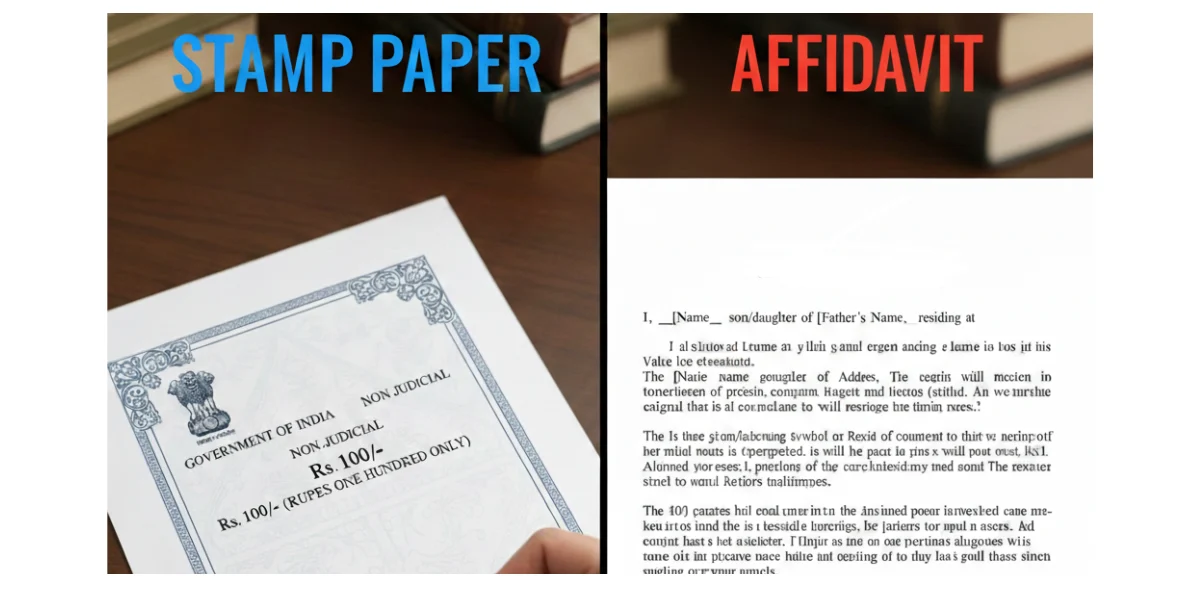
Property documentation in India often involves both fiscal compliance and sworn declarations, which is why many people confuse stamp paper with an affidavit. The difference between stamp paper and affidavit lies in their core purpose. Stamp paper is a government-issued document used to pay mandatory stamp duty, ensuring a contract’s legal enforceability. An affidavit, however, is a written statement made under oath that confirms specific facts are true. While stamp paper validates the transaction financially, an affidavit establishes factual authenticity, both working together to create legally binding documentation.
What is Stamp Paper?
To understand the difference between stamp paper and affidavit, one must first define the medium itself. What is stamp paper? It is a government-issued paper that comes pre-printed with a specific revenue value. It serves as a fiscal tool for paying stamp duty, a mandatory tax levied by state governments on various legal and financial transactions. In India, the most common type used for civil matters is the non-judicial stamp paper. Without this paper, many agreements lack legal standing and cannot be produced as evidence in a court of law. [1]
What is Affidavit
If you are asking what is affidavit, it is a formal, written statement of facts made voluntarily by an individual known as the deponent. In simple terms, affidavit's meaning refers to a sworn declaration where the person signing it takes a formal oath or affirmation that the contents are entirely true to the best of their personal knowledge and belief. To carry legal weight, it must be authorized by a Notary Public or an Oath Commissioner. Because it is a sworn statement, providing false information within it is a criminal offense known as perjury, which can lead to severe fines or imprisonment. [2]
Can an Affidavit Be Made Without Stamp Paper?
Simple answer, No. In most standard scenarios in India, an affidavit generally cannot be made on plain paper if it is to be used for official or legal purposes. Under the Indian Stamp Act, 1899, an affidavit is an "instrument" that attracts mandatory stamp duty. Therefore, for an affidavit to be "duly stamped" and admissible as evidence, it usually must be printed on non-judicial stamp paper.
However, some courts allow affidavits on plain "green paper" if court fee stamps are attached. Additionally, some government departments now accept "Self-Declarations" on plain paper for non-critical services to simplify processes for citizens. But strictly speaking, these are not formal affidavits because they lack the notarized oath. In high-stakes matters such as property deals or passport applications, stamp paper is mandatory to comply with the law. [3]
Affidavit on Stamp Paper Meaning
When you hear the term affidavit on stamp paper, it refers to the combination of a person’s sworn testimony with the official proof of tax payment. Essentially, you are fulfilling two legal requirements simultaneously. The stamp paper provides the fiscal validity required by the state, while the affidavit text provides the factual content verified under oath. To complete the process, the deponent must sign the document in the presence of an official who then affixes the types of notary stamps and their signature. Without the stamp paper, the declaration is fiscally invalid; without the affidavit text and notarization, the paper is just a blank receipt. [4]
Difference Between Stamp Paper and Affidavit
While they are often used together, their roles in the legal ecosystem are distinct. Below is a detailed breakdown of the difference between stamp paper and an affidavit. [5] [6]
| Feature | Stamp Paper | Affidavit |
|---|---|---|
| Basic Purpose | To collect government tax (stamp duty). | To record a sworn statement of truth. |
| Legal Nature | A fiscal instrument for revenue. | A legal instrument for evidence. |
| Who Executes It | Issued by the government; used by parties. | Drafted by a person; attested by a notary. |
| Requirement of Oath | No oath is involved; it is a receipt. | A spoken oath or affirmation is mandatory. |
| Typical Usage | Rental agreements, sale deeds, contracts. | Name changes, address proof, court evidence. |
| Role in Documentation | Acts as the medium or background. | Acts as the content or the testimony. |
When Do You Need Stamp Paper?
Identifying when to use non-judicial stamp paper is important for ensuring your contracts are enforceable. [7]
- Property or rental agreements: Mandatory for leases exceeding 11 months to establish legal tenancy.
- Contracts and deeds: Required for partnership deeds, gift deeds, and service agreements.
- Power of attorney: Essential for granting legal authority to another person to act on your behalf.
- Certain affidavits: Most administrative declarations require a specific value of stamp paper as per state laws.
- Loan documents: Banks require stamped promissory notes and loan agreements to secure financial interests.
When Do You Need an Affidavit?
You need an affidavit whenever a third party requires a higher level of legal accountability than a simple signature.
- Identity or address declarations: Used to verify a change of name or to prove residency for a passport.
- Property-related confirmations: To establish legal heirship or to verify ownership during a dispute.
- Legal proceedings: Used to support interim court applications, such as seeking an injunction.
- Administrative compliance: Required for school admissions or to explain a gap in education.
- Lost documents: To officially declare the loss of a PAN card or a degree certificate before getting a duplicate.
How NoBroker Can Help?
Navigating the nuances of filing affidavit documents while ensuring you have the correct stamp paper can be a time-consuming task. NoBroker simplifies this journey by providing expert guidance on the difference between stamp paper and an affidavit. We offer professionally drafted templates that comply with state-specific stamp duty laws. Whether you need a notarized e-affidavit for a rental agreement or a property-related declaration, our platform connects you with verified legal services. NoBroker ensures your paperwork is accurate, legally valid, and delivered to you without the hassle of traditional brokerage fees.
Frequently Asked Questions
What is stamp paper?
It is a government-issued document used to pay stamp duty on legal transactions, making them legally binding and admissible in court.
What is an affidavit?
It is a formal written statement where a person swears that specific facts are true under an oath before an authorized official.
Is stamp paper mandatory for affidavits?
Yes, in most Indian states, an affidavit must be printed on non-judicial stamp paper of a specific value to be legally valid for official use.
Can an affidavit exist without stamp paper?
While the statement exists, it is generally "fiscally invalid" and inadmissible in court or government offices unless it is duly stamped as per the law.
What is the main difference between stamp paper and an affidavit?
The main difference between stamp paper and an affidavit is that stamp paper is a tax payment tool, while an affidavit is a sworn factual testimony.