





Summary
Conducted under the Special Marriage Act, 1954, the law suits inter-faith, inter-caste, and NRI couples who prefer a non-religious approach. The court marriage procedure in Mumbai requires submitting an application, completing a 30-day notice period, and attending a brief ceremony at the Marriage Registrar’s office. With proper affidavits, notarization, and supporting documents, the marriage gains full legal recognition, offering security, convenience, and a cost-effective alternative to elaborate traditional celebrations.
About Court Marriage - A Quick Information
Here is a quick overview of the key aspects of the court marriage process in Mumbai to help you get started.
Recommended Reading
| Particulars | Details |
|---|---|
| Legal Age | Male: 21 Years, Female: 18 Years |
| Applicable Act | The Special Marriage Act, 1954 |
| Affidavit Needed | Yes, for both partners |
| Notarization Required | Yes, for affidavits and other specified documents |
| Minimum Notice Period | 30 Days |
| Witnesses Needed | Three |
| Marriage Certificate Issued | Yes, by the Marriage Registrar |
| Total Duration | Approximately 35 to 45 Days |
Eligibility for Court Marriage in Mumbai
Before applying, couples must meet the legal requirements for court marriage in India.
- Marital Status: Both should be single, divorced, or widowed at the time of marriage.
- Age Requirement: Groom must be 21 years or older, bride must be 18 years or older.
- Consent: Both must agree to the marriage willingly, without any pressure.
- Mental Capacity: Both should be of sound mind and able to understand marriage responsibilities.
- Prohibited Relationships: The couple should not be closely related by blood, unless allowed by their community custom.
Documents Required for Court Marriage in Mumbai
Having the right documents is important. Here’s what you’ll need:
For Both Partners:
- Application Form: Filled out and signed the court marriage form.
- ID Proof: PAN, Passport, or Driving Licence (any one).
- Address Proof: Aadhaar, Voter ID, Rent Agreement, or utility bill (any one).
- Age Proof: Birth Certificate, Class 10 Marksheet, or School Leaving Certificate.
- Photos: 4–6 recent passport-size photos each.
- Affidavit: From each partner confirming personal details.
- Divorce Papers (if applicable): If previously married and divorced.
- Death Certificate (if applicable): If widowed.
For Witnesses (3 required):
- ID Proof: PAN, Passport, or Driving Licence (any one).
- Address Proof: Aadhaar, Voter ID, or utility bill (any one).
- Photos: 2 passport-size photos each.
Affidavit Requirements (By Both Parties)
The affidavit is a vital legal document in the court marriage application in Mumbai. It is a sworn statement where both partners declare key facts truthfully. This document must be prepared on non-judicial stamp paper and must include the date of birth, current marital status (unmarried/divorced/widowed), and residential address. It also contains a declaration that the parties are marrying of their own free will and are not related within the prohibited degrees.
Notarization of Documents
Notarization is the process of having a document authenticated by a Notary Public, which is essential for verifying the document's legitimacy. It confirms that the signatures on the documents are genuine. In Mumbai, affidavits and sometimes photocopies of identity and address proofs must be notarised on a valid stamp paper, typically of a denomination between ₹10 and ₹100, to be accepted by the marriage registrar.
What is the Procedure for a Court Marriage in Mumbai?
The court marriage procedure in Mumbai is systematic and follows a clear legal path. Here are the steps involved in solemnising your marriage under the Special Marriage Act.
- Step 1: The first step is to submit a written "Notice of Intended Marriage" to the Marriage Registrar of the district where at least one of the partners has resided for a minimum of 30 days before the date of the notice. This notice is submitted in the prescribed format along with the required documents and fees.
- Step 2: Once the notice is received, the Marriage Registrar will enter it into the "Marriage Notice Book" and display a copy of the notice in a conspicuous place within the office. This is done to ensure public visibility. The notice remains displayed for a mandatory 30-day period.
- Step 3: During these 30 days, any person can object to the intended marriage if it contravenes any of the conditions specified in the Act (such as age, subsisting marriage, or prohibited relationship). If an objection is raised, the Marriage Registrar must conduct an inquiry and decide on its validity within 30 days. If the objection is upheld, the marriage cannot be solemnised.
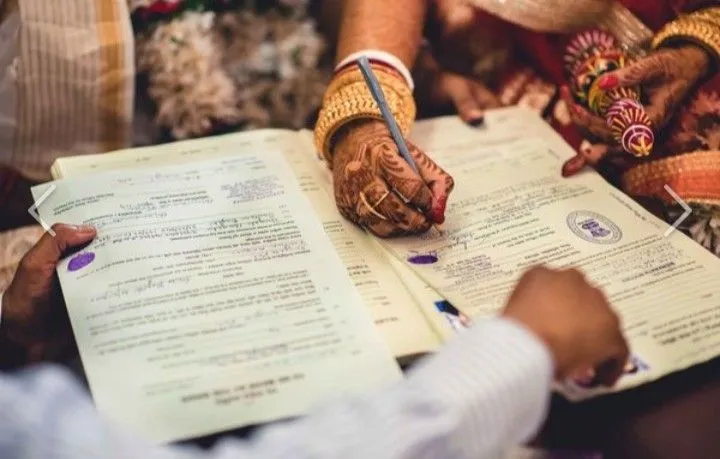
- Step 4: If no objections are received within the 30 days, or if the Registrar dismisses any objections, the marriage can proceed. On the chosen date, the couple, along with their three witnesses, must appear before the Marriage Registrar. They will sign a declaration form, affirming their consent to marry each other.
- Step 5: After the declaration is signed, the Marriage Registrar issues the Marriage Certificate. This certificate is conclusive legal proof of the marriage. The entire procedure from notice to certification typically takes between 35 and 45 days. Understanding this is key to understanding the Difference Between Court Marriage and Registered Marriage.
Process for Tatkal Court Marriage in Mumbai
The term "Tatkal Court Marriage" can be misleading. A court marriage under the Special Marriage Act cannot be completed in one day due to the mandatory 30-day notice period. This waiting period is a legal requirement and cannot be waived. The "Tatkal" or expedited service typically refers to faster registration after a traditional wedding has already been performed, rather than for a court marriage from scratch.
Fees and Timeline for Court Marriage in Mumbai
A court marriage is a very cost-effective option compared to a traditional wedding. Here is an approximate breakdown of the associated costs and timeline.
- Application Fees: The fee for submitting the marriage notice is nominal, generally ranging from ₹100 to ₹150.
- Stamp Duty and Notarization: Costs for affidavits and notarization can add another ₹300 to ₹500.
- Total Cost: The entire process can typically be completed within a budget of ₹1,500 to ₹3,000, although this can vary slightly.
- Timeline: The total duration is primarily dictated by the 30-day notice period. Including document preparation and the final appointment, the process generally takes about 35 to 45 days to complete.
Benefits of Court Marriage
Choosing a court marriage comes with several significant advantages, especially in a diverse city like Mumbai. Here are some of the key benefits.
- Legal Security: The marriage certificate is a legally binding document, offering protection and rights to both partners.
- Simplicity and Cost-Effectiveness: The process is straightforward and avoids the immense expenses associated with traditional wedding ceremonies.
- Inter-Faith and Inter-Caste Union: It provides a neutral and respectful path for couples from different religious or caste backgrounds to marry without requiring conversion.
- Proof for Official Purposes: The certificate is essential for various administrative tasks, such as applying for a spouse visa, opening a joint bank account, or availing insurance and other financial benefits. For Non-Resident Indians, this is a vital part of NRI Marriage Registration in Mumbai.
- Prevents Bigamy: Since the marriage is officially recorded, it acts as a deterrent against illegal second marriages.
Know About Court Marriage Procedure :
How NoBroker Can Help With Affidavit Services?
Navigating the legal paperwork for a court marriage can feel overwhelming. NoBroker simplifies this part of the court marriage procedure in Mumbai by offering expert assistance with online affidavit services. Our services can help you prepare the necessary Affidavit Format for Marriage correctly and get it notarised without any hassle, ensuring your documents meet the specific requirements of the Marriage Registrar’s office.
