





- https://blog.ipleaders.in/what-is-affidavit/
- https://www.nobroker.in/prophub/notary/guides/what-is-sworn-affidavit/
- https://www.nobroker.in/prophub/notary/guides/difference-between-affidavit-and-declaration/
- https://navi.com/blog/affidavit
Summary
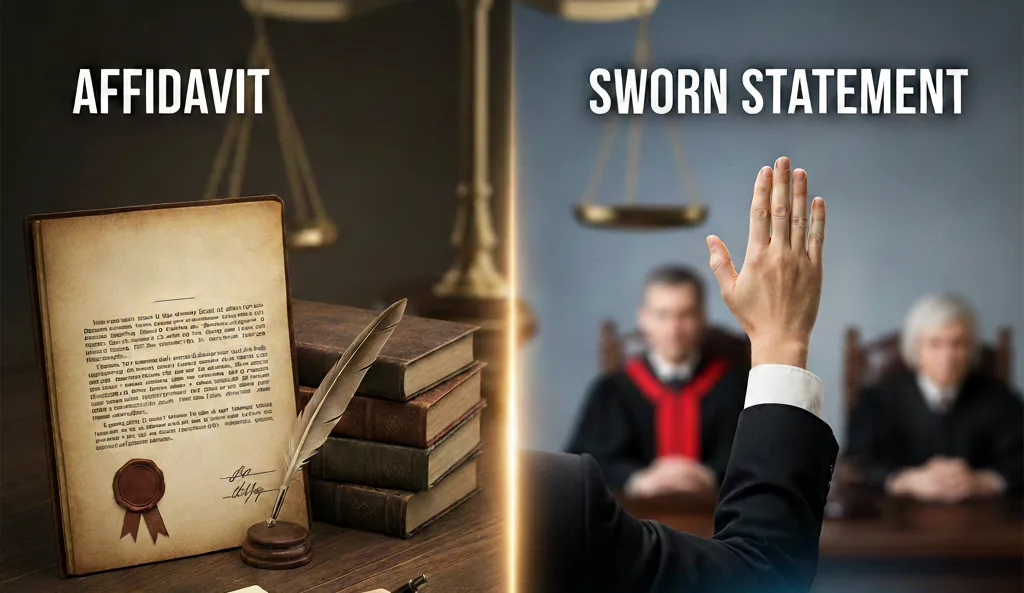
An affidavit is a specific type of sworn written statement made under oath and signed before a notary or authorized official. A sworn statement, however, is a broader term that refers to any declaration made under oath, either written or oral. While every affidavit is a sworn statement, not every sworn statement qualifies as an affidavit. The key difference lies in formal notarization and structured legal documentation requirements.
What Is an Affidavit?
An affidavit is a formal, written statement of facts voluntarily made by a person known as a deponent. This statement is confirmed by an oath or a solemn affirmation. In India, an affidavit is a high-level legal document that must be executed on non-judicial stamp paper and signed in the physical presence of an authorized officer, such as a Notary Public. It is widely used in judicial proceedings and high-stakes administrative tasks where the truth of the content must be verified by a government-appointed witness to prevent fraud. [1]
What Is a Sworn Statement?
A sworn statement is a broader category of declaration where an individual affirms that the contents of a document are true under the penalty of perjury. These statements are often used in preliminary legal contexts, insurance claims, or internal business matters. While they still carry legal consequences for lying, they are frequently used outside formal courtroom settings where the receiving authority does not strictly require a high degree of procedural solemnity. [2]
Affidavit vs Sworn Statement
While both documents represent a commitment to the truth, their procedural requirements and legal "strength" vary significantly in the Indian justice system. [3]
| Feature | Affidavit | Sworn Statement |
|---|---|---|
| Legal Formalities | High; follows a strict, state-mandated format. | Lower; structure is more flexible and varied. |
| Notarization | Mandatory; must be sworn before an official. | Often optional; may be self-certified. |
| Typical Use Cases | Court evidence, property deeds, and name changes. | Insurance claims, academic forms, and employment. |
| Evidentiary Strength | Stronger; treated as primary written testimony. | Medium; often requires further corroboration. |
| Acceptance | Universally accepted by courts and banks. | Accepted by administrative and private bodies. |
When Is an Affidavit Used?
In India, an affidavit is required whenever a formal, legally binding verification of facts is necessary for official records. [4]
- Court cases: To present evidence-in-chief or support interim applications like stay orders.
- Property transactions: To declare legal heirs or verify ownership details during a sale.
- Immigration or visa applications: Mandatory for declaring financial support or marital status.
- Insurance claims: High-value claims often require a notarized statement to prevent fraud.
- Identity or residency declarations: Used for name changes or proving a birth date.
When Is a Sworn Statement Used?
A sworn statement is used in situations that require honesty while allowing a more streamlined administrative process. [2]
- Internal investigations: Used by companies to record employee testimonies regarding workplace incidents.
- Administrative disputes: Helpful in resolving minor conflicts with utility providers or local bodies.
- Business or employment matters: Verifying the authenticity of work contracts or educational certificates.
- Declaration of facts: Used in scenarios where the receiving authority trusts the signer without a notary.
Key Elements of Both Documents
To be legally enforceable, both documents must contain specific "bones" that identify the declarant and the truth of the facts.
- Full name and signature: Clearly identifies the person taking absolute responsibility for the statement.
- Clear factual statements: Information must be organized into numbered paragraphs and written in the first person.
- Date and place of signing: Provides a specific legal context for when and where the oath was taken.
- Oath or affirmation: For an affidavit, this must be a formal religious or secular pledge of truth.
- Notarization: Essential for an affidavit to bear the official seal and registration number of a notary public.
How They Are Executed Legally?
The execution process is what truly separates these two documents in the eyes of the law. (5)
- Affidavit: Sworn before a notary: The person making the statement, often called an affiant, must physically appear before an official.
- Sworn statement: Signed under penalty: This is often just signed and submitted with a specific "truth clause" included.
- Witness requirements: Affidavits usually require two witnesses, whereas a sworn statement may only require the declarant’s signature.
- Jurisdictional nuances: Stamp duty for an e-affidavit varies by state, while sworn statements often use plain paper.
Legal Validity in India
The legal validity of these documents is supported by the Indian Penal Code, particularly with respect to perjury and false evidence.
- Affidavit as recognized evidence: Under Order XIX of the CPC, it is admissible in court as a verified form of testimony.
- Sworn statement validity: Its acceptance depends entirely on the specific authority, such as a bank or an insurance company.
- Importance of truthfulness: Providing false information in either document can lead to seven years in prison under Section 193 of the IPC.
How NoBroker Can Help With Affidavits and Sworn Statements?
Managing the paperwork for an affidavit vs sworn statement can be daunting, especially when dealing with rental or property matters. NoBroker simplifies this journey by providing expert guidance on what an affidavit is and offering ready-to-use templates. We connect you with verified professionals for seamless notarization, ensuring your legal documents comply with state laws. Whether you need a name change affidavit or a property-related sworn declaration, NoBroker makes the process faster, more transparent, and completely brokerage-free.
Frequently Asked Questions
What is a sworn statement?
It is a formal written declaration where an individual affirms that the information provided is true under the penalty of perjury.
Is an affidavit the same as a sworn statement?
No. An affidavit is a sworn statement that must be notarized and follows a stricter legal format.
Does a sworn statement need a notary?
Not always. While an affidavit requires a notary, many administrative sworn statements only require a signature or a witness.
Can affidavits and sworn statements be used interchangeably?
Generally, no. An affidavit can often serve as a sworn statement, but a simple statement is usually rejected where a notarized affidavit is required.
Which has stronger legal weight?
An affidavit has stronger legal weight in Indian courts and government offices because it involves a formal oath and official attestation.