





- https://en.wikipedia.org/wiki/Affidavit
- https://cleartax.in/glossary/deposition
- https://blog.deposely.com/blog/deposition-vs-affidavit
- https://blog.ipleaders.in/affidavits/#:~:text=Introduction,must%20be%20paragraphed%20and%20numbered.
- https://lawbhoomi.com/deponent-in-an-affidavit/
- http://14.139.60.116:8080/jspui/bitstream/123456789/17448/1/011_Affidavits_Some%20Legal%20Aspects%20%28165-181%29.pdf
Summary
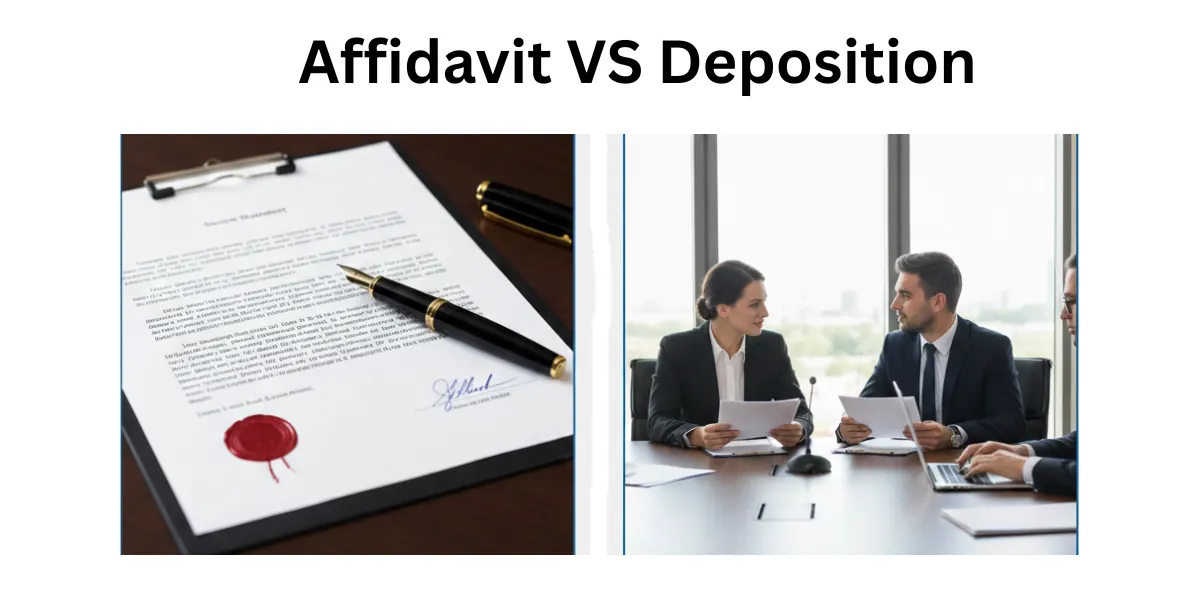
An affidavit is a written statement made under oath and signed before a notary or authorized officer, while a deposition is an oral testimony given under oath outside the courtroom, usually recorded by a court reporter. Affidavits are typically used for documentation and evidence submission, whereas depositions are part of the discovery process in legal proceedings. Both carry legal weight but differ in format, purpose, and procedural use.
What Is an Affidavit?
An affidavit is a formal written statement of facts made voluntarily under an oath or affirmation. It serves as an essential tool in administrative processes, providing verified information when direct evidence is unavailable. The document is signed by the person making the declaration, known as the deponent. For legal validity, it requires strict notarization by an official, ensuring the identity and signature are completely authentic. [1]
What Is a Deposition?
A deposition is defined as an oral, sworn testimony that is meticulously recorded outside of formal court proceedings, typically during the discovery phase of litigation. It differs significantly from written declarations in both process and purpose. While written statements are voluntary, depositions are often compelled by the court, requiring notice to the adverse party. This process involves immediate cross-examination by opposing lawyers to thoroughly test the witness's credibility. [2]
Affidavit vs Deposition - Key Differences
Understanding the core differences between an affidavit vs deposition helps clarify exactly how the Indian legal system processes written declarations compared to recorded oral testimonies. [3]
| Feature | Affidavit | Deposition |
|---|---|---|
| Form | It is strictly a written statement of facts that is prepared, drafted, and fully formalized in advance of any legal filing. | It is a formal oral testimony that is meticulously transcribed and officially recorded in writing during a legal questioning session. |
| Mode | It is usually a completely voluntary act by an individual, made without prior notice to the opposing legal party. | It is very often compelled by the presiding court and strictly requires formal legal notice to be sent to the adverse party. |
| Oath Administered By | An authorized government officer, such as a commissioned Notary Public, an Executive Magistrate, or an appointed Oath Commissioner in India. | A specially court-appointed legal commissioner, a magistrate, or a designated formal legal official is present during the extensive discovery process. |
| Cross-Examination | The opposing party is completely absent when the document is originally drafted, signed, and formally notarized by the authorized official. | It fundamentally includes the absolute legal right of the adverse party's lawyers to cross-examine the witness immediately during the session. |
| Legal Weight | It is generally not considered direct evidence under the Indian Evidence Act unless the court explicitly orders it to be utilized. | It can be admitted as solid evidence in trials or used to impeach a witness's credibility. |
Who Is a Deponent in an Affidavit?
If you are wondering who a deponent is in an affidavit or what a deponent is on an affidavit, it is simply the person making the sworn statement. This individual assumes full legal responsibility for the truthfulness of the contents. They must rely solely on personal knowledge. If they state falsehoods, they face criminal prosecution for perjury. Learning who can notarize an affidavit is also important to secure their sworn testimony. [4]
Signature of Deponent Meaning
The signature of a deponent involves the physical act of confirming the document's truthfulness. The deponent's signature on the affidavit is essential because it transforms a standard document into binding sworn testimony. By signing, the individual legally accepts the contents, establishing clear legal accountability. If the signature is missing, the document is invalid and cannot be used as evidence anywhere. [5]
When Are Affidavits and Depositions Commonly Used?
These sworn legal instruments serve distinct roles in the justice system. Below are the specific scenarios where they are most frequently utilized across India. [2]
- Property transactions: They help verify ownership details, clarify address discrepancies, and confidently declare marital status during complex real estate property deals.
- Court proceedings: Oral testimony is widely used during pre-trial discovery to establish facts and prevent unpleasant surprises at trial.
- Identity or address verification: Written declarations seamlessly replace missing standard proofs for banking compliance, passport applications, and various official government registry service updates.
- Legal disputes: In civil suits, examination-in-chief is routinely submitted in written declarations to significantly save time during initial preliminary hearings.
- Corporate documentation: Organizations depend on sworn statements signed by authorized directors to legally verify financial claims and ensure strict government regulatory compliance.
Affidavit as Evidence vs Deposition as Evidence
The Indian Evidence Act treats these sworn statements quite differently. Their overall legal admissibility and practical usage depend heavily on the context of the ongoing dispute.
- How affidavits are treated as evidence: They are generally not accepted as default evidence unless a presiding judge specifically orders them to be utilized legally.
- Need for deponent’s appearance if disputed: If the opposing counsel challenges the written document, the individual must physically appear in court for mandatory cross-examination.
- Relationship between affidavit and deposition: Recorded oral testimonies carry significantly more immediate evidentiary weight because the opposing legal counsel has already thoroughly cross-examined the witness.
Advantages and Limitations
Evaluating an affidavit vs deposition involves looking at their distinct strengths and weaknesses. Both legal tools offer unique benefits while presenting specific procedural challenges. [6]
Advantages of an Affidavit
- They offer exceptional speed and efficiency, enabling courts to decide on interim applications promptly without waiting for full trials.
- Drafting them is highly cost-effective and convenient, as the person does not need an immediate in-person courtroom appearance.
Limitations of Affidavit
- These documents possess very limited evidentiary weight by default unless a presiding judge specifically orders them to be utilized.
- Statements based merely on personal belief rather than absolute factual knowledge can be quickly rejected by the opposing legal counsel.
Advantages of Deposition
- This method enables the immediate discovery of key facts and hidden details before a formal trial begins.
- It perfectly preserves essential testimony if a key witness becomes ill, elderly, or permanently relocates to another country.
Limitations of Deposition
- The process is highly expensive and time-consuming, requiring the physical presence of lawyers from both sides.
- Aggressive questioning by opposing legal counsel can severely intimidate witnesses, causing unnecessary stress and potential confusion during the proceedings.
How NoBroker Can Help With Affidavits and Property Documentation?
Managing the legal nuances of an affidavit vs deposition can be overwhelming, particularly during property transactions. NoBroker assists users by providing expert guidance for drafting property-related affidavits and comprehensive rental documentation. We seamlessly connect you with verified legal services for proper notarization, ensuring you fully understand the difference between affidavits and notarization. Secure your property agreements effortlessly by leveraging our trusted and efficient online e-affidavit services today.
Frequently Asked Questions
What is the difference between an affidavit vs deposition?
An affidavit is a voluntarily written, sworn statement, whereas a deposition is a recorded oral testimony that involves immediate cross-examination by opposing legal counsel before trials.
Who is the deponent in an affidavit?
The deponent is the individual who voluntarily signs the written statement under oath, assuming absolute legal accountability for the accuracy of the facts documented.
Is the deponent's signature mandatory?
Yes, the signature is strictly mandatory. An unsigned statement is considered a legal nullity and cannot be utilized as valid evidence in Indian courts or offices.
What is an affidavit vs notary?
The affidavit is a sworn legal document containing verified facts, and a notary is the authorized government official who verifies identity and seals the paperwork.
Can affidavits replace depositions?
No, they serve completely different legal purposes. While written statements expedite interim applications, formal trials require depositions to allow opposing counsel the right to cross-examine witnesses.