Documents Required for NRIs to Buy Property in India: A Complete 2026 Guide

NRI Real Estate Guide & Property Tips

3.7K Views
Table of Contents
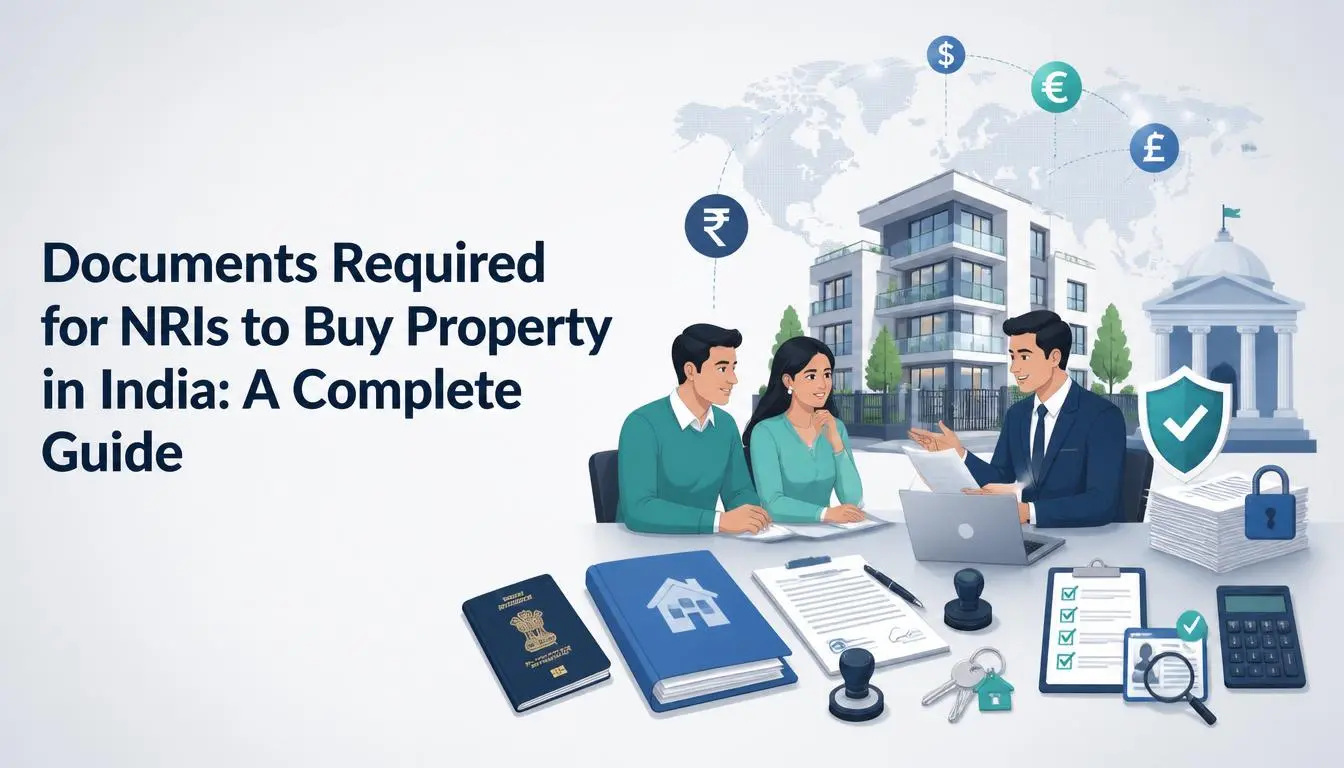
A missing PAN card, an incomplete Power of Attorney, or incorrect property documents are likely to delay an NRI's property purchase and even postpone registration. Getting your NRI property purchase documents right from the start — a valid passport, PAN Card, OCI or PIO card, and proof of overseas status — helps you avoid these delays entirely. Other required documents include bank statements and income proof. You'll also need property-related papers such as the title deed, Encumbrance Certificate, approved building plans, and No Objection Certificates. The purchase must be paid through eligible NRE, NRO, or FCNR(B) accounts under RBI and FEMA regulations. This is a foreign national’s guide covering the documents required for NRIs to buy property in India and the purpose of each document.
Documents Required for NRI to Buy Property in India: Full Checklist
To buy property in India, NRIs need identity, address, financial, and property-related documents. Together, these help you complete KYC, meet banking compliance requirements, and register the property The exact documents needed can vary. It depends on whether the property is under construction or ready to move in. Moreover, it depends on whether a home loan is involved, and whether the purchase happens in person or through a Power of Attorney
| Document | Purpose | Mandatory |
| Valid Indian Passport | Primary proof of identity and NRI status | Yes |
| NRI PAN card | Required for property registration, tax compliance, and TDS-related transactions | Yes |
| OCI card or PIO card | Confirms eligibility for OCI/PIO holders purchasing property in India | Applicable only if held |
| Overseas address proof | Required for KYC verification | Yes |
| Indian address proof | Required for correspondence, home loans, or registration purposes | If applicable |
| Passport-sized photographs | Required for KYC, registration, and loan documentation | Yes |
| NRE, NRO or FCNR(B) bank account details or bank statements | Confirms the source of funds and payment through the permitted banking channels | Yes |
| Income proof | Required mainly when applying for a home loan | If applying for a loan |
| Power of Attorney | Authorises a trusted representative to complete the transaction if the buyer is abroad | Required only if purchasing remotely |
| Sale deed or draft sale deed | Confirms the terms of sale and legal transfer of ownership | Yes |
| Title deed | Establishes the seller's legal ownership of the property | Yes |
| Encumbrance certificate | Confirms that the property is free from registered legal or financial liabilities | Yes |
| Approved building plan | Verifies that the construction has been approved by the competent authority | Yes, for constructed properties |
| Occupancy certificate | Confirms that the completed building is fit for occupation | Required for completed buildings |
| Completion certificate | Certifies that construction complies with approved plans and local regulations | Required for completed buildings |
| No Objection Certificate | Confirms approvals from relevant authorities or societies | Depends on the property |
| RERA registration | Helps verify that an under-construction project is registered with the state RERA authority | Required for applicable under-construction projects |
| Home loan sanction letter | Required if the purchase is financed through a home loan | If applicable. |
Documents Required for NRI: Identity & Residency Proof
NRIs are required to submit a set of documents to verify their identity and overseas residency status before purchasing property in India. Ideally, these documents should be valid, up to date, and attested wherever required.
Passport & Visa/OCI/PIO Proof
- Legally valid passport, valid at the time of property registration
- Valid visa, residence permit or work permit to establish the buyer's current overseas residency status
- OCI Card to verify legal status. Authorities also accept existing PIO cards merged with the OCI scheme.
Overseas Address Proof What's Accepted
- Recent electricity, water, gas, or internet bills showing the overseas residential address
- Recent statements displaying the applicant's overseas address
- Government-issued residence permit or National ID Card confirming overseas residence
- Valid driving licence issued by the country of residence, showing the current address
- Tenancy agreement or lease deed as proof of overseas residential address
- Employer-issued residence certificate; official letter or certificate confirming the applicant's overseas residential address.
Financial & Banking Documents
Among the most important NRI property purchase documents are financial and banking records, which must comply with RBI, FEMA, and income tax regulations. Specifically, these documents help verify the source of funds and play a part in payment processing.funds and play a part in payment processing.
PAN Card: Is It Mandatory?
NRIs must hold a Permanent Account Number Card for property transactions in India. In fact, you'll need it for property registration, tax compliance, TDS-related procedures, and other financial transactions linked to the purchase.
NRE/NRO Account Documents & Income Proof
- Use your NRE/NRO bank account to route property payments through authorised banking channels, in compliance with RBI and FEMA regulations
- Recent bank statements for verifying the source of funds and payment history
- Salary slips, employment certificate, income tax returns, or other financial documents as requested for income proof
- Loan sanction letter, required if you finance the property purchase through a home loan
- Foreign inward remittance certificate to confirm that you remitted the purchase funds to India through authorised banking channels
- Form 15CA or 15CB for certain cross-border remittances for compliance with the Income Tax Act, 1961.
NRI Property Purchase Documents for Home Loans
When a home loan is involved, lenders require additional NRI property purchase documents beyond the basics — used to verify identity, employment, income, and repayment capacity. However, the documents required for an NRI home loan vary between lenders, and the following are most commonly requested
Identity & Residency Documents
- Valid passport
- Valid visa, residence permit or work permit
- OCI card
Employment & Income Documents
- Employment certificate or appointment letter
- Last 3-6 months' recent salary slips
- Last 6-12 months' bank statements
- Last 2 years' income tax return filings
Property & loan documents
- Property documents: Sale agreement, title documents, approved building plan, and other required property-related documents
- Loan application form
- Passport-size photographs
NRI Home Loan Document Checklist
| Document | Salaried NRIs | Self-Employed NRIs |
| Valid passport | ✔ | ✔ |
| PAN card | ✔ | ✔ |
| Valid visa, residence or work permit | ✔ | ✔ |
| Overseas address proof | ✔ | ✔ |
| Home loan application form | ✔ | ✔ |
| Passport-size photographs | ✔ | ✔ |
| 6 - 12 months bank statements | ✔ | ✔ |
| Income proof | Last 3 - 6 months salary slips | ITR and business financial statements |
| Employment or business proof | Employment certificate or appointment letter | Business registration or proof of business ownership |
| Property documents | ✔ | ✔ |
Power of Attorney: Buying Property Without Visiting India
Can't travel to India to complete your purchase? You can authorise a trusted family member, friend, or legal representative to act on your behalf. You do this through a Power of Attorney. For instance, a PoA representative can help you carry out specific tasks such as signing agreements, completing property registration, and submitting documents.
Types of POA for Property Purchase
- Special Power of Attorney: A Special Power of Attorney is the most common option for buying properties in India. It grants authority for a specific property transaction, such as purchasing, registering, or taking possession of a particular property.
- General Power of Attorney: A General Power of Attorney grants broader authority to manage multiple financial or property-related matters. However, You use it only when you genuinely need broader powers.
How to Notarise or Apostille a POA from Abroad
Notarising and apostilling a Power of Attorney from abroad involves signing it before a local notary, getting state/federal authentication, and obtaining an Apostille sticker. You can complete it through the following steps:
- Step 1: Draft the PoA: Prepare a PoA clearly specifying the powers you are authorising, such as signing the sale agreement, completing registration, or taking possession of the property.
- Step 2: Sign the PoA before the appropriate authority: Sign the document before a Notary Public or have it attested by the Indian Embassy or Consulate, depending on the legal requirements of the country where you reside.
- Step 3: Send the original PoA to India: Courier the original signed PoA to your authorised representative in India.
- Step 4: Get the PoA adjudicated or stamped: You must adjudicate or stamp the PoA in India within the time limit under the relevant State Stamp Act before you can use it for property registration.
- Step 5: Complete the property transaction: Once the PoA is legally valid, your authorised representative will then have to sign documents, appear before the registration authority, and complete the property transaction on your behalf, as permitted under the regulations.
Documents Needed for Registration & Stamp Duty in India
At the registration stage, you must submit a specific set of NRI property purchase documents at the jurisdictional Sub-Registrar's Office, along with the applicable stamp duty and registration charges. Then, during registration, submit both your property-related and identity documents for verification.
Property & Title Documents:
- Original Sale Deed or Mother Deed
- Encumbrance Certificate
- Khata Certificate and Khata Extract
- Latest Property Tax Receipts
- Approved Building Plan
- Occupancy Certificate, for completed properties
- Completion Certificate
Transaction & Identity Documents:
- Stamp duty and registration fee payment receipts
- PAN Card or Form 60
- Aadhaar card
- Valid passport
- Passport-size photographs
- Power of Attorney
- Bank’s No Objection Certificate, if the property is financed through a home loan or under mortgage.
Country-Wise Document & Attestation Rules
The process for executing and validating documents such as a Power of Attorney is different depending on the country where you reside. Each country sets its own notarisation, attestation, and apostille requirements before you can use these documents in India. Finally, after the documents reach India, you will also need to stamp or adjudicate them as per the specific State Stamp Act.
| NRI Region | Extra Document Requirement | Attestation & Compliance Requirement |
| USA | FATCA declaration, SSN, if requested & a valid visa and residence proof | PoA notarisation and apostille along with Indian Consulate attestation |
| Canada | Tax Identification Number & valid residence permit | PoA notarisation and authentication |
| United Kingdom | National Insurance Number along with valid residence proof | PoA notarization and apostille |
| UAE & GCC Countries | Emirates ID or residence visa along with salary certificate for home loans | PoA notarisation, local authority attestation, and Indian Embassy attestation |
| Australia & New Zealand | Tax Identification Number & residence visa | PoA notarisation and apostille |
| Singapore | FIN, employment pass & residence proof | PoA notarisation and apostille |
Tax Documents to Keep After Purchase
After purchasing a property in India, safely retain all tax, payment, and property-related documents. Overall, these records help you establish the property's cost of acquisition, support future capital gains tax calculations, claim eligible tax deductions, and respond to any queries from the Income Tax Department
Documents to Keep Permanently
- Registered Sale Deed
- Title deed and previous title documents received from the seller
- Stamp duty and registration fee receipts
- Payment receipts and bank transaction records
- Home loan sanction letter and loan agreement
- Possession letter and allotment letter
- Occupancy certificate and completion certificate
- Invoices for major renovations or capital improvements
- Encumbrance certificate, if obtained during purchase
Documents to Keep for 7-8 Years After Purchase or Loan Closure
- Home loan repayment statements
- Interest and principal repayment certificates
- Property tax payment receipts
- Society maintenance receipts
- Insurance policy documents for the property
Documents to Keep for 3-6 Years After Filing Your Income Tax Returns
- Income Tax Return acknowledgements
- Form 26AS and Annual Information Statement
- TDS certificates
- Proof of tax payments and refund records
- Documents supporting any tax deductions or exemptions claimed.
Common Document Mistakes NRIs Make While Purchasing Property
Getting your NRI property purchase documents wrong is one of the most common causes of delay. In fact, even a small mistake can postpone registration, create compliance issues, or lead to financial losses. Here are some of the most common mistakes NRIs should avoid:
- Using an invalid or improperly executed Power of Attorney: Many NRIs execute a PoA without proper notarisation, apostille, or consular attestation. Others fail to get it stamped in India where required. The Sub-Registrar's Office will likely reject an invalid PoA.
- Violating FEMA payment rules: Some NRIs make property payments through resident savings accounts, cash, or other non-permitted channels instead of eligible NRE, NRO, or FCNR(B) accounts. As a result, this becomes a direct FEMA violation.
- Missing TDS and tax compliance: Many buyers overlook requirements for TDS on property purchase by NRI, or fail to preserve tax-related documents such as TDS certificates and payment records. This can lead to tax disputes, penalties, or difficulties while filing income tax returns or selling the property in the future.
- Skipping RERA verification and title due diligence: Purchasing a property without verifying the title documents, Encumbrance Certificate, approvals, or RERA registration increases the risk of ownership disputes, hidden liabilities, or purchasing an unauthorised property.
- Name or residential status mismatches across documents: Differences in the name, passport details, PAN, or NRI status across KYC and property documents are common mistakes that NRIs make. Consequently, these delay home loan approval, KYC verification, and property registration until you correct the records.
Remote vs In-Person Property Purchase: Document Checklist for NRIs
NRIs can buy property in India either by visiting the country and completing formalities themselves or by authorising a trusted representative through a Power of Attorney. The document checklist for NRIs for property purchase includes:
| Stage | Buying In Person | Buying Remotely |
| Identity verification | Passport, PAN card, OCI card & address proof | Passport, PAN Card, OCI card & address proof |
| Property verification | Title deed, Encumbrance certificate, approved plans & RERA details | Title deed, Encumbrance certificate, approved plans & RERA details |
| Home loan approval | Submit loan application and supporting documents directly to the lender | Submit loan application and supporting documents directly to the lender with additional authorisation |
| Signing the sale agreement | Buyer signs in person | Authorised representative signs under a valid Power of Attorney |
| Property registration | Buyer appears before the Sub-Registrar for registration | Authorised representative has to represent with the original PoA and other required documents |
| Payment | Through eligible NRE, NRO, or FCNR(B) account | Through eligible NRE, NRO, or FCNR(B) account |
| Extra documents | None | You need a valid Power of Attorney, proof of notarisation, and stamping |
Step-by-Step Process for NRIs to Buy Property in India
Buying a property in India as an NRI is easier than it sounds, and you can do it through the following steps. Availing NoBroker’s NRI property-related legal services can assist you at every stage of the process:
- Step 1: Financial & document preparation: Before you begin your property search, make sure you have all the required identity, banking, and financial documents ready. Specifically, this includes your passport, PAN Card, overseas address proof, OCI card, and NRE, NRO, or FCNR(B) account details.
- Step 2: Conduct legal due diligence: Before paying a booking amount or signing any agreement, verify the property's legal status. Review the title deed, Encumbrance Certificate, approved building plans, OC, CC, RERA registration, and ensure there are no pending legal disputes or unpaid dues.
- Step 3: Arrange financing, if applying for a home loan: If you're financing the purchase with an NRI home loan, submit the required identity, income, employment, and property documents to the lender. Once the lender verifies your eligibility and approves the property, it will issue the loan sanction.
- Step 4: Complete the property purchase & registration: Once you verify the property and arrange funds, sign the sale agreement. Make all payments through permitted banking channels, in line with FEMA regulations. Pay the applicable stamp duty and registration charges, then register the Sale Deed at the jurisdictional Sub-Registrar's Office. If you are not in India, your authorised representative can complete the registration using a valid Power of Attorney.
- Step 5: Complete post-purchase formalities: Once registration is complete, collect the registered Sale Deed and other original property documents. Transfer utility connections, update municipal or revenue records, preserve all tax and payment records, and comply with any ongoing tax obligations related to the property.
Complete Your Property Purchase with NoBroker
Understanding the documents required for NRI to buy property in India is the first step — the process involves multiple legal, financial, and documentation requirements. Ultimately, NoBroker makes the entire process easy with end-to-end assistance with everything from property verification, legal documentation, home loans, to registration and post-purchase services, all under one roof. With expert guidance at every stage, NoBroker helps NRIs complete secure, legally compliant property transactions in India.
Frequently Asked Questions
Is Aadhaar mandatory for NRIs to buy property in India?
Can an NRI buy property in India without visiting India?
What documents does an NRI need for a home loan in India?
Is a PAN card compulsory for an NRI property purchase?
How do NRIs get a Power of Attorney attested from abroad?
What extra documents does a UAE-based NRI need to buy property in India?
What documents should an NRI keep after buying property for future resale or tax purposes?
About the Author

jeevan
Senior Editor


Recent Blogs

Subscribe to our Newsletter
Get latest news delivered straight to your inbox