- https://www.drishtiias.com/pdf/1757187290.pdf
- https://english.lokshahi.com/latest-news/how-to-make-a-kunbi-certificate-learn-about-the-process
Table of Contents
Quick Info Table â Kunbi CertificateHistorical BackgroundWhy is the Kunbi Certificate Important?Eligibility for Kunbi CertificateDocuments Required for Kunbi CertificateHow to Apply for the Kunbi Certificate in Maharashtra?How to Download Kunbi Certificate?Verification and Approval ProcessBenefits of the Kunbi CertificateRole of Affidavit in Kunbi CertificateChallenges in Obtaining a Kunbi CertificateScenarios Where Affidavits Are NeededHow NoBroker Can Help with Affidavit ServicesFrequently Asked Questions
Loved what you read? Share it with others!


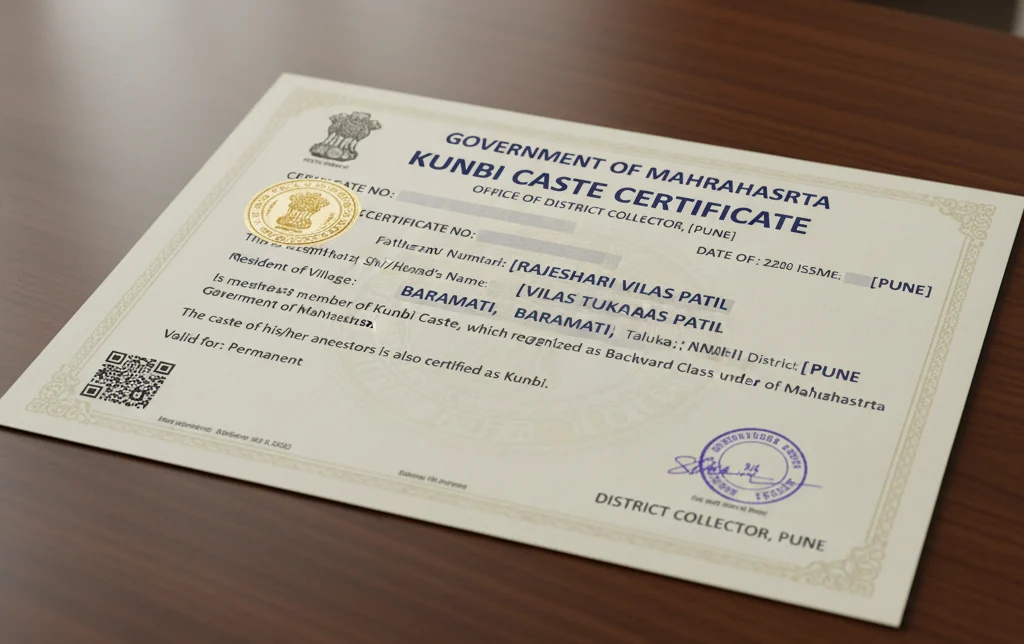
Kunbi Certificate in Maharashtra: Eligibility, Documents, Application Process and Benefits in 2026
Updated : February 3, 2026, 1:51 PM
Author :
 Vivek
Vivek
Summary
Securing a Kunbi certificate in Maharashtra is vital for members of the Maratha-Kunbi community to access OBC reservations in education, jobs, and welfare schemes. The process requires ancestral proof, genealogical records, and often affidavits to resolve discrepancies or missing documents. Applications can be made online via the Aaple Sarkar portal or offline at the SDO office, with thorough verification ensuring authenticity. Despite challenges like tracing old records, the certificate opens doors to significant benefits. Services like NoBroker also simplify affidavit needs, making the application smoother and more accessible.
Table of Contents
Quick Info Table â Kunbi CertificateHistorical BackgroundWhy is the Kunbi Certificate Important?Eligibility for Kunbi CertificateDocuments Required for Kunbi CertificateHow to Apply for the Kunbi Certificate in Maharashtra?How to Download Kunbi Certificate?Verification and Approval ProcessBenefits of the Kunbi CertificateRole of Affidavit in Kunbi CertificateChallenges in Obtaining a Kunbi CertificateScenarios Where Affidavits Are NeededHow NoBroker Can Help with Affidavit ServicesFrequently Asked Questions
A Kunbi certificate is an official document in Maharashtra that certifies an individual’s caste as Kunbi, classified under the Other Backward Classes (OBC) category. It enables members of the Maratha-Kunbi community to access reservation benefits in education, government employment, and social welfare schemes. Obtaining the certificate often requires historical records, and in cases of missing or conflicting proof, a legal affidavit may be necessary. This ensures eligibility, protects rights, and facilitates access to government entitlements and social justice initiatives.
Quick Info Table – Kunbi Certificate
Here is a quick overview of the essential details regarding the Kunbi caste certificate to help understand the process at a glance.
| Feature | Details |
|---|---|
| Certificate Name | Kunbi Caste Certificate |
| Applicable State | Maharashtra |
| Issued By | Sub-Divisional Officer (SDO) / Tehsildar's Office |
| Eligibility | Primarily based on ancestral proof of belonging to the Kunbi community. |
| Application Mode | Online (Aaple Sarkar portal) and Offline (at SDO/Tehsildar office). |
| Key Benefits | Access to OBC reservations in education, employment, and government schemes. |
| Affidavit Requirement | Frequently required to prove lineage, correct name discrepancies, or declare missing documents. |
Historical Background
The demand for the Kunbi certificate in Maharashtra is deeply rooted in the Marathwada region. Before Independence, this region was part of the Hyderabad State under the Nizam's rule. During that period, official records, most notably the Hyderabad Gazette of 1918 and earlier documents, listed many Marathas as "Kunbis," a designation commonly associated with agrarian or farming communities. These historical gazettes and other regional records like the Satara Gazette have now become vital pieces of evidence for individuals to trace their lineage and establish their Kunbi identity to qualify for OBC status. [1]
Why is the Kunbi Certificate Important?
The Kunbi certificate is critically important because it serves as the official link between the Maratha community and the Other Backward Classes (OBC) reservation quota in Maharashtra. The Kunbi community has been historically recognised as an OBC group. By obtaining a Kunbi certificate, eligible Marathas can formally establish their lineage to this agrarian community. This recognition unlocks access to significant benefits, including reservations in educational institution admissions, government job recruitments, and eligibility for various state and central welfare schemes designed to uplift backward classes.
Eligibility for Kunbi Certificate
To successfully obtain a Kunbi caste reservation certificate, applicants must meet the specific criteria set by the Maharashtra government. [2]
- Primary Eligibility: The most crucial criterion is the ability to prove that ancestors (father, grandfather, or great-grandfather) were recorded as "Kunbi" in official documents before 1967.
- Residency: The applicant must be a resident of Maharashtra. A domicile certificate is often required as proof. For more details, read about how to get a domicile certificate.
- Genealogical Proof: One must provide a family tree (Vanshaval) that clearly connects one to the ancestor whose Kunbi records are being used as proof.
- Income Criteria (for OBC benefits): To avail reservation benefits, one will also need a non-creamy layer certificate, which requires the family's annual income to be below ₹8 lakhs.
Documents Required for Kunbi Certificate
Having the correct documents required for the Kunbi certificate is the most critical part of the application process. A complete and organised set of documents will ensure a smoother verification. [2]
- Identity Proof and address proof like Aadhaar Card, Voter ID, Passport, or Driving License.
- Ancestral Proof (Primary Document):
- An old official record (dated before 1967) that mentions the applicant’s ancestor's caste as "Kunbi." This can be a birth/death certificate, land record (Satara Gazette, Hyderabad Gazette), school leaving certificate, or an entry in the village register.
- A self-declared family tree (Vanshaval) connecting to the ancestor.
- School-leaving certificate or birth certificate, preferably mentioning the applicant’s caste.
- Affidavits:
- An affidavit is required to attest to the authenticity of the family tree.
- Another affidavit may be needed if there are spelling mistakes or discrepancies in names or surnames across documents.
- Photographs: Recent passport-sized photographs of the applicant.
How to Apply for the Kunbi Certificate in Maharashtra?
The certificate can be applied for through both online and offline channels. The process for obtaining a Kunbi certificate is designed to be thorough, ensuring authenticity. [2]
Online Process
The kunbi certificate online application method is convenient and allows for easy tracking.
- Step 1: Visit the Maharashtra government's Aaple Sarkar portal and register by creating a user profile.
- Step 2: After logging in, navigate to the Revenue Department services and select "Caste Certificate."
- Step 3: Fill in all the required personal and ancestral details accurately in the Kunbi certificate application form.
- Step 4: Scan and upload clear copies of all the required documents, including identity proof, address proof, ancestral records, and the necessary affidavits.
- Step 5: Pay the nominal application fee online through the available payment methods.
- Step 6: After submission, one will receive an application number, which can be used to track the status of the application on the portal.
Offline Process
- Step 1: Visit the local Sub-Divisional Officer (SDO) or Tehsildar's office and collect the application form for the caste certificate.
- Step 2: Fill out the form carefully and attach all the required documents and photographs.
- Step 3: Keep all the necessary affidavits, such as the one for the family tree, duly notarised. Understanding the difference between a notary and registration can be helpful here.
- Step 4: Submit the completed form and all documents to the designated counter at the SDO office or a Setu Kendra.
- Step 5: Receive an acknowledgement receipt with an application number for future reference. The authorities will then initiate the verification process.
How to Download Kunbi Certificate?
Once the application is approved, it is easy to download it. A Kunbi certificate can be downloaded upon successful online application.
- Step 1: Log in to the Aaple Sarkar portal with credentials.
- Step 2: Go to the application tracking section or dashboard.
- Step 3: Once the status displays "Approved" or "Certificate Issued," you will have access to the download link.
- Step 4: Click the link to download the digitally signed Kunbi certificate.
Verification and Approval Process
The kunbi certificate verification is a meticulous process to ensure the authenticity of claims.
- Initial Scrutiny: The SDO's office first checks if the application form and all attached documents are complete.
- Committee Verification: The application is then sent to a local inquiry committee, often headed by a Talathi.
- Field Inquiry: The committee conducts a field inquiry, which may involve visiting a native village, verifying the family tree with local elders, and checking local government records.
- Report Submission: The committee submits a detailed report of its findings to the SDO.
- Final Decision: Based on the committee's report and the documentary evidence, the SDO makes the final decision to approve or reject the application.
Benefits of the Kunbi Certificate
The Kunbi certificate offers significant benefits, providing access to various government schemes and reservations.
- Educational Reservation: Access to reserved seats in schools, colleges, and professional courses like engineering and medicine.
- Government Jobs: Reservation in recruitment for central and state government jobs, as well as public sector undertakings.
- Welfare Schemes: Eligibility for various government schemes related to scholarships, financial aid, and entrepreneurship for OBCs.
- Political Reservation: The ability to contest elections from seats reserved for the OBC category.
- Fee Concessions: Availing concessions on application fees for exams and tuition fees for educational courses.
Role of Affidavit in Kunbi Certificate
An affidavit is a sworn statement made on stamp paper and is a legally binding document. It plays a critical role in the Kunbi certificate application process, especially when documentary evidence is not straightforward.
- To Attest the Family Tree: An affidavit is mandatory to declare that the provided family tree (Vanshaval).
- To Bridge Gaps in Documents: It is used to explain and legally state any discrepancies in names, surnames, or dates across different documents.
- To Declare Missing Documents: If a crucial document is lost or unavailable, an affidavit can be submitted to declare this and present alternative evidence formally.
- To Establish Relationships: It is used to prove one’s relationship with a blood relative who already possesses a valid Kunbi certificate.
Challenges in Obtaining a Kunbi Certificate
Applicants often face several hurdles during the application process.
- It can be challenging to trace the Ancestral Documents back to 1967, especially for families who have migrated or were landless.
- Applications are often rejected if the documents provided do not conclusively prove the Kunbi lineage.
- The field inquiry and verification by the local committee can be a time-consuming process, resulting in prolonged delays.
- Complex cases with numerous discrepancies may necessitate multiple affidavits, thereby increasing the cost and complexity of the application.
Scenarios Where Affidavits Are Needed
An e-affidavit or a notarised one becomes essential in many specific situations. Here are some common scenarios where it is needed.
- In case of ancestral name discrepancies across various documents, a name change affidavit or a one-and-the-same-person affidavit is required.
- Many Maratha and Kunbi families use different surnames (e.g., Patil, Deshmukh, More). An affidavit is needed to establish that these different surnames belong to the same family lineage.
- If an ancestor's old document is available but the caste column is blank or unreadable, an affidavit is needed to support the claim with other circumstantial evidence.
- If an original document, such as a school leaving certificate, is lost, one must file an FIR and submit an affidavit declaring the loss.
- If one’s family migrated from another district or region (like from Marathwada to Western Maharashtra), an affidavit is needed to explain the migration and link documents from both places.
How NoBroker Can Help with Affidavit Services
Navigating the legal requirements for a Kunbi certificate, especially the drafting of affidavits, can be challenging. NoBroker offers a straightforward and reliable solution through its online e-affidavit and notary services. One can easily get various types of affidavits, such as those for name changes or proof of address, drafted by legal experts and delivered to the doorstep, making the application process smoother and hassle-free.
Frequently Asked Questions
Q: What is the Kunbi certificate used for?
Ans: The certificate is used to officially certify a person as belonging to the Kunbi caste, which allows them to avail of reservation benefits under the OBC category in Maharashtra.
Q: How to apply for a Kunbi caste certificate online?
Ans: You can apply online through the Maharashtra government's Aaple Sarkar portal by filling out the application form and uploading the required ancestral documents and sworn affidavits.
Q: What documents are required for a Kunbi certificate?
Ans: The primary document is an official record from before 1967 that shows your ancestor's caste as Kunbi, along with your identity/address proof, and a family tree affidavit.
Q: How long does it take to get a Kunbi certificate?
Ans: The process can take anywhere from a few weeks to several months, depending on the complexity of your case and the time taken for the local verification process.
Q: Can a rejected Kunbi certificate application be appealed?
Ans: Yes, if your application is rejected, you have the right to file an appeal with a higher authority, typically the Divisional Caste Scrutiny Committee, within a specified timeframe.
Recommended Reading
Kunbi Certificate in Maharashtra: Eligibility, Documents, Application Process and Benefits in 2026
September 25, 2025
1180+ views

How To Get Education Gap Certificate in India: Documents, Procedure, Cost and Time in 2026
September 22, 2025
763+ views
ARTICLE SOURCES
Most Viewed Articles

How to Get a Marriage Certificate in India: Role of Affidavit, Format and Documents in 2026
July 31, 2025
3492+ views
Name Change After Marriage in India: Procedure, Documents & Benefits in 2026
September 22, 2025
3315+ views
Get a Marriage Certificate in Tamil Nadu: Online and Offline Procedure and Affidavit Format
August 2, 2025
3114+ views

How To Get Marriage Certificate In Karnataka: Affidavit Format, Eligibilty and Documents
July 31, 2025
2833+ views

How to Get a Marriage Certificate in Maharashtra Online: Eligibility, Documents and Affidavit
August 2, 2025
2588+ views
Author
Loved what you read? Share it with others!
Recent blogs in
Name Change Process In Tamil Nadu: Documentation, Legal Procedure and Timeline in 2026
October 30, 2025 by Aditya Mishra
Name Change Procedure In Delhi: Documentation, Legal Procedure and Benefits in 2026
October 30, 2025 by Krishnanunni H M
Name Change in Maharashtra: Documentation, Legal Procedure and Timeline in 2026
October 30, 2025 by Vivek Mishra










 Full RM + FRM support


Join the conversation!